Mechanical
Flanges and pressure classes — why Class 150 is not 150 psi
What a flange class means, how pressure–temperature ratings work, the common facing types, and why a gasket and bolt set are part of the rating.
Standards referencedASME B16.5ASME B16.47ASME B16.20ASME B31.3
A flange is a bolted joint that lets you take piping apart. That sounds trivial, and the hardware is simple, but flanged joints are where a disproportionate share of plant leaks happen — and where a disproportionate share of specification errors hide.
The class number is a label, not a pressure
The number in “Class 150” or “Class 300” is a rating class, not a pressure in psi. Historically it meant the steam pressure in psi the flange could hold at 500 °F, which is why the figures look like pressures. Today it is simply an index into a rating table.
What actually matters is this: the pressure a flange can hold falls as it gets hotter.
| -29 | 19.6 | 51.1 | 102.1 | 153.2 | 255.3 | 425.5 |
|---|---|---|---|---|---|---|
| 38 | 19.6 | 51.1 | 102.1 | 153.2 | 255.3 | 425.5 |
| 50 | 19.2 | 50.1 | 100.2 | 150.4 | 250.6 | 417.7 |
| 100 | 17.7 | 46.6 | 93.2 | 139.8 | 233 | 388.3 |
| 150 | 15.8 | 45.1 | 90.2 | 135.2 | 225.4 | 375.6 |
| 200 | 13.8 | 43.8 | 87.6 | 131.4 | 219 | 365 |
| 250 | 12.1 | 41.9 | 83.9 | 125.8 | 209.7 | 349.5 |
| 300 | 10.2 | 39.8 | 79.6 | 119.5 | 199.1 | 331.8 |
| 350 | 8.4 | 37.6 | 75.1 | 112.7 | 187.8 | 313 |
| 400 | 6.5 | 34.7 | 69.4 | 104.2 | 173.6 | 289.3 |
| 425 | 5.5 | 28.8 | 57.5 | 86.3 | 143.8 | 239.7 |
No rows match that filter.
A flange class is not a pressure. A Class 150 flange holds about 19.6 bar when cold and only about 10 bar at 300 °C — the rating falls as the metal gets hotter. Always read the rating at the design temperature, never the class number alone.
Read a row across. A Class 150 carbon steel flange holds 19.6 bar at −29 °C, but only 10.2 bar at 300 °C and 5.5 bar at 425 °C. If your design temperature is 300 °C, Class 150 gives you 10.2 bar, no matter what the number on the flange says.
Material group matters as much as class
ASME B16.5 fixes the dimensions of a flange by NPS and class — the bolt circle, the number and size of bolts, the thickness, the facing. Those are the same regardless of material, which is why a stainless Class 300 flange bolts to a carbon steel Class 300 flange.
The rating depends on the material group. The table above is Group 1.1, which covers A105 carbon steel — the most common case. Stainless (Group 2.x) has its own tables, and its ratings are lower at low temperature and higher at high temperature than carbon steel. Never read a rating from the wrong group table.
Flange types you will see
- Weld neck — a long tapered hub butt-welded to the pipe. The strongest and the default for process service. The taper transfers stress smoothly and there is no crevice.
- Slip-on — the pipe slides into the bore and is fillet welded inside and out. Cheaper, easier to align, lower rating. Common on utilities.
- Socket weld — the pipe drops into a recess and is fillet welded outside. Small bore only, and there is a deliberate gap at the bottom of the socket to allow for thermal expansion.
- Blind — a solid disc that closes off a line or a nozzle.
- Lap joint with a stub end — the flange spins freely for alignment. Used where frequent dismantling is needed or where an expensive alloy stub end can be paired with a cheap carbon steel backing flange.
- Threaded — screwed onto the pipe, no welding. Restricted to small bore, low pressure, non-hazardous service.
Facings
The facing is the surface that carries the gasket:
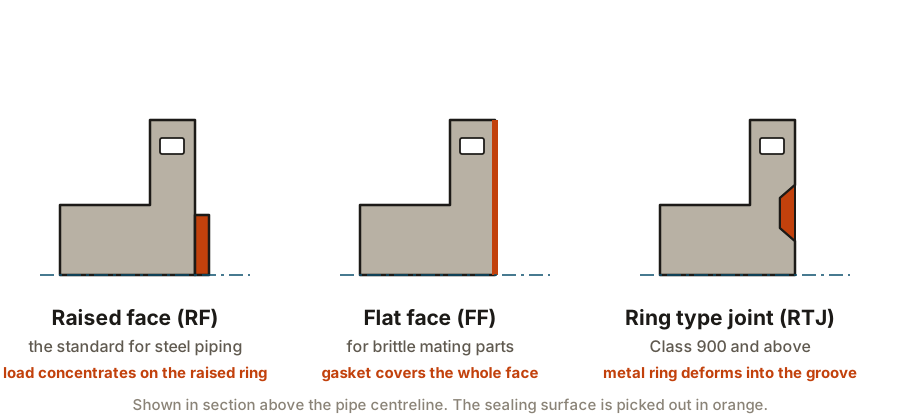
- RF (Raised Face) — a small raised annulus around the bore. The standard choice for steel piping. It concentrates the bolt load on a smaller area, so the gasket seats at a lower torque.
- FF (Flat Face) — the whole face is flat, gasket covers it all. Used when mating to a brittle component: cast iron pump casings, GRP equipment. A raised face against cast iron bends the casting flange and cracks it.
- RTJ (Ring Type Joint) — a machined groove takes a solid metal ring that deforms into place. Used for high pressure and temperature, typically Class 900 and above, and where fire safety matters.
The gasket and the bolts are part of the rating
A flange rating assumes the correct gasket and the correct bolting. Change either and the joint is no longer what the rating describes.
- Spiral wound gaskets (ASME B16.20) are the workhorse for hydrocarbon service: alternating metal winding and filler, with an inner and outer ring. The filler material — graphite or PTFE — is chosen for the service, and its colour coding on the outer ring is how you identify it on site.
- Sheet gaskets in compressed fibre or PTFE serve utilities and low-duty lines.
- Ring joints in soft iron, low alloy or stainless serve RTJ flanges.
- Bolting is normally ASTM A193 B7 studs with A194 2H nuts for carbon steel service, and B8/B8M for stainless. Bolt material is specified with the line class and is not interchangeable — a B7 stud in a low-temperature line can fail in a brittle way.
Bolt-up matters more than the paperwork
The correct flange, gasket and bolts still leak if assembled badly. The things that actually determine whether a joint seals:
- Flange faces clean and undamaged. A radial scratch across a raised face is a leak path. Machine it or replace it.
- Alignment before bolting. Pulling a misaligned flange together with the bolts loads the gasket unevenly and stresses the pipe. It will leak on the low side.
- Correct gasket, correctly centred. An off-centre spiral wound gasket seats on one side only.
- Cross-pattern tightening in stages, to a specified torque. Not one bolt at a time all the way down.
- Retorque after thermal cycling where the specification calls for it.
What to take away
- The class number is an index into a rating table, not a pressure.
- The rating falls with temperature — always look it up at the design temperature, in your material group’s table.
- Dimensions are fixed by class and NPS; ratings are fixed by class, NPS and material.
- Facing type must match the mating equipment. RF against brittle FF equipment breaks it.
- The gasket and bolting are part of the rating, and the bolt-up procedure decides whether any of it works.
Check your understanding
10 questions. Nothing is recorded — this is just for you.