
Mechanical
Spring hanger selection — variable, constant, and the pin nobody pulled
Choosing a spring for a line that moves vertically. Hot and cold load, the load variation limit and when it forces a constant effort unit, travel and rod swing, why the pointer is the most useful thing on a walkdown, and the installation errors that make a spring worse than no spring.
Standards referencedMSS SP-58MSS SP-69ASME B31.3ASME B31.1API 610
Pipe supports and thermal expansion explains why a line that rises as it heats cannot be held on a rigid support. This topic is the selection decision that follows, and the handful of field errors that turn a correctly chosen spring into a worse support than none at all.
The problem a spring solves
At a point where the line moves vertically, a rigid support has only two outcomes, both bad:
- the line lifts off it, the support stops carrying, and its share of the weight is redistributed to the neighbouring supports and to any equipment nozzle in reach; or
- the line presses down onto it, and the force required to stop thermal movement is very large indeed.
A spring carries weight throughout the movement. That is the entire job.
Variable effort, and the number that decides
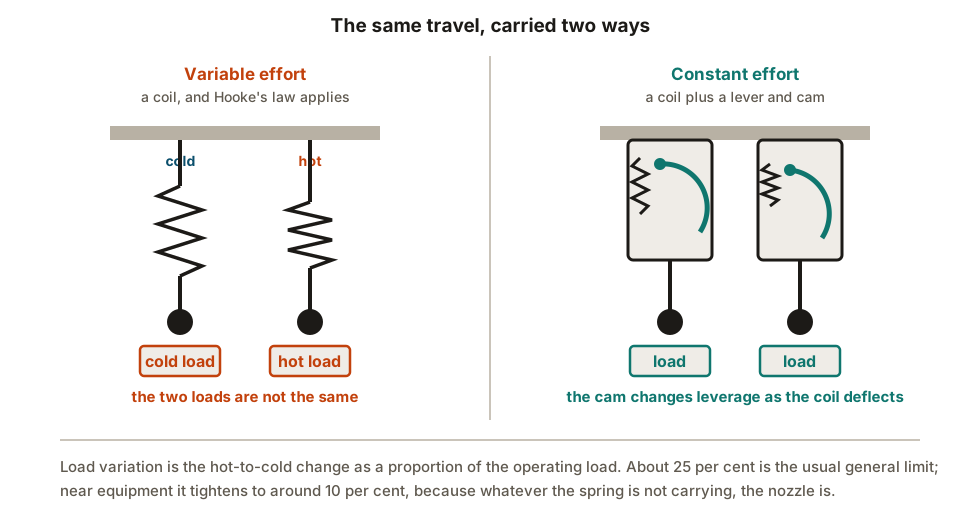
A variable effort unit is a coil spring in a casing. It obeys Hooke’s law, so as it deflects through the travel its force changes. The design question is whether that change is acceptable:
Load variation = | hot load − cold load | / hot loadThe common general limit is 25 per cent. Near equipment it is much tighter — 10 per cent is typical — because whatever the spring is not carrying is being carried by the nozzle, and nozzle allowables are small. See nozzle loads and allowables.
Selection in practice:
- Take the operating load and the vertical travel from the analysis.
- Choose a size whose travel range contains that movement with margin at both ends, so the unit neither bottoms out nor tops out.
- Calculate the resulting load variation.
- If it exceeds the limit for that location, try a larger size — a stiffer-rated unit used over a smaller fraction of its range has lower variation — and if that still fails, move to constant effort.
- Check the cold load is still positive. A spring that goes slack cold is not a support.
The unit is sized on the hot load because that is the condition the line lives in, and pre-set and installed at the cold load so it can be hung before start-up. Both values belong on the nameplate.
Constant effort, and when it is the answer
A constant effort hanger adds a lever or cam so that the mechanical advantage changes as the coil deflects. The two effects cancel and the load delivered to the pipe stays nearly flat — typically within a few per cent — over a long travel.
It is the right answer where the travel is large or where the variation limit cannot be met, which in practice means at and near equipment. The costs are real: more expensive, physically larger, and a mechanism rather than a coil, so there is something to jam.
Travel, rods and geometry
Hanger or support. A spring hanger hangs from steel above on a rod. A spring support, or can, sits beneath the line. Which one depends on whether the line rises or falls and on what structure exists.
Rod swing. A hanger can only pull along its rod. Once the rod leans, part of that pull is horizontal — acting on the pipe and on the steel above. Where the horizontal movement is appreciable, the hanger is offset at installation so the rod comes to vertical in the hot position, which is where the line spends its life.
The installation errors
These are not exotic. Each is found on commissioned plants regularly.
Others worth knowing:
- Re-pinned by maintenance. A spring that looks loose invites someone to secure it.
- Painted solid. A general touch-up seizes the mechanism, buries the nameplate and obscures the pointer. Spring units get masked.
- Installed the wrong way up or at the wrong preset, usually because the nameplate was not read.
- Load changed by a neighbour. A failed or seized support next door redistributes weight, and the spring that reads wrong is often the messenger rather than the problem.
The pointer is the diagnostic
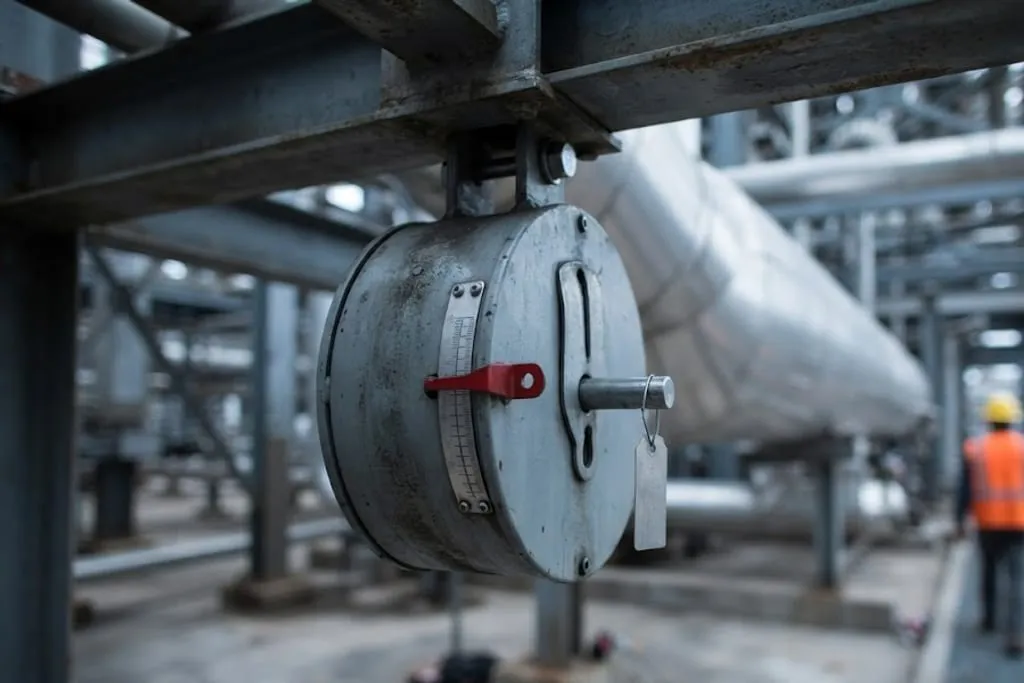
Every variable unit carries a load scale and a pointer. On a walkdown, it is the cheapest piece of information on the plant.
- Pointer near the expected hot position with the plant running: the line is where the design put it.
- Pointer hard against a stop: the real load or the real movement is not what was assumed. Look for a seized guide, an accidental anchor, a failed adjacent support, or a unit that was never de-pinned. See anchors, guides and restraint schemes.
- Pointer unchanged between hot and cold: the line is not moving. Something is holding it.
That last one is the most valuable, and it costs two visits and no instruments.
What to take away
- A spring exists to keep carrying weight while the line moves. Nothing else.
- Load variation is hot-to-cold load change over hot load. About 25 per cent generally, about 10 per cent near equipment.
- Size on the hot load, pre-set and install at the cold load, and check the cold load has not gone slack.
- Travel must sit inside the range with margin at both ends.
- Constant effort where travel is large or variation cannot be met — and it carries, it does not locate.
- Offset the hanger so the rod is vertical hot, not cold.
- Pins out at commissioning, and consider what the hydrotest weight does before then.
- Do not paint it, and do not let anyone re-pin it.
- The pointer tells you whether the line is where the design said, for free.
Check your understanding
10 questions. Nothing is recorded — this is just for you.