
Mechanical
Inspector competence and certification — who may interpret, and who only operates
SNT-TC-1A as an employer's written practice rather than a certificate, ISO 9712 as the independent route, what Levels I, II and III may each do, and why the inspector's own qualification is the first thing a client audits.
Standards referencedASNT SNT-TC-1AISO 9712ASME Section VISO 9001
Every examination report is only as good as the person who signed it, and “qualified inspector” turns out to mean several quite different things. This topic is about which, and about the one distinction that matters most on site: operating the equipment and interpreting what it produces are two different competences.
Two routes to the same question
ASNT SNT-TC-1A — a recommended practice
The thing to understand first: SNT-TC-1A certifies nobody. It is a recommended practice that tells an employer what their own written practice should contain — training hours, experience, examinations, recertification intervals — for each method and level.
The employer then writes that practice, and certifies their own people against it.
ISO 9712 — independent certification
The structurally opposite answer. Certification is issued by an independent body against a published central scheme, after an examination the body controls. It travels with the person.
Inspectors working across clients and countries tend to hold it for exactly that reason. Most projects accept either route, and an inspector should know which one their own paperwork is — because the question gets asked.
The three levels
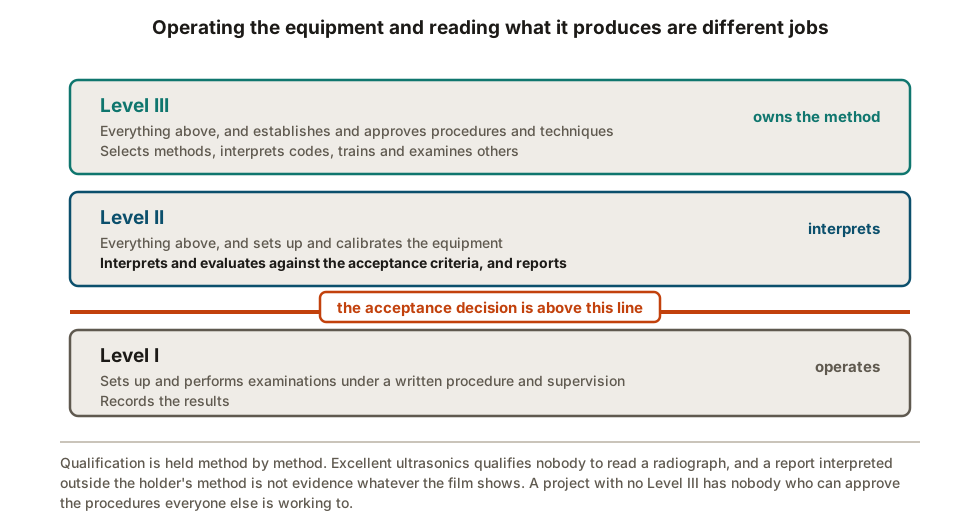
| Level | May do | May not |
|---|---|---|
| I | Set up and perform examinations under a written procedure and supervision; record results | Interpret, or accept and reject |
| II | Everything Level I does, plus interpret and evaluate against the acceptance criteria; set up and calibrate; report | Write or approve the procedure |
| III | Everything above, plus establish and approve procedures and techniques, select methods, interpret codes, and train and examine others | — |
And a point that catches experienced people: qualification is method-specific. Excellent ultrasonics qualifies nobody to read a radiograph. A report interpreted outside the holder’s method is not evidence, whatever the film shows.
A project with no Level III available has nobody who can properly approve the procedures everyone else is working to. That is a resourcing gap, and it usually surfaces as an audit finding rather than as a problem anybody noticed.

Welding inspector, NDT technician
These are complementary rather than ranked, and conflating them is common.
- The NDT technician produces reliable data about the weld: the right method, properly applied, correctly calibrated, honestly recorded.
- The welding inspector understands how the weld was made, what the code requires of it, and what the data means for acceptance — the WPS, the variables, the fit-up, the service.
A project needs both. An NDT Level II is not automatically competent to judge whether a procedure was followed; a welding inspector is not automatically competent to interpret a film.
Vision, and the requirement that quietly lapses
Near vision acuity and colour perception are tested periodically, because in visual examination and in reading most NDT output the eye is the instrument. It applies to personnel performing visual examination and to NDT personnel generally.
It is easy to let slide and it is checked in every serious audit.
What the dossier needs
For every person who examined or accepted anything:
- method and level
- certifying body, or the employer’s written practice it was issued under
- scope — what it actually covers
- expiry, and the vision test date
The expiry is the one that bites. A certificate that lapsed mid-project leaves a block of examinations that have to be defended or repeated, and finding that out at handover is much worse than finding it on day one.
What to take away
- SNT-TC-1A is a recommended practice; the employer certifies against their own written practice, so audit the practice.
- ISO 9712 is independent certification and travels with the person.
- Level I operates. Level II interprets. Level III owns the procedure.
- Qualification is method-specific — UT does not qualify anyone for RT.
- Welding inspector and NDT technician are different competences, and a project needs both.
- Vision tests are a real requirement and are the one that lapses.
- Record method, level, body or practice, scope and expiry — the expiry is what bites.
Check your understanding
10 questions. Nothing is recorded — this is just for you.