
Mechanical
Non-conformance and corrective action — the four dispositions, and why NCRs repeat
Writing an NCR somebody can act on, the difference between rework, repair, use-as-is and reject, who may grant a concession, and why closing non-conformances one at a time without ever raising a corrective action guarantees the same defect next week.
Standards referencedISO 9001ASME B31.3ASME Section IXEN 10204
An inspector who finds nothing is not inspecting. The question is what happens to what they find — and the machinery for that is the non-conformance report, its disposition, and the corrective action that may or may not follow.
Most projects run the first two reasonably and the third almost not at all. That is the subject here.
Writing one somebody can act on
A weak NCR describes something the writer did not like. A usable one states four things:
The requirement that was breached, and where it is written. This is the one most often missing and it is the one that matters. “Root gap too wide” is an opinion. “Root gap 5 mm against WPS-014 which specifies 2 to 3 mm” is a check anybody can repeat. Without the clause, the argument becomes about seniority.
The evidence. What was observed or measured, by whom, when, with what.
The extent. One bad weld raises the question of how many others share its cause. A report that stops at the single item leaves that unasked. State what was checked to bound it — which welder, which procedure, which shift, which heat.
The affected item, identified. Weld number, spool, line, heat number. A non-conformance that cannot be traced to a specific thing cannot be closed against it either.

The four dispositions
| Disposition | What it means | Needs a concession? |
|---|---|---|
| Rework | Restore conformity by the original process. Cut out and reweld to the same WPS | No — the item ends up as specified |
| Repair | Produce an acceptable item by another route — a weld repair procedure, a build-up, a local treatment | Yes, with an approved procedure |
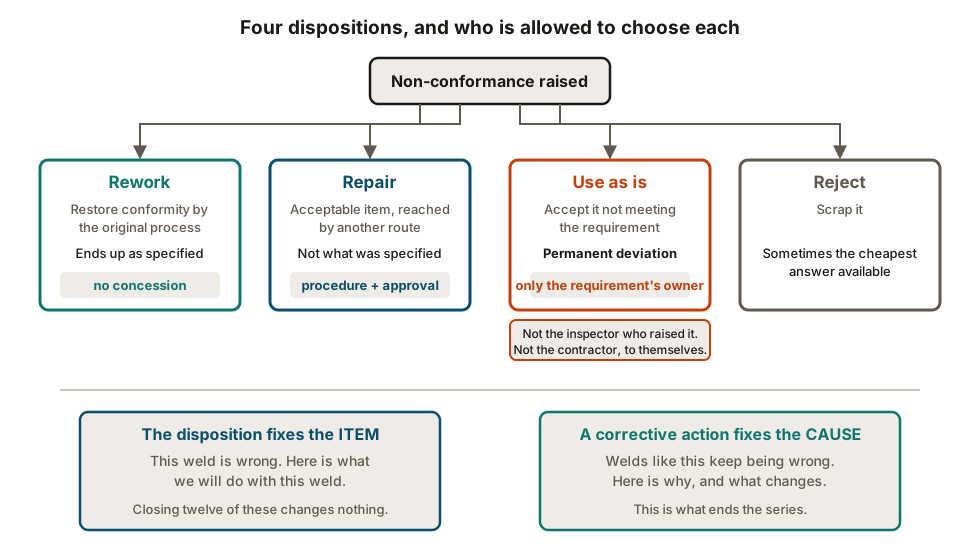
| Use-as-is | Accept it as it is, not meeting the stated requirement | Yes, from the requirement’s owner |
| Reject | Scrap it | No |
Rework and repair are routinely confused. Rework arrives at what was specified in the first place. Repair arrives at something acceptable that is not what was specified — which is why it needs its own procedure, its own approval, and its own place in the dossier.
Non-conformance against corrective action
The distinction is simple and almost universally under-used.
- A non-conformance addresses the item. This weld is wrong; here is what we will do with it.
- A corrective action addresses the cause. Welds like this keep being wrong; here is why, and here is what changes.
A project that closes non-conformances efficiently and never raises a corrective action has a very tidy register and an unchanged defect rate.
Closing, and not withdrawing
Closing and withdrawing are different.
A non-conformance is closed against the disposition, with the evidence that the disposition was carried out — the rework NDE report, the approved repair procedure and its examination, the signed concession. The record stays.
It is not withdrawn because the item has since been put right. The record of what was found and what was done is precisely what the dossier is for. A register containing only problems nobody solved would be useless to whoever maintains the plant later.
Reading the register
The open count tells you about the backlog. The pattern tells you what is wrong with how the work is being done.
Sort by cause rather than by date and the project’s real quality position becomes visible in about ten minutes: one welder, one procedure, one material, one shift, one subcontractor, one specification clause nobody understands. That reading is what prevents the next fifty entries, and it is the reason the register is worth keeping properly rather than decoratively.
What to take away
- Name the requirement and where it is written — without it, an NCR is an opinion.
- State the extent, and what you did to bound it.
- Rework restores conformity. Repair reaches acceptability another way. Use-as-is accepts a permanent deviation. Reject scraps it.
- Only the owner of the requirement may concede it. Not the inspector, not the contractor.
- Use-as-is must be reasoned and recorded — somebody will meet it in twenty years.
- A non-conformance fixes the item; a corrective action fixes the cause.
- Twelve of the same finding is one problem found twelve times.
- Close against evidence; do not withdraw.
- Read the register for patterns, not just for the open count.
Check your understanding
10 questions. Nothing is recorded — this is just for you.