Electrical
Lighting and small power — the systems people only notice when they fail
How lighting levels are set and why uniformity matters more than average lux, the three tiers of emergency lighting, and why a socket outlet in a hazardous area is not a simple thing.
Standards referencedEN 12464IEC 60598IEC 60364IEC 60079-14
Lighting and small power are the last things designed and the first things complained about. They also have more safety content than their reputation suggests.
Lux is only half the specification
| Control room | 300 – 500 | Screen work, with glare control the real issue |
|---|---|---|
| Laboratory | 500 – 750 | Close visual work and colour judgement |
| Workshop | 300 – 500 | Hand and machine work |
| Switchroom and substation | 200 – 300 | Reading labels and working on equipment |
| Process area, general | 50 – 100 | Safe movement and routine operation |
| Local at instruments and valves | 100 – 200 | Reading gauges and operating equipment |
| Pump and compressor houses | 150 – 200 | Maintenance access around machines |
| Roads and access ways | 10 – 20 | Vehicle and pedestrian movement |
| Tank farm and storage | 10 – 30 | Occasional access and security |
| Escape routes, emergency | 1 minimum on the centre line | Getting out with the normal supply gone |
No rows match that filter.
Average lux is only half the answer. Uniformity matters as much — a walkway averaging the right level but made of bright pools and dark gaps is harder to move through safely than a dimmer, even one. Glare control matters too, particularly where people read instruments.
Average illuminance is the number everyone quotes. Two others matter as much:
Uniformity. Eyes adapt to the brightest thing in view. A walkway of bright pools and dark gaps between them is harder to move along safely than a dimmer, even scheme — and it can meet its average comfortably while doing so.
Glare. Bright sources in the field of view make everything else harder to see. In a control room that means screen reflections; outdoors it means a luminaire that dazzles anyone climbing towards it.
Hazardous area luminaires
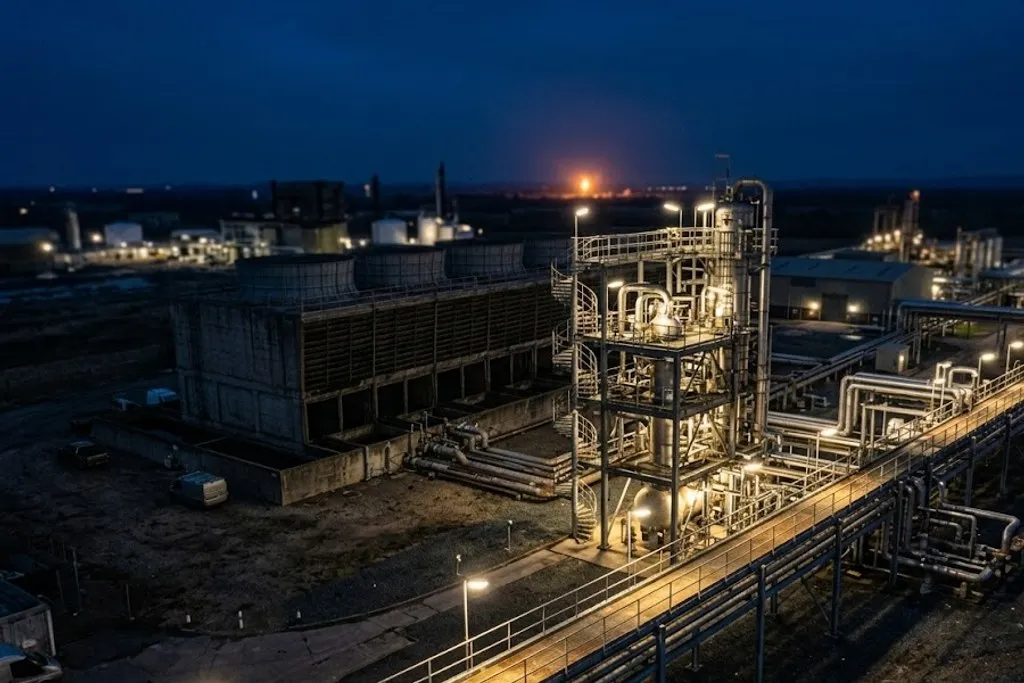
A light fitting in a classified area is certified equipment, with all that follows from Ex installation: correct protection type, correct glands, certified stopping plugs in unused entries.
The detail that catches people out is relamping. Fitting a lamp that is physically identical but of a different type or rating changes the surface temperature the fitting was certified at. That is a certification breach, and it is done in good faith constantly — which is exactly why LED fittings, sealed and with no user-replaceable lamp, have been such an improvement in hazardous areas.
Three tiers, and they are not interchangeable
| Normal lighting | Normal | General illumination for operation and access | Usually LED now; switched by photocell and timeclock |
|---|---|---|---|
| Emergency lighting | Essential, from the standby generator | Keeping the plant workable through a power failure | Comes on after the generator picks up, so there is a short gap |
| Escape lighting | UPS or local battery | Getting people out, with no break at all | Maintained or non-maintained; tested on a defined cycle |
| Aviation obstruction lighting | Essential, often duplicated | Marking stacks, flares and tall structures for aircraft | Failure is usually reportable to the aviation authority |
| Socket outlets, general | Normal | Portable equipment and maintenance | RCD protected; in hazardous areas, interlocked or Ex rated |
| Welding sockets | Normal, dedicated circuits | Welding sets during maintenance and turnaround | High current, and requires a hot work permit to use |
| Reduced low voltage tools | Via a site transformer, commonly 110 V centre-tapped | Hand tools, so a fault gives only 55 V to earth | Standard practice on construction and in confined spaces |
| Trace heating | Normal or essential, depending on the service | Keeping lines above freezing or above pour point | Loss of tracing can block a line before anyone notices |
No rows match that filter.
The grouping that matters is which supply each sits on. Normal lighting goes out with the grid; emergency lighting has to work precisely then. Getting a circuit onto the wrong supply is invisible until the day the power fails.
Aviation obstruction lighting on stacks, flares and tall structures is its own requirement, usually duplicated, and its failure is normally reportable to the aviation authority rather than logged as a maintenance job.
Small power is not small
Socket outlets are RCD protected. In a hazardous area they are certified and normally mechanically interlocked, so the switch must be off before the plug can be withdrawn — because the hazard is the act of plugging and unplugging, which arcs.
Welding sockets are dedicated high-current circuits, and their use requires a hot work permit. The socket existing does not mean welding is permitted there.
Reduced low voltage — commonly 110 V centre-tapped to earth — is standard for hand tools on site. Centre-tapping means neither leg exceeds 55 V from earth, so a damaged lead or a wet grip is far less likely to be fatal. That matters most in the damp, cramped conditions where tools actually get used.
Trace heating deserves a mention here because it sits on these same distribution boards and is easy to overlook. Its job is keeping lines above freezing or above pour point, and its failure is silent — the first symptom is usually a line that has already blocked. Whether it sits on the normal or essential supply is a process decision, not an electrical one.
Maintenance access is a design input
Every luminaire will need attention at some point. Where a fitting is only reachable by scaffolding or a mobile platform, that cost recurs for the life of the plant.
Practical consequences:
- Mount fittings where a person can reach them from an existing platform or ladder.
- Prefer long-life sealed LED fittings where access is genuinely difficult.
- Group fittings so one access visit serves several.
- Remember that lighting in a hazardous area cannot simply be worked on live — it needs isolation, and possibly a permit.
A lighting scheme that looks elegant on a drawing and requires a cherry picker in a live process area is a scheme that will slowly stop working, one failed fitting at a time.
What to take away
- Average lux is one number of three. Uniformity and glare matter as much.
- Light the task, not the plan view. Local lighting at instruments is what makes night work possible.
- Relamping an Ex fitting with a different lamp breaks its certification.
- Emergency lighting comes from the generator with a gap; escape lighting is battery-backed with none. Prove which is which by testing.
- The hazard at a socket is the plugging and unplugging. Hence certification and interlocks.
- 110 V centre-tapped keeps any fault to 55 V from earth.
- If a fitting needs a cherry picker, it will eventually stay dark.
Check your understanding
10 questions. Nothing is recorded — this is just for you.