
Civil & Structural
Fire and impact damage to structural steel
How steel loses stiffness and then strength as it heats, what fire protection actually buys you, how to read the temperature a fire reached from the wreckage it left, and how to decide whether a fire- or impact-damaged member is reused, tested or cut out.
Standards referencedEN 1993-1-2EN 13381UL 1709API 2218ASTM E119ISO 834
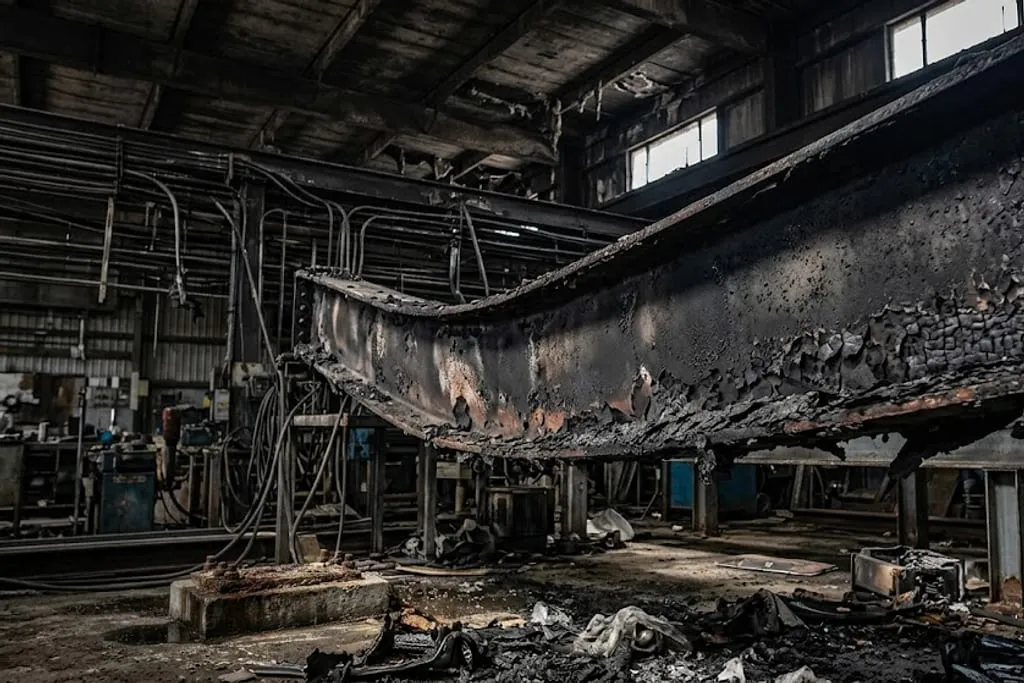
Steel does not burn and it does not melt in a building fire. What it does is go soft, and it does so long before anything reaches the temperatures people imagine. A structural fire reaches 800–1000 °C in the gas; steel melts at about 1500 °C. The gap between those two numbers is why steel-framed buildings can collapse in a fire that never came close to melting anything.
This topic covers the two damage events an inspector is most often asked to judge after the fact — a fire and an impact — and they turn out to need the same discipline: establish what the member actually experienced, then decide reuse, test or replace.
What heat does to steel
Two properties fall, and they fall at different rates. That difference is the whole story.

- Stiffness starts falling at around 100 °C and is down to roughly 70 % by 400 °C. Nothing has failed, but the frame has become noticeably more flexible and everything slender is closer to buckling.
- Strength holds essentially unchanged to 400 °C, then falls off a cliff — about 60 % left at 550 °C, 23 % at 700 °C, under 10 % at 800 °C.
There is also thermal expansion, and it causes damage of its own. Steel grows about 1.4 mm per metre per 100 °C. A 10 m beam heated 500 °C wants to grow 70 mm. If the frame will not let it, the beam goes into enormous compression, buckles, and then — as it cools — pulls its connections apart in tension. A great deal of the structural damage found after a fire was done during the cooling phase, not the heating one.
Fire protection, and what it actually buys
Fire protection does not make steel stronger. It slows the rate at which heat gets in, so the steel crosses its critical temperature later than the required rating. That is all — and it is enough.
| System | How it works | Typical use |
|---|---|---|
| Intumescent coating | Paint that foams to an insulating char at 200–250 °C | Exposed architectural steel; thin, can be shop applied |
| Cementitious spray | Sprayed vermiculite or gypsum insulation | Concealed steel; cheap, robust, ugly |
| Board systems | Calcium silicate or gypsum boxing | Clean lines, good where the steel must stay accessible |
| Concrete encasement | Mass and low conductivity | Heavy, durable, largely superseded except in blast areas |
| Dense epoxy (PFP) | Thick epoxy intumescent, hydrocarbon rated | Offshore and petrochemical — jet fire and blast resistant |
A commonly missed point: the thickness of protection needed depends on the section factor
A/V — the exposed surface area per unit volume. A slender member has a high section factor and
heats quickly; a chunky one heats slowly and may need much less protection for the same rating.
Two members on the same floor with the same fire rating can legitimately carry very different
coating thicknesses, and an inspector who does not know this will raise a finding that is not one.
What to inspect before a fire
Fireproofing is one of the few systems where the inspection matters more than the product, because almost every failure is an application failure.
- Surface preparation and primer compatibility — the same rules as any coating system, and intumescents are fussy about what they sit on
- Dry film thickness against the schedule — measured per member, not per area, because the required thickness varies with section factor
- Mesh and fixings on cementitious and board systems, especially at corners and beam webs
- Continuity at penetrations and interfaces — bolted connections, base plates, bracing gussets, and where the protection meets a wall or floor
- Damage and detachment during subsequent trades — scaffolders and pipefitters are hard on fireproofing
- Moisture ingress behind cementitious systems, which corrodes the steel it was protecting
After a fire: reading the temperature back
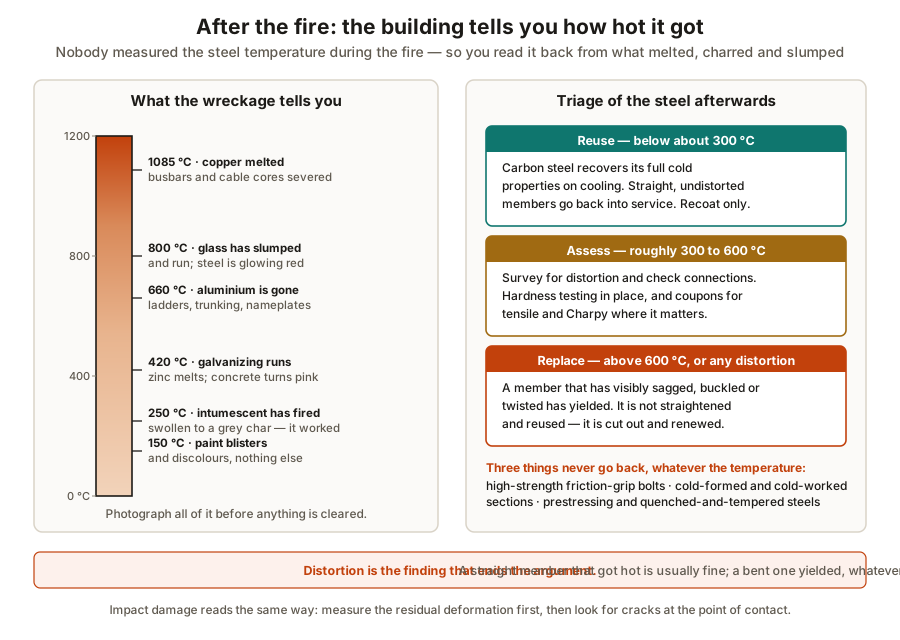
Nobody was measuring steel temperature during the fire. The temperature is reconstructed from what the fire left behind, and a building is full of accidental thermometers.
| Evidence found | Temperature it implies |
|---|---|
| Paint discoloured or blistered, otherwise intact | ~150 °C |
| Intumescent swollen into a grey char | 200–250 °C — the system worked |
| Concrete surface turned pink | above ~300 °C |
| Paint fully charred and burnt away | ~400 °C |
| Galvanizing melted and run | ~420 °C |
| Aluminium fittings, ladders and nameplates gone | ~660 °C |
| Glass slumped and flowed | ~750–800 °C |
| Copper busbars and cable cores melted through | above 1085 °C |
| Concrete spalled explosively, rebar exposed | rapid heating, usually above 300 °C with moist concrete |
The triage decision
| Evidence | Assessment | Action |
|---|---|---|
| Paint discoloured, member straight | Below ~300 °C | Reuse. Clean and recoat. |
| Paint burnt off, member straight, no distortion | 300–600 °C | Survey for straightness; check connections; usually reuse |
| Member distorted, sagged, twisted or locally buckled | Yielded at temperature | Replace. Do not straighten and reuse. |
| Galvanizing run, aluminium gone, member straight | 400–700 °C | Hardness test in place; coupon test if critical; replace if in doubt |
| Cracks at connections, bolts elongated or sheared | Cooling-phase restraint damage | Replace the connection, investigate the members either side |
| Any HSFG bolt in the heated zone | Preload lost | Replace, whatever it looks like |
| Cold-formed purlin, deck or hollow section that got hot | Cold work relieved | Replace |
Testing, in order of how invasive it is:
- Dimensional survey — string line, level, plumb. Free, and it answers the main question.
- In-situ hardness (portable UCI or Leeb) — screens for any change in properties, and finds the odd member that was quenched by fire water while hot
- Replica metallography — surface microstructure without cutting anything out
- Coupon removal — tensile and Charpy on material cut from a low-stress location, for the members the decision actually hinges on
Impact damage
Impact is less dramatic than fire and turns up far more often: a forklift into a rack leg, a load swung into a pipe bridge, a vehicle into a column, a dropped object onto a walkway.
The assessment is the same shape. Measure first, judge second.
| Finding | What it means | Action |
|---|---|---|
| Paint scraped, no measurable deformation | Contact only | Touch up the coating, record it |
| Local dent in a flange or a hollow section wall | Local yielding | Assess reduced capacity; often acceptable, often not for a hollow section in compression |
| Member out of straight | Global yielding | Assess as a bent member — the buckling capacity has fallen sharply |
| Crack at the contact point | Brittle initiation | Cut out and replace; a crack in cold steel will run |
| Connection distorted, bolts bent or holes elongated | The load path has shifted | Replace the connection |
| Bracing member struck | Stability affected | Treat as urgent — a bent brace may not be doing anything at all |
Impacts also have a habit of being repeated. The rack leg that has been hit once is in the place where forklifts turn, and it will be hit again. A finding that only says “repair the leg” misses the point — the useful finding adds a barrier, a bollard or a changed traffic route.
Takeaways
- Steel softens rather than melts; the structural problem arrives at 550 °C, not 1500 °C
- Stiffness falls first, from around 100 °C, so deflection and buckling precede loss of strength
- 550 °C is the common critical temperature because the fire-case load is roughly 60 % of cold capacity
- Thermal expansion, and the tension that follows on cooling, cause much of the connection damage
- Fire protection delays heating — it is rated in time and matched to a fire curve, cellulosic or hydrocarbon
- Required thickness depends on the section factor, so it varies member by member
- After a fire, the temperature is read back from melted zinc, aluminium, glass and copper
- Distortion is the finding that decides it; straight carbon steel that got hot is usually fine
- HSFG bolts, cold-worked sections and quenched-and-tempered steels never go back
- Impact is judged the same way: measure the residual deformation, then look for cracks at the contact point
Related: fatigue and fracture in steel explains why a crack at an impact point is taken so seriously, and structural stability and buckling explains why a bent compression member has lost so much.
Next: structural NDT and inspection access, which covers how any of this gets found in the first place.
Check your understanding
10 questions. Nothing is recorded — this is just for you.