
Automotive
Transmissions and gear ratios
Why an engine that makes useful torque over 3,000 rpm needs six ratios to move a car from rest to motorway speed, how tractive effort and road load set the gearing, and what manual, torque converter, DCT and CVT each trade away.
A petrol engine makes nothing at all below about 1,000 rpm and destroys itself above about 6,500 — a usable span of roughly six to one. The wheels have to turn from zero to something like 2,000 rpm. Every gearbox ever built exists to bridge that mismatch, and every design decision in one is a compromise between how wide a span it covers and how coarsely it has to step through it.
Ratios multiply
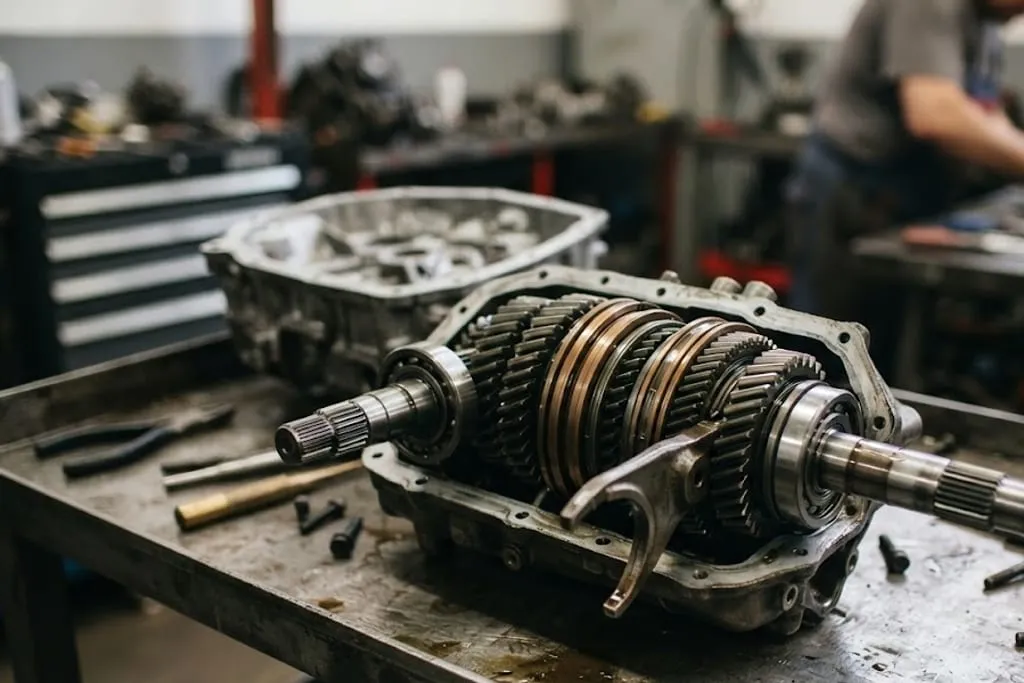
A gear pair with a 36-tooth driven gear and a 12-tooth driving gear has a ratio of 3 : 1. The output turns a third as fast and, less losses, carries three times the torque. Ratios in series multiply, so the overall reduction is:
overall = gearbox ratio × final drive ratio
With first gear at 3.6 : 1 and a final drive of 4.1 : 1, the overall is 14.76 : 1 — the engine turns nearly fifteen times for one turn of the wheel. Wheel torque is 14.76 × engine torque, wheel speed is engine speed ÷ 14.76.
Road speed follows directly from the tyre:
road speed = engine rpm × tyre rolling circumference ÷ overall ratio
which is why fitting taller tyres quietly lengthens every gear, drops the indicated speed and makes the car feel slower.
Tractive effort against road load
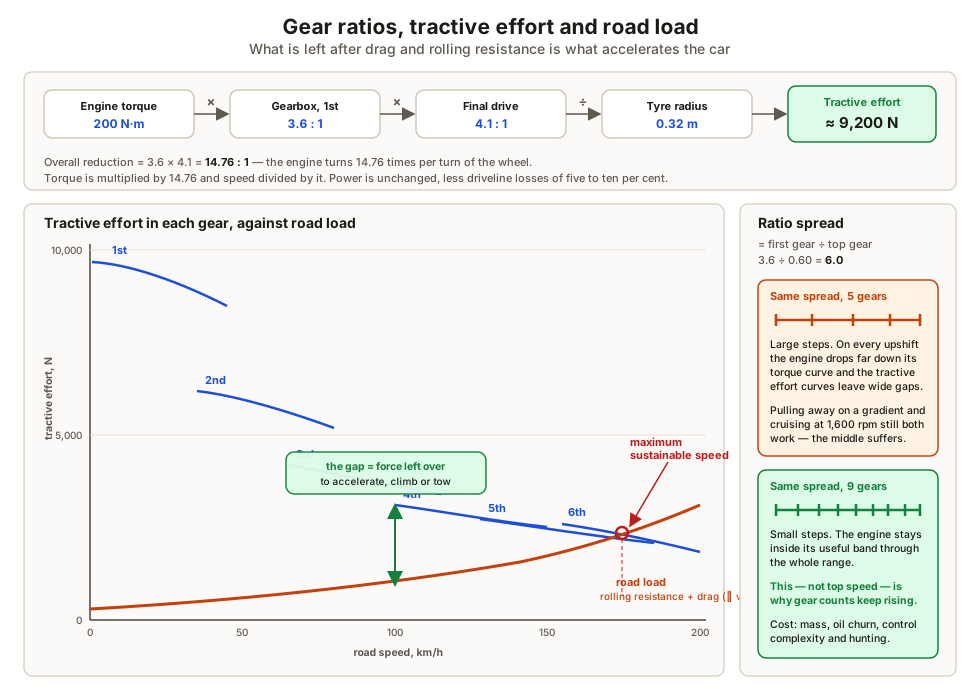
Tractive effort is the force the tyres can push the car with:
F = engine torque × overall ratio × driveline efficiency ÷ tyre rolling radius
Road load is what resists it — rolling resistance, roughly constant, plus aerodynamic drag, which rises with the square of speed and therefore dominates above about 60 km/h. Plot both and everything about the gearing becomes visible: the vertical gap is what accelerates the car, and where the top gear curve meets road load is top speed.
| Low (numerically high) ratio | High (numerically low) ratio | |
|---|---|---|
| Wheel torque | High | Low |
| Road speed per rpm | Low | High |
| Used for | Launch, gradients, towing | Cruise, economy, noise |
| Typical value | 3.5 : 1 in first | 0.6 : 1 in an overdrive top |
Ratio spread is first ÷ top. A spread of six lets one gearbox pull a loaded car up a 20 per cent gradient and cruise at 1,600 rpm. The trouble is that covering that spread in five gears means large steps, so the engine drops far down its torque curve on every upshift. Covering it in eight or nine means small steps and an engine that stays where it is useful — which is the entire argument for the modern high ratio-count automatic, not, as often assumed, more top speed.
The four common architectures

Manual. Every gear pair is permanently in mesh, running free on its shaft. The lever moves a sliding sleeve that locks one of them to the shaft. Between the sleeve and the gear sits the synchroniser — a brass or carbon blocker ring that is pushed onto a cone on the gear and, through friction, drags the two to the same speed before the teeth will let the sleeve pass. A worn synchro is what a crunch on a fast change actually is; the ring can no longer match the speeds in the time the driver allows.
Torque converter automatic. The engine drives an impeller, which throws oil at a turbine connected to the gearbox. Between them sits the stator on a one way clutch, which turns the returning flow so it pushes the impeller along instead of fighting it — that redirection is what multiplies torque, typically about 2 : 1 at stall. As the turbine catches up, the flow reverses onto the back of the stator vanes, the one way clutch lets go and the unit becomes a plain fluid coupling. Because a coupling always slips a little, a lock-up clutch then clamps turbine to impeller mechanically at cruise.
Dual clutch. Odd gears on one shaft behind clutch 1, even gears on a hollow shaft around it behind clutch 2. The next gear is engaged before it is needed, so the shift is a handover of clutch pressure with no break in drive — mechanically it is two manual gearboxes taking turns.
CVT. A steel push belt between two pulleys whose effective diameters change as their cone halves move together and apart. The ratio is continuous, so the controller can hold the engine at its best BSFC point and let the ratio sweep instead.
The differential, and why it is not optional
The outer wheel on a corner travels further than the inner one in the same time. Locked together, one of them has to scrub, which ruins tyres and makes the car refuse to turn. The differential splits torque equally while letting the two sides turn at different speeds.
The flaw is in the same sentence: equal torque to both sides means the side with the least grip sets the limit for both. One wheel on ice and the whole axle delivers what that wheel can hold, which is almost nothing. A limited slip differential — clutch pack, Torsen gearing or electronically controlled — biases torque towards the wheel that can use it, and most modern cars approximate the same result by braking the spinning wheel, which fools the differential into sending torque across.
Electric drive, briefly
An electric motor makes maximum torque from zero and pulls to 15,000 rpm or more, so its usable speed range covers the whole job. Most EVs therefore have one fixed reduction of about 8 or 10 to 1, plus a differential, and no gearbox at all. A few performance models fit two ratios to trade launch against top speed, but the absence of a multi-speed transmission is one of the real simplifications of the architecture.
What to take away
- A gearbox exists because the engine’s usable speed range is far narrower than the wheels’.
- Ratios multiply in series: overall = gearbox × final drive.
- A gearbox trades torque against speed; it never makes power.
- Tractive effort falls with speed in each gear; road load rises with speed squared, and the gap between them is the acceleration available.
- Their intersection in top gear is maximum sustainable speed.
- Ratio spread is first ÷ top; more gears give the same spread with smaller steps.
- A synchroniser matches shaft speeds by friction before the teeth can engage.
- A torque converter’s stator is what multiplies torque; the lock-up clutch removes the residual slip at cruise.
- A DCT pre-selects the next gear, which is why it shifts fast and crawls badly.
- A CVT decouples engine speed from road speed and can sit at best BSFC.
- A differential splits torque equally, so the low-grip wheel sets the limit unless something intervenes.
- An electric motor’s speed range usually removes the need for a gearbox entirely.
Check your understanding
10 questions. Nothing is recorded — this is just for you.