
Mechanical
Tie-ins and shutdown windows — preparing for the hours that cannot be extended
Why a tie-in window is the only genuinely fixed date on a project, what must be complete before it opens, why a trial fit is the highest-value hour on the job, what actually causes a window to overrun, and how to decide in advance what will be cut if it slips.
Standards referencedASME B31.3
A tie-in is where new work meets plant that already exists. It is the hardest thing a piping supervisor does, and the reason is not technical. The welding is ordinary. What is extraordinary is that it happens inside a period that cannot be extended, on a plant whose restart date was published before the job was planned.
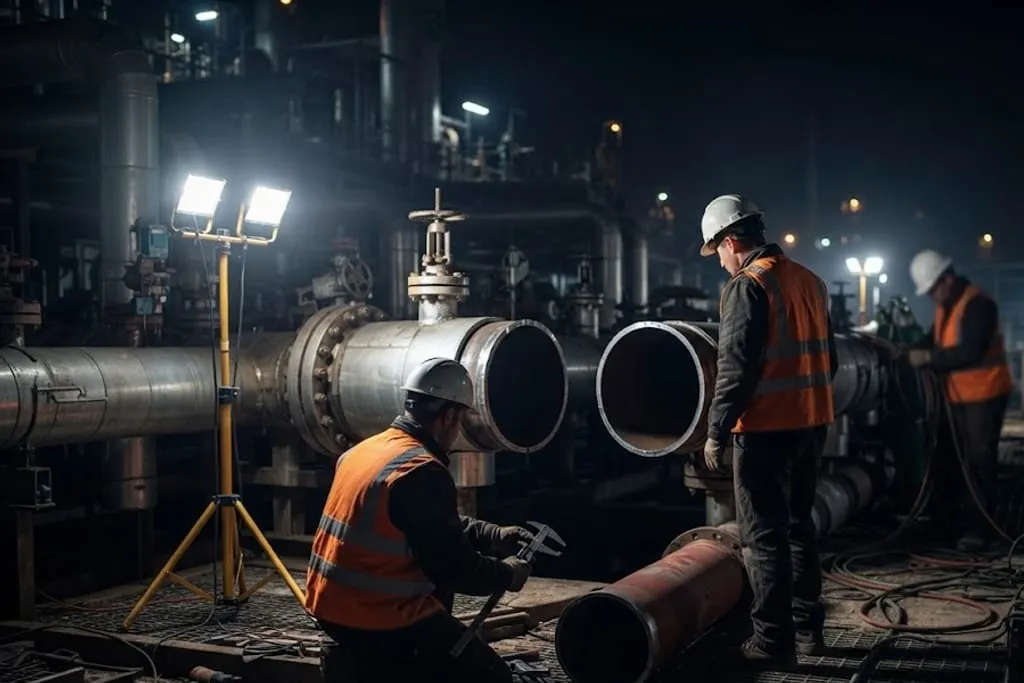
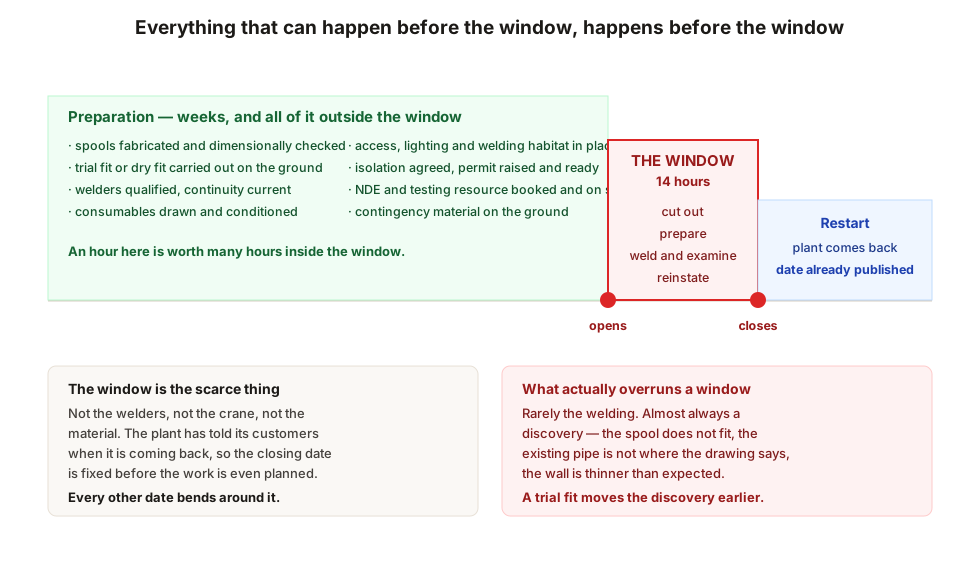
The window is the only genuinely fixed date on most projects. Everything else can be argued about.
The governing rule
Nothing that can be done before the window is done inside it.
That sounds obvious and is routinely broken, because the items that get done inside are small and feel harmless. Drawing consumables. Finding a grinder. Qualifying a welder whose continuity lapsed. Working out where the lighting will come from.
None of those needed the plant to be down. Each costs perhaps twenty minutes. Six of them cost two hours out of fourteen, and those two hours were the only contingency there was.
What has to be true before it opens
A checklist worth holding to, because the items are independent and each one has a lead time.
| Item | Why it cannot wait |
|---|---|
| Spools fabricated and dimensionally checked | A spool that is wrong is useless, and there is no time to make another |
| Trial fit completed | The single highest-value hour on the job — see below |
| Welders qualified, continuity current | Continuity lapses through disuse and is checked too late |
| Consumables drawn and conditioned | Low-hydrogen consumables need conditioning, which takes hours |
| Access, lighting, welding habitat | Night work in a live unit needs all three and none appear quickly |
| Isolation agreed, permit prepared | Agreed in principle beforehand, issued on the day |
| NDE and testing resource standing by | On the critical path, so it waits rather than being called |
| Contingency material on the ground | An extra length of pipe, a spare fitting, a second gasket set |
The trial fit
If only one thing in this topic survives, it should be this.
A tie-in joins new pipework to existing pipework. Existing pipework is frequently not where the drawing says it is. It was built thirty years ago, modified twice, and surveyed by somebody working to a different datum. The as-built may be excellent or it may be fiction, and there is no way to tell from the office.
A trial fit — offering the spool up, or at minimum surveying the existing connection points properly and checking them against the spool before it is finished — does not prevent a mismatch. It moves the mismatch outside the window, where it can be fixed by recutting, re-machining or re-fabricating.
Inside the window the same discovery is a crisis, because every remedy takes hours and there are none.
Deciding the cut list in advance
Something will slip. The useful question is not whether, but what gets abandoned when it does — and that question should be answered calmly, in daylight, a week beforehand.
Divide the scope into three:
- Essential to restart. The plant cannot come back without it. These are the only items that genuinely own window hours.
- Desirable, completable later. Work that can be done under a smaller isolation, or at the next opportunity.
- Opportunistic. Things being done because the plant happens to be down. These go first and should be understood as going first by everyone involved before the window opens.
The failure mode without this is familiar: at three in the morning, tired, under pressure, somebody decides what to drop. They usually drop the wrong thing, because the opportunistic item has an advocate present and the essential item does not.
Reinstatement is inside the window too
A frequently underestimated point. The window does not close when the weld is accepted. It closes when the plant can be restarted, which means blinds out, bolting complete and torqued, insulation reinstated where it affects operation, and the isolation formally returned.
Reinstatement is where tested systems start leaking, and it is being done at the end of a long shift by people who believe they have finished. Planning it as a distinct activity with its own time and its own check — rather than as tidying up — is what keeps the restart on the hour it was promised for.
Check your understanding
6 questions. Nothing is recorded — this is just for you.