
Mechanical
Supervising under a permit — the shift you signed for
Not what a permit is, which is covered elsewhere and free, but what changes when you are the person who signed it — what to verify at the work rather than on the form, the conditions routinely accepted and not met, why a gas test expires, and what handing back actually requires.
Standards referencedASME B31.3
What a permit is, what the types are, why proving an isolation matters more than making one, and the ways a permit system decays into paperwork — all of that is covered in permit to work, which is free and does not need repeating.
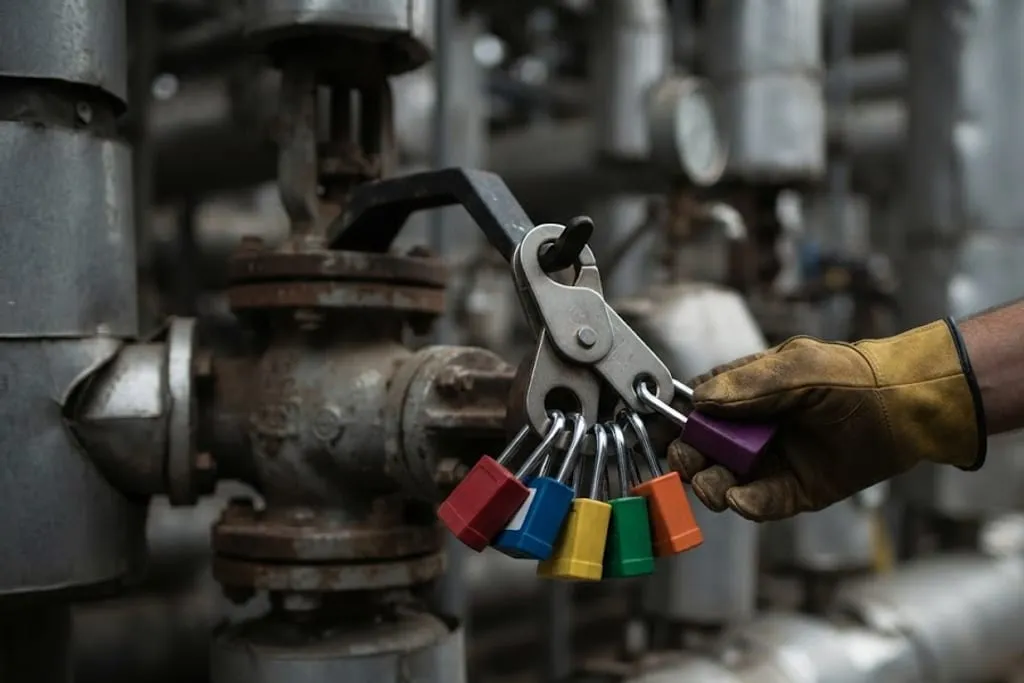
This topic is the other half, and it starts at the moment the subject stops being general. You have signed it. The crew is standing behind you. The shift is yours.
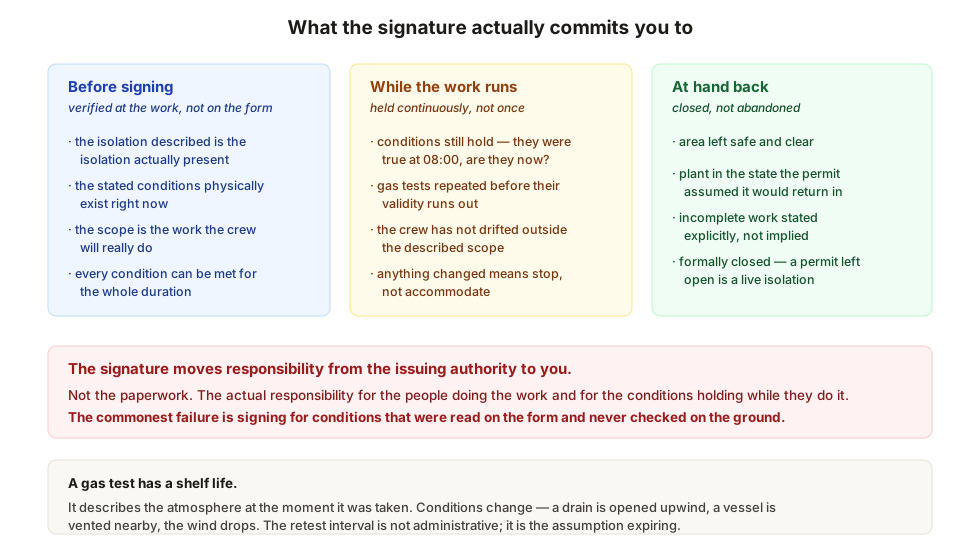
Before signing — verify at the work, not on the form
The form says what somebody intended to be true when they wrote it, usually in an office, possibly yesterday. Four things are worth checking with your feet.
Is the isolation described the isolation present? Valves in the stated position, locks on, blinds where the drawing says. A described isolation and a fitted isolation are different objects and occasionally different in ways that matter.
Do the stated conditions physically exist? Lighting, access, extraction, fire-fighting provision. “Adequate ventilation” written on a form does not move air.
Is the scope the work your crew will actually do? Not the work the planner imagined. If the crew intends to cut two additional supports, the permit needs to say so now rather than at eleven o’clock.
Can every condition be met for the whole duration? This is the one that gets nodded through, and it has its own section below.
The condition routinely accepted and not met
A continuous fire watch, or a standby person for an entry.
It is accepted honestly at seven in the morning. By ten the standby has been sent for a fitting, or has drifted twenty metres to help lift something, because a person visibly doing nothing is the first resource anybody borrows. The permit condition has lapsed and nobody has decided to lapse it.
While the work runs
A permit is not a gate you pass through. It is a set of conditions that must keep being true.
Gas tests expire for a physical reason. A test describes the atmosphere at the instant it was taken. Someone opens a drain upwind, a vessel is vented nearby, the wind drops — and the reading that was accurate at 07:30 describes a situation that no longer exists. The retest interval is the point at which the assumption runs out, not an administrative formality.
Scope drift is the characteristic failure. It is never a decision. It is one extra cut, then a support that was in the way, then a line that turned out to be connected to the one being worked on. Each step is two metres from the last and the crew ends up somewhere nobody assessed. The rule has to be absolute precisely because each individual step is so obviously reasonable.
Anything changed means stop. Not accommodate, not note and continue. The assessment was made against a described situation; when the situation changes, the assessment no longer applies and somebody has to make a new one.
Simultaneous operations
The case where two permits are each perfectly sound and the combination is not.
Your crew is welding. Another crew begins draining a line thirty metres upwind. Both permits were correctly assessed. Neither assessment included the other, because they were raised separately and nobody held both pieces of paper at once.
This is not solved by paperwork. It is solved by knowing what else is happening in the area, which means the coordination meeting, and by a willingness to go and ask what somebody has just started doing nearby. The supervisor who notices is almost always the one who looked up.
Handing back
A permit is closed by an action. It does not expire quietly at the end of a shift.
| At hand back | Why |
|---|---|
| Area left safe and clear | Tools, leads, gas bottles, openings left guarded |
| Plant in the assumed state | If the permit assumed the line would be reinstated, reinstate it or say plainly that it is not |
| Incomplete work stated explicitly | The next shift inherits what you tell them, not what you meant |
| Formally closed | An open permit usually means a live isolation with nobody accountable |
That last row is the one with teeth. An open permit frequently means plant is still isolated and operations do not know they can restore it. The person named on it has gone home. On a Friday that condition lasts the weekend.
What stays yours, and what does not
Worth being clear about, because supervisors sometimes take on exposure that is not theirs and sometimes decline exposure that is.
- Not yours — assessing the hazards of the plant, specifying the isolation, deciding what controls are required. That is the issuing authority’s, and disagreeing with it is a conversation rather than a unilateral change.
- Yours — verifying that what was specified is actually in place, that the conditions hold throughout, that your crew stays inside the scope, and that the work stops the moment any of that stops being true.
The second list is short. It is also the whole of the job, on the shift.
Check your understanding
6 questions. Nothing is recorded — this is just for you.