
Mechanical
Construction productivity factors — why the same weld takes three times as long
Why a norm measured in the shop does not survive contact with a live unit, the conditions that multiply the hours without changing the work, crew composition and what a waiting welder costs, and the difference between a crew that is busy and a crew that is producing.
Standards referencedISO 21508
A welding norm — so many hours per diameter-inch — is a real number, carefully measured. It is also measured in the one place where measuring is easy, which is a fabrication shop with the joint on a bench at a convenient height and everything needed within reach.
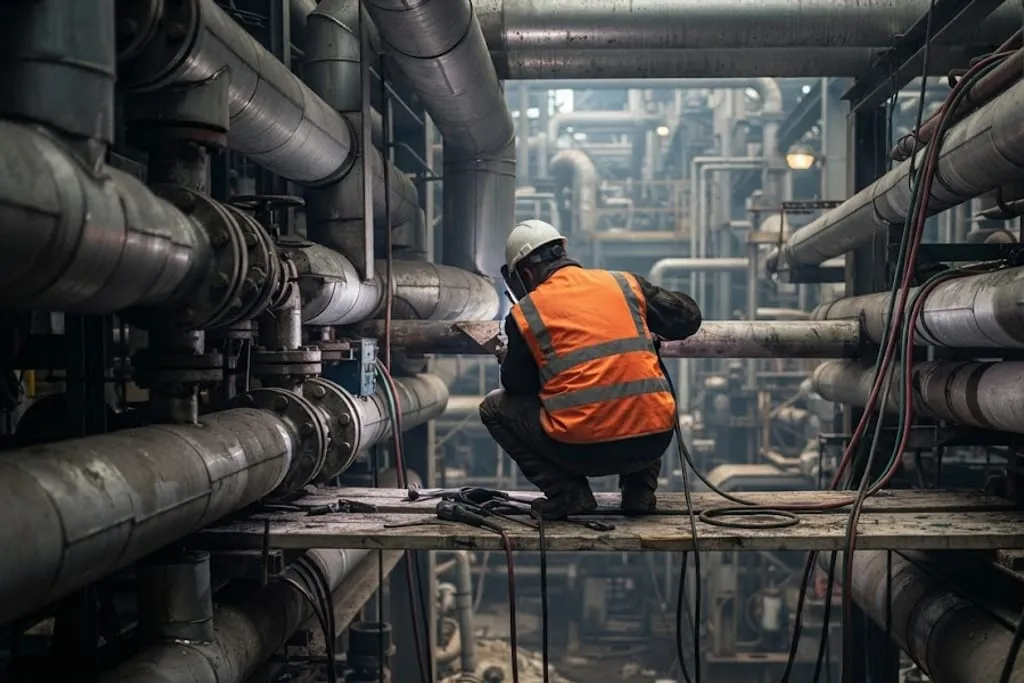
Almost no field weld is made in those conditions. The gap between the norm and the reality is the productivity factor, and it is the item most often left out of a programme entirely.
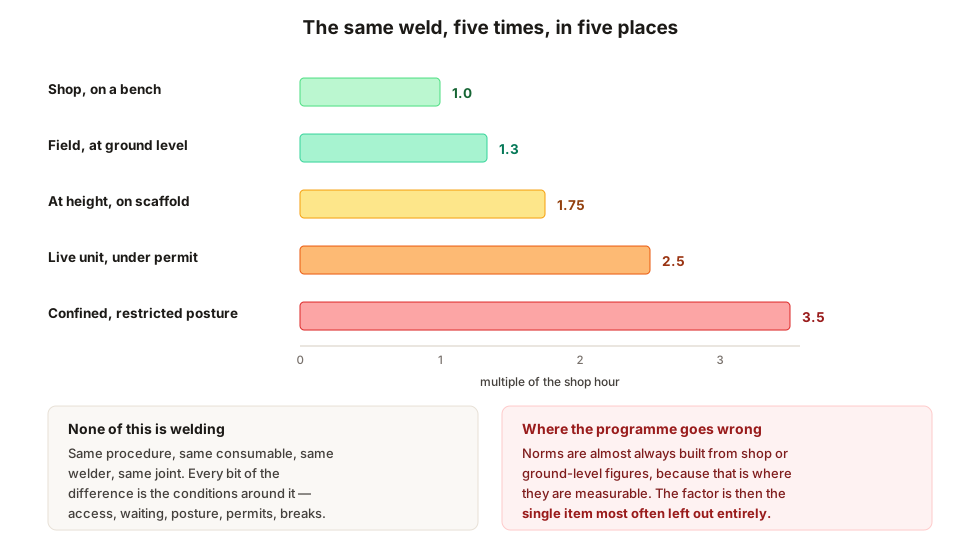
The figures above are indicative rather than authoritative — every organisation that does this well carries its own, built from its own history. What is not indicative is the shape: the factor compounds, and it compounds faster than people expect.
What drives it
Access. Getting to the work, and the position the work is done in. A weld made standing comfortably is a different operation from the same weld made overhead at arm’s length through a gap.
Height. Everything takes longer — the walk, the hoisting of equipment, the retrieval of the thing that was forgotten, the care taken.
Live plant. Permits, gas tests that expire, isolations verified at the point of work, stand-downs when an adjacent operation starts. All necessary, none of it productive.
Congestion. Other trades in the same space, sharing the same access, occasionally requiring each other to stop.
Weather and temperature. Not only comfort — preheat holds differently, and a crew in full PPE in forty degrees works in shorter cycles.
Time of day. The last hour of a shift and the first hour after a break are genuinely less productive, which is why scattering short tasks across a day produces less than grouping them.
Crew composition beats crew size
The instinct when a job is behind is to add people. It frequently makes no difference at all, and the reason is that output is set by the constraining activity rather than by headcount.
A crew of two welders and one fitter will produce at the rate the fitter can prepare joints, however many welders are added. The welders will be visibly busy — grinding, setting up, waiting with the rod in hand — and the progress figure will not move.
So the question when a front is slow is never how many people are here. It is which trade is everybody else waiting on, and that is answered by watching for ten minutes rather than by reading a report.
| Symptom | Usually means |
|---|---|
| Welders grinding and tidying | Fit-up is the constraint |
| Fitters waiting with joints prepared | Welders are the constraint, or consumables are |
| Everybody moving materials | The area was not prepared before the crew arrived |
| Crew split across three fronts | Nobody is the constraint and nothing is finishing |
That last one is worth dwelling on. A crew spread thinly across several fronts is busy everywhere and completing nothing, and because every front shows activity it looks healthier than it is.
Busy is not producing
The distinction that separates a supervisor who improves a job from one who merely manages it.
A great deal of genuinely necessary site activity earns nothing: carrying materials, erecting access, hunting for a gasket, reworking somebody else’s defect, attending briefings, waiting for a permit. A crew can fill a shift completely with it.
The check is not whether people are working. It is what was finished today, counted the same way it will be counted at the valuation. If the answer is nothing, the shift was consumed by preparation and the preparation should have happened before the crew arrived.
What a waiting welder costs
More than the welder, which is the point usually missed.
Welders do not work alone. A welder waiting ordinarily means a fitter waiting, a helper waiting, and sometimes a scaffold standing and a crane booked. The crew was assembled around that activity, and when the activity stops the whole assembly stops.
This is the arithmetic behind keeping a second front prepared. It is not tidiness. It is the only mechanism available for converting an interruption into a redeployment rather than into lost hours, and it costs nothing except having thought about it the week before.
Check your understanding
6 questions. Nothing is recorded — this is just for you.