
Mechanical
Special piping components — the places that do not corrode like the pipe
Why dead legs, injection points, mixing points, soil-to-air interfaces and small-bore connections are pulled out of ordinary piping circuits, what each one actually suffers from, and why a healthy reading on the parent line tells you nothing about any of them.
A piping circuit rests on the idea that its members behave alike, so a reading on one says something about the others. A handful of features break that idea completely, and every RBI methodology pulls them out and treats them individually.
They are worth knowing by name, because they account for a strikingly large share of piping leaks.
Why they are separated
| Dead leg | No flow, so it holds whatever settles in it and sits at a different temperature from the live line | Under-deposit and microbial corrosion, water drop-out, freezing, solids accumulation | Readings at the stagnant end and the low point — not at the live end, where it looks healthy |
|---|---|---|---|
| Injection point | A chemical enters the stream here, so the mixture and the flow pattern are local to this spot | Localised corrosion and erosion downstream of the quill, impingement opposite it | Dense CML grid from upstream of the injection to the second change in flow direction |
| Mixing point | Two streams meet at different temperatures or compositions and do not mix instantly | Thermal fatigue from cyclic mixing, corrosion where the blend is aggressive | CMLs through the mixing length; consider cracking as well as thinning |
| Soil-to-air interface | The transition from buried to exposed concentrates the corrosion cell at one band | Severe external corrosion in a narrow zone, usually under damaged coating | Excavate to a depth below grade and inspect the band; readings on the exposed pipe miss it |
| Small-bore piping | Vents, drains, sample and instrument connections, often unsupported and left off surveys | Vibration fatigue cracking at the branch weld, plus ordinary internal corrosion | Visual and support inspection for fatigue; thickness where the service warrants it |
| Spec break | The material or rating changes, so the two sides do not behave alike | Galvanic attack where dissimilar metals are coupled; wrong material installed in repair | Confirm materials by PMI; CMLs on both sides of the break |
| Threaded connection | The root of the thread is the thinnest section and is not visible | Corrosion and fatigue at the thread root, leaks that follow no thinning trend | Visual and radiography; treat as a leak source rather than a thickness question |
No rows match that filter.
These are separated out of ordinary piping circuits because they do not corrode like the pipe around them. A reading taken on the parent line says nothing useful about any of them.
Dead legs
A dead leg is any section with no flow: a blanked branch, a spare pump suction, a redundant bypass, a vent or drain run, a stub left where equipment was removed.
Stagnant fluid stratifies. Water drops out, solids settle, bacteria colonise the sludge, and the metal sits in contact with the worst phase present rather than the bulk stream. In cold climates it freezes; in hot service it may be the one part of the line below the dew point.
Most dead legs are not designed — they accumulate. A line is blanked and left in place, a pump comes out and its branch stays, a bypass falls out of use. None of it reaches the P&ID. Finding them is a walkdown job, which is why the verification walk described in corrosion loops and piping circuits matters so much.
The best treatment is removal. A dead leg that does not exist needs no inspection.
Injection and mixing points
An injection point is where something is deliberately added to the stream — corrosion inhibitor, wash water, caustic, antifoam, biocide.
Three things happen there at once: turbulence, impingement on the bore opposite the quill, and a chemical that has not yet mixed contacting the wall at full strength. The result is localised — severe loss over a short length with normal readings either side.
A mixing point is the same problem without the chemical: two streams meeting at different temperatures or compositions. Where the temperature difference is large and the mixing unsteady, the concern is thermal fatigue cracking rather than thinning — a different mechanism needing a different inspection method, and one that thickness readings will never reveal.
Soil-to-air interfaces
Where a line passes from buried to above ground, the conditions change abruptly: oxygen availability, moisture, coating condition, and often the end of effective cathodic protection.
That sets up a strong corrosion cell concentrated in a narrow band at the transition, usually under coating that was damaged during backfill.
Small-bore piping
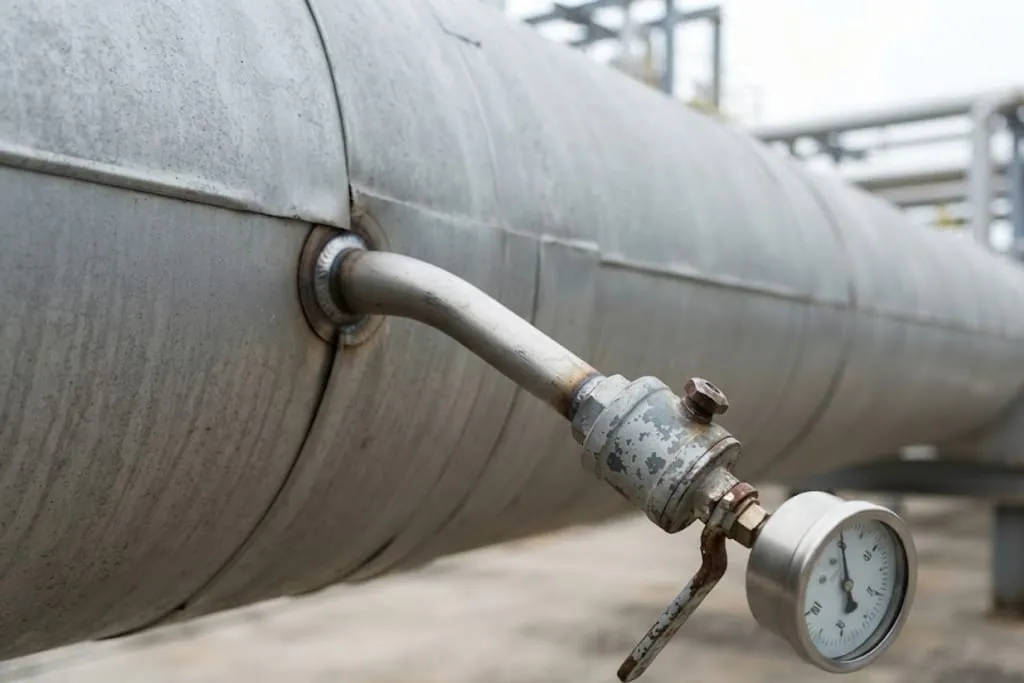
Vents, drains, sample connections, instrument tappings — typically 2 in. and below, hanging off larger lines, and very often carrying no support beyond the branch weld itself.
Spec breaks and dissimilar joints
A spec break is where the line class changes — different material, different rating.
Two questions arise. First, is the material actually there the material specified? Spec breaks are where the wrong grade gets installed during a repair, when the correct one was not on the shelf. Positive material identification settles it.
Second, where dissimilar metals are joined, there is a galvanic couple, and the less noble side corrodes preferentially — with the area ratio deciding how aggressively. See material degradation.
What to take away
- These components are separated because readings on the parent line do not represent them.
- Dead legs hold what settles; measure at the stagnant end and low point, and remove them where you can.
- Most dead legs accumulate through modification and appear on no drawing — find them by walking the line.
- Injection points damage locally; the circuit runs to the second change of flow direction with a dense grid.
- Mixing points may crack from thermal fatigue rather than thin.
- Soil-to-air interfaces lose metal in a narrow band at grade and must be excavated to inspect.
- Small-bore piping fails by vibration fatigue at the branch weld — a visual and support problem, not a thickness one.
- At spec breaks, confirm the material by PMI and consider the galvanic couple.
Check your understanding
7 questions. Nothing is recorded — this is just for you.