
Mechanical
Running an RBI assessment — from data to an inspection plan that happens
How probability and consequence of failure are actually estimated, why inventory group and detection time decide consequence more than vessel size does, what inspection effectiveness really changes, and why most RBI programmes fail after the study rather than during it.
By the time an assessment runs, the thinking has already been done: the corrosion loops and circuits are drawn, the damage mechanisms are named, the CMLs are placed and the baseline readings are in.
What remains is to turn that into two numbers per component, and then into work that actually happens. The second part is where programmes fail.
Probability of failure
Probability follows from three things: what can damage this item, how fast that damage is progressing against the thickness available, and how well the damage state is actually known.
Note what is absent. Age is not an input. A thirty-year-old line in benign service may be in better condition than a five-year-old one carrying wet chlorides, and an assessment driven by age would get both wrong.
Consequence of failure
Consequence asks what happens if this item releases its contents — measured across personnel injury, business interruption and environmental harm.
Two inputs dominate, and neither is a property of the item itself.

What inspection actually changes
| Highly effective | Correctly identifies the true damage state in nearly every case | Extensive automated ultrasonic scanning with high coverage of the susceptible area |
|---|---|---|
| Usually effective | Correctly identifies the true damage state most of the time | A substantial grid of manual ultrasonic readings covering the areas of concern |
| Fairly effective | Correctly identifies the true damage state about half the time | A limited set of spot readings at nominated monitoring locations |
| Poorly effective | Provides little information about the true damage state | External visual inspection only, on a line whose damage is internal |
| Ineffective | Provides no useful information about this mechanism at all | Thickness readings on a line whose credible mechanism is stress corrosion cracking |
No rows match that filter.
Effectiveness describes how much the inspection reduces uncertainty about the damage state. A highly effective inspection for one mechanism can be useless for another, so the category is always assigned against a named damage mechanism.
And effectiveness is always against a named mechanism. A dense thickness grid is powerful evidence about general thinning and tells you essentially nothing about stress corrosion cracking. Recording an inspection as “highly effective” without saying what it was effective for is how a cracking mechanism ends up marked as well covered by a survey that could never have found it.
Ranking, and what the matrix is for
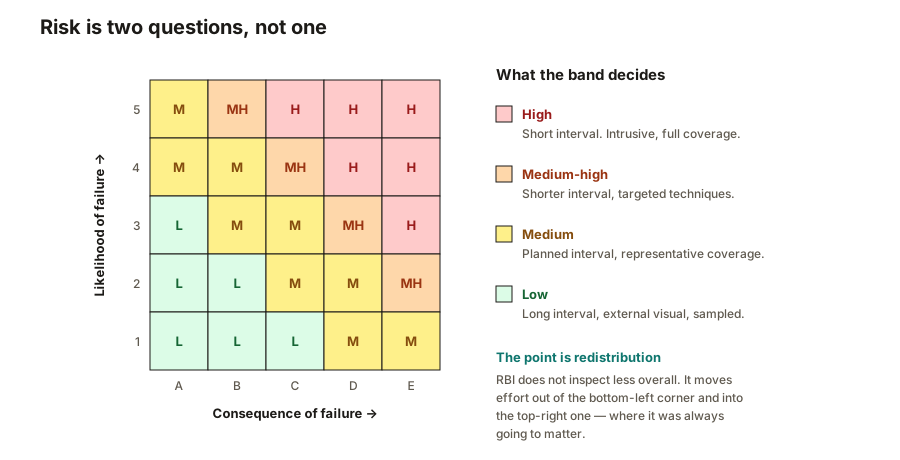
The position tells you why an item is where it is, and that governs the response. High probability with modest consequence is an inspection and repair problem. Low probability with severe consequence is usually a detection, isolation or inventory problem, and no amount of inspection will move it far.
Recommendations, and the step that gets skipped
The assessment produces recommendations: what to inspect, by which method, over what extent, and by when.
Risk is reduced by inspecting, repairing, isolating or changing something. Assessing reduces nothing. A study whose recommendations are not implemented has consumed budget and delivered no integrity benefit whatever.
Updates and revalidations
An assessment is a snapshot of the data available on the day it ran.
It is re-run when the inputs change: new thickness readings, a feed or throughput change, a modification through management of change, an incident or leak, an IOW exceedance, or simply the elapse of the review period.
What to take away
- Probability comes from mechanism, rate and confidence in the damage state — not from age.
- Consequence is dominated by the inventory group and the detection and isolation time, neither of which is a property of the item.
- Inspection reduces uncertainty, not damage. Diligent inspection with no repair has not reduced risk.
- Effectiveness is assigned against a named mechanism, or it means nothing.
- The matrix orders work; why an item sits where it does decides the response.
- Programmes fail at converting recommendations into owned, scheduled tasks and at feeding results back.
- Update it, and revalidate it. An assessment that is never re-run describes the plant as it used to be.
Check your understanding
8 questions. Nothing is recorded — this is just for you.