
Mechanical
Inspection and test plans — hold, witness, review, and who signs
What an ITP actually is, how it is built line by line from the code and the specification, what each of the four intervention levels obliges, why a document full of hold points is worse than a short one, and the notification failure that turns a witness point into nothing.
Standards referencedASME B31.3ISO 9001ASNT SNT-TC-1AEN 10204
An inspection and test plan is the document that answers, for every step of a piece of work, three questions: what is checked, against what, and who has to be there. It is the practical bridge between a code that states requirements and a site where somebody has to decide whether to let the next operation start.
It is also the document most often produced to satisfy a client, filed, and then not used. That failure mode is the subject of half of this topic.
Where the authority comes from
Worth settling first, because it is the thing people get wrong in arguments.
A code states technical requirements. It does not appoint anybody or grant anybody powers. ASME B31.3 says what an examination must achieve; it does not say that you personally may stop a crew.
The chain is:
- The contract, which says there will be a quality plan and who may do what.
- The project quality plan, made under it.
- The ITP, which implements the plan activity by activity.
- The code and the specification, which supply the acceptance criteria each line points at.
So when the question “who says so?” arrives — and on a pressured site it arrives — the answer is a document, not a job title. An inspector who can name the line, the plan and the clause is in a different position from one who cannot.
What a line has to contain
A usable ITP line carries five things. Miss any of them and the line cannot be used to accept or reject anything.
| Element | Why it is there |
|---|---|
| The activity | Specific enough to point at. “Welding” is not an activity; “root pass, line 6”-P-1502” is |
| The reference document | The procedure, drawing or specification that governs it |
| The acceptance criteria | And where they come from. Without this the line is an observation, not a decision |
| The intervention level | For each party, separately — see below |
| The record | What closes the line out, and who signs it |
The four intervention levels
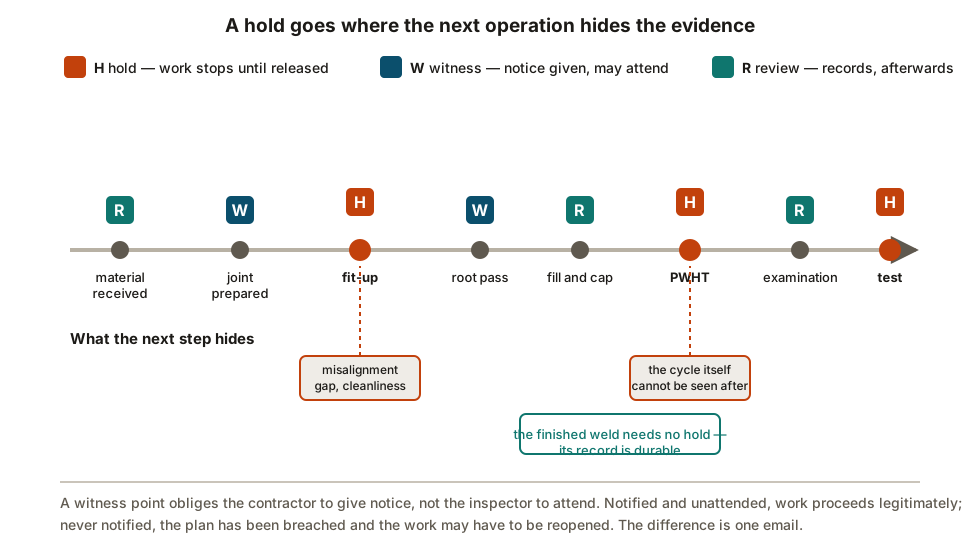
Each party — contractor, client, third party, certifying authority — gets its own level on each line. They are not the same for everyone.
H — Hold. Work may not proceed past this step until the named party has attended and released it. This is the only level that actually stops anything.
W — Witness. The party is notified and may attend. If notice is given and nobody comes, work proceeds legitimately. The obligation created is a notification obligation on the contractor, not an attendance obligation on the inspector.
R — Review. The records are examined after the fact. Right where the evidence is durable — a heat treatment chart, a material certificate, a radiograph. Wrong where the evidence vanishes when the next operation starts.
M — Monitor. Periodic oversight at the inspector’s discretion, with no notification and no stopping.
Where holds belong
The rule is short: a hold goes where the next operation would make the problem permanent or invisible.
That single test explains most of a well-built plan:
- Fit-up is a hold. Internal misalignment, root gap, bevel condition and cleanliness are all visible now and gone the moment the root is run.
- Before PWHT is a hold. Once the cycle has run, it cannot be assessed by looking at the pipe.
- Before a line is closed, insulated or buried is a hold, for the obvious reason.
- Pressure test is a hold, because it is the gate and because the result has to be seen, not reported.
- The finished weld is usually not a hold. It is examined by NDE under its own regime, and the record is durable.
Why a long plan is a worse plan
There is a resourcing point underneath this too. The ITP is what tells a contractor how much inspection attendance to price and a client how many inspector-days to fund. A plan written without that arithmetic is a plan whose cost arrives as a surprise and gets cut under pressure.
Keeping it a controlled document
The ITP is approved before the work it covers begins, and the version on site is the version in force. Three habits keep that true:
- Changes are revisions, issued and acknowledged. A hold added informally is a hold nobody can later prove was agreed.
- Signatures are collected as the work proceeds, not reconstructed at handover. A plan signed off in one sitting at the end is evidence of nothing.
- Each party signs its own lines. A client hold with no client signature is an open question regardless of how the weld looks.
What to take away
- The ITP implements the quality plan, which implements the contract. The code supplies criteria, not authority.
- A line needs activity, reference, acceptance criteria, intervention level and record — and the criterion is the one most often missing.
- Hold stops work. Witness obliges notice, not attendance. Review is after the fact. Monitor is discretionary.
- A properly notified witness point that nobody attended is closed; one that was never notified is a breach.
- Put holds where the next operation makes the problem permanent or invisible — which is why fit-up is one and the finished weld usually is not.
- A plan full of holds gets ignored, and takes the real ones with it.
- It is a controlled document: approved before the work, revised properly, signed as you go.
Check your understanding
10 questions. Nothing is recorded — this is just for you.