
Mechanical
Expansion loops and offsets — sizing the detour that absorbs the growth
How a loop actually absorbs movement, the guided cantilever hand calculation that gives you a first size, why the answer never fits the rack, and the honest ranking of what to do when it does not.
Standards referencedASME B31.3ASME B31.1MSS SP-69EJMA
Pipe supports and thermal expansion establishes the two facts this topic is built on: a hot line grows a long way, and restraining that growth produces a force large enough to destroy whatever is holding it. The answer is to give the movement somewhere to go. This topic is about designing that somewhere — the shape of it, the size of it, and what to do when it does not fit.
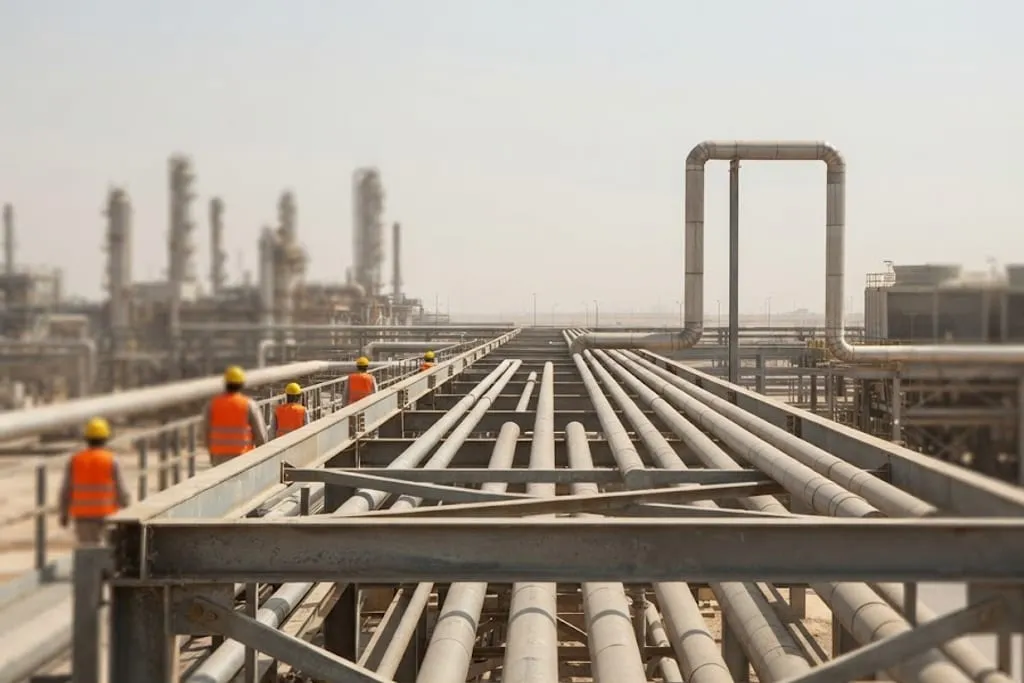
The order of preference, and why it is an order
There are three ways to absorb growth, and they are not alternatives of equal standing:
- The changes of direction the route already has. Free. Nothing to maintain, nothing to inspect, nothing to fail.
- A deliberate loop or offset. Costs pipe, pressure drop and space. Still nothing to maintain, nothing to fail.
- An expansion joint. Costs a component with a fatigue life, a pressure thrust the anchors must now resist, and an inspection item for the life of the plant.
Each step down the list adds a failure mode that did not exist before. That is the whole justification for the order, and it is worth being able to state when somebody proposes jumping to step three to save rack width.
How a loop actually works
A loop is not a shock absorber and nothing in it stretches. What it does is turn growth along the run into bending across a leg.
The pipe arrives at the loop having grown towards it. The first elbow turns the pipe through ninety degrees, so the leg that follows is now perpendicular to the direction of that movement. The growth pushes the end of that leg sideways, and the leg bends like a cantilever. The same happens on the other side. The loop absorbs the movement in the flexing of its perpendicular legs, and the elbows are simply what makes the pipe perpendicular.
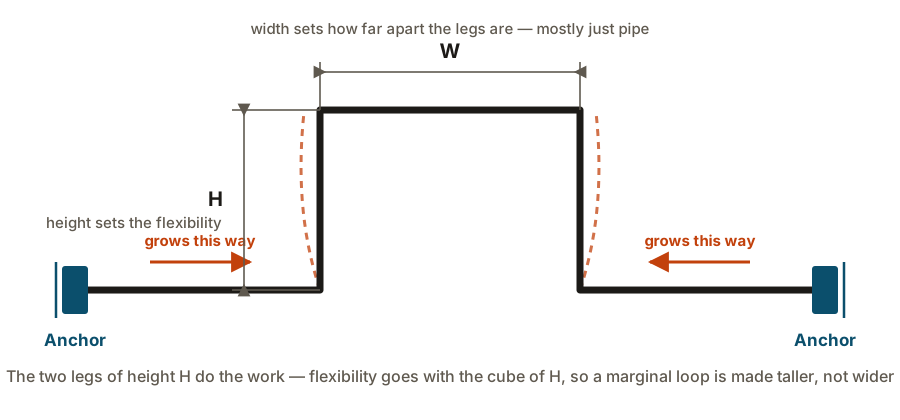
Two consequences follow immediately, and both are more useful than they look.
Height matters far more than width. The deflection a cantilever can take at a given stress goes with the square of its length, and its flexibility with the cube. Double the height of a loop and it becomes roughly eight times more flexible. Double the width and you have mostly bought pipe. When a loop is marginal, the answer is almost always to make it taller, not wider.
A slightly short leg is a much worse problem than it looks. That cubic relationship runs both ways. Trimming a metre off a six-metre leg to clear an obstruction does not cost you a sixth of the flexibility.
Sizing one by hand
The guided cantilever method gives a required leg length in about two minutes:
H = √( 3 · E · D · Δ / S_A )Where E is the modulus of elasticity, D the pipe outside diameter, Δ the
movement the leg has to absorb, and S_A the allowable displacement stress
range. Work in consistent units — MPa and mm throughout gives an answer in mm.
Take the NPS 6 carbon steel line from the parent topic: 60 m between anchors, 20 °C to 200 °C, so about 126 mm of total growth, half of it arriving at the loop from each side.
E   = 200,000 MPa
D   = 168.3 mm   (NPS 6 outside diameter)
Δ   = 126 mm
S_A = 206 MPa    (a typical allowable range for carbon steel — read yours from the code)

H = √( 3 × 200,000 × 168.3 × 126 / 206 )
  = √( 61,760,000 )
  ≈ 7,860 mm
Just under eight metres of leg. On a rack with four metres of headroom. This is the normal outcome of the calculation and it is the reason the calculation is worth doing early — not because the number is final, but because the conversation it starts has to happen before the route is drawn rather than after the stress package comes back.
Loops, offsets and the shapes in between
A U-loop is the standard: two elbows out, two elbows back, four in total. It is symmetrical, it is easy to guide, and it is what most people mean by a loop.
An expansion offset is a Z-shape — the run steps sideways and carries on. It absorbs less movement than a U-loop of the same depth but it costs no extra length, so where a route has to dodge an obstruction anyway, the dodge can be made to earn its keep.
An L-bend is simply a change of direction with a long enough leg after it. This is the natural flexibility of a route, formalised. The cheapest flexibility on any plant is a corner that was going to be there regardless, given a leg long enough to do some work.
Vertical or horizontal
On a rack, a loop can go sideways in plan or upwards in elevation, and the choice is a trade rather than a preference.
Horizontal loops nest neatly, drain naturally and are easy to support. They cost rack width, which on a congested plot is the most expensive dimension there is.
Vertical loops cost nothing in plan and are the common answer where width has run out. The price is drainage. Turning the pipe up and back down puts a pocket somewhere — at the crown if the loop goes down, or in the return to the rack if it goes up. On steam, on any condensing service, and on anything carrying solids, that pocket is a problem that has to be solved deliberately with a trap or a drain rather than discovered in commissioning.
Nesting several loops
A rack carrying six hot lines does not get six loops in six places. They are nested at one location, so that one local widening of the rack serves all of them.
Nesting has its own rules. The line with the greatest growth needs the deepest loop and therefore the position with the most room. Adjacent loops need clearance between them while they are all moving, which is not the same as clearance on the drawing. And the guides that drive growth into each loop have to be arranged so that the lines do not fight each other on a shared support steel.
When the loop does not fit
It usually does not. The honest ranking of what to do about it:
- Re-route. Find the natural flexibility somewhere else — a different corridor, a detour the plot plan already wanted, a change of elevation.
- Move the anchors. Shortening the anchored section cuts the growth proportionally, and the loop with it. Two smaller loops often fit where one large one does not.
- Make it taller rather than wider. The cubic relationship is on your side, if there is headroom.
- Accept a higher reaction and check the equipment. Sometimes the nozzle and the structure can take it. Sometimes. This is an analysis question, not an opinion.
- Expansion joint. With the anchors designed for pressure thrust, the maintenance regime agreed, and everyone aware of what has been accepted. See expansion joints and bellows.
- Ask the stress engineer for a miracle. Listed only because it is what actually happens, and because the answer is usually one of the five above, arrived at three weeks later and at greater cost.
What to take away
- A loop converts growth along the run into bending across a leg. Nothing in it stretches.
- Height beats width, by a cube law. A marginal loop is made taller.
- The guided cantilever formula gives a first leg length in two minutes. It is for finding out whether it fits, not for proving it works.
- The honest first answer is usually about eight metres of leg on a rack with four metres of headroom — which is why the calculation is done early.
- Put the loop mid-run between anchors, so both sections grow into it and the anchor loads balance.
- A loop only absorbs what the restraint scheme drives into it. Without the anchor, the growth goes to the softest thing available, which is often an equipment nozzle.
- Vertical loops buy rack width and sell you a drainage problem. Solve it deliberately.
- Nest loops at one location, deepest where there is room, with clearance checked in the moved position rather than the drawn one.
- An expansion joint is the last option, not an equivalent one.
Check your understanding
10 questions. Nothing is recorded — this is just for you.