
HSE
Chemical hazards and safety data sheets — reading the document before opening the drum
Which sections of a safety data sheet actually matter on the day, why segregation in a store is about what happens when two things mix, how glove selection goes wrong, and why a substance that is safe in the drum may not be safe in the vessel.
Every plant runs on substances that will burn, corrode, poison or asphyxiate somebody who handles them carelessly. The safety data sheet is the document that says which, and it is mostly read after an incident rather than before one.
The data sheet, and the parts worth reading
A safety data sheet has sixteen sections in a fixed order, which is useful because you can go straight to what you need without reading the rest.
Before anybody opens a container, two sections answer the questions that matter:
- Section 2, hazards identification — what this can do to a person, with the pictograms and hazard statements
- Section 8, exposure controls and personal protection — the limits, the ventilation required, and the specific protective equipment
Two more matter the moment something goes wrong:
- Section 4, first aid — what to do in the first minutes, which is when it counts
- Section 6, accidental release — how to contain and clean up, and what not to use
Exposure limits, and what they do not cover
Section 8 carries occupational exposure limits — typically a long-term average over a working day and a short-term limit over fifteen minutes. Occupational health covers what those mean in practice.
The critical point is what a limit assumes: a healthy adult, a normal working week, and one substance at a time. It says nothing about somebody exposed to three things at once, or about the person who reacts at a fraction of the limit.
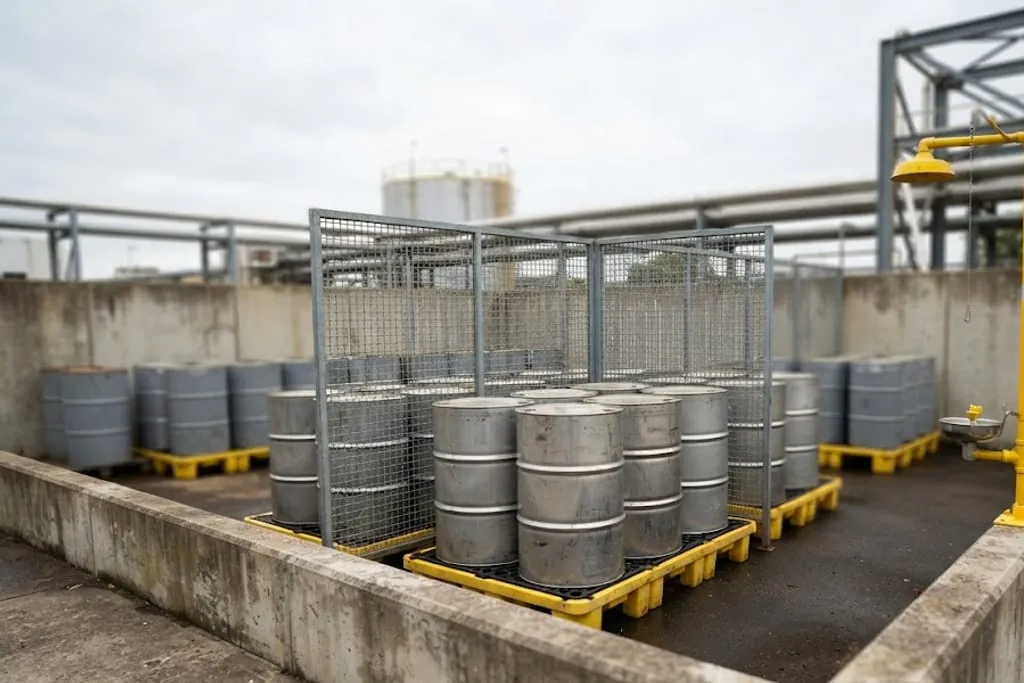
Storage: segregation is about what happens if both leak
A chemical store is arranged around a single question — what happens if two containers fail into the same bund?
- Acids and alkalis neutralise one another violently, with enough heat to boil and spray the mixture
- Oxidisers and fuels are the two halves of a fire that needs no external ignition
- Cyanides and acids produce hydrogen cyanide gas
- Water-reactive substances need to be nowhere near a sprinkler discharge or a wash-down
Beyond segregation, a store wants bunding that will hold the largest container plus a margin, ventilation at the right level for the vapour density, protection from sun and rain, and labels that are still readable after two years outdoors.
Protective equipment, and how glove selection goes wrong
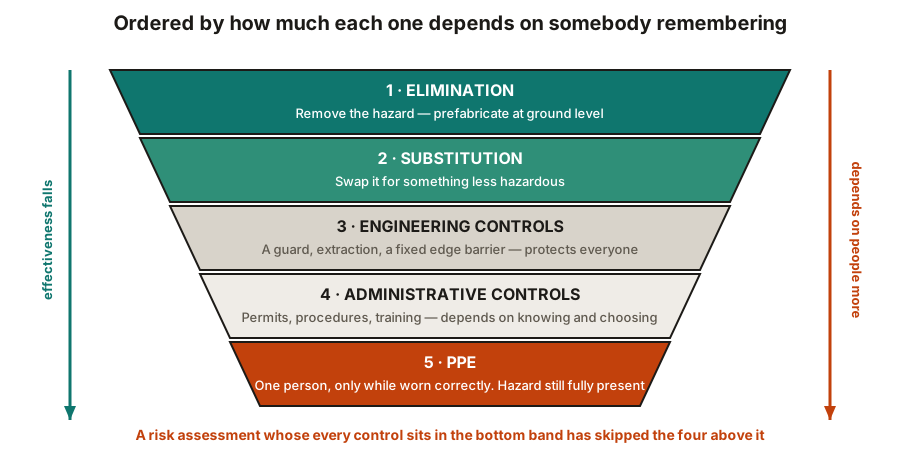
Personal protective equipment sits at the bottom of the hierarchy of control for good reason: it protects one person, only while worn correctly, and it fails without announcing itself.
Gloves are the commonest error, because “chemical resistant” sounds binary and is not.
Respiratory protection carries its own absolute limit, covered in occupational health: no filtering device works in an oxygen-deficient atmosphere, because a filter cleans air rather than supplying it.
Confined spaces change everything
Nothing about a chemical changes when it goes into a vessel. What changes is that the vapour cannot disperse.
A solvent that evaporates harmlessly in the open builds to a flammable or toxic concentration inside a tank. An inert gas used for purging displaces oxygen silently and without smell. See permit to work for the entry controls that follow from this.
Spills
For anything beyond a minor, identified, contained spill the sequence is: protect people first, contain second, clean up third. In that order, and the first step includes not walking through it.
What to take away
- Read sections 2 and 8 before opening a container, and know where 4 and 6 are before you need them.
- A data sheet describes the substance as supplied — not heated, pressurised, mixed or held in tonnes.
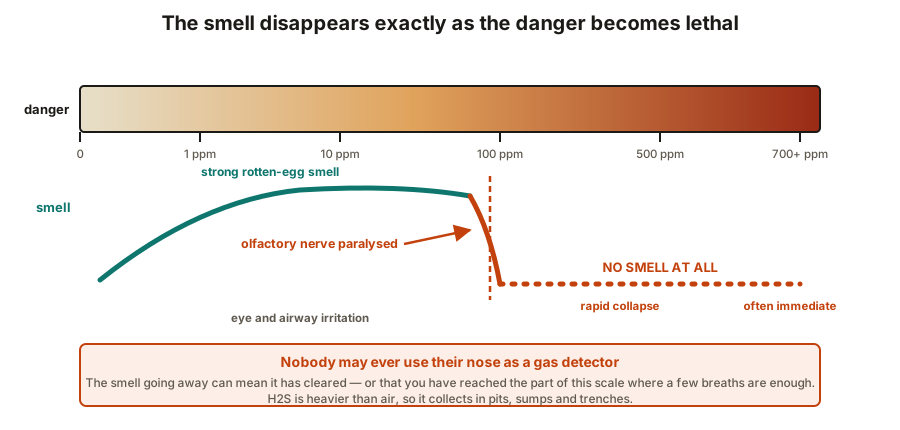
- Smell is not a warning system. Some substances remove their own warning as the concentration rises.
- Segregation answers one question: what happens if both containers leak into the same bund?
- Label at the moment of decanting, or you have created an unknown liquid.
- Gloves have a breakthrough time. Match it to the task duration, not to how dirty they look.
- A confined space does not change the chemical, only its ability to disperse.
- Identify a spill before treating it. Water makes some of them worse.
Check your understanding
7 questions. Nothing is recorded — this is just for you.