HSE
Occupational health — substances, H2S and working in heat
Why hydrogen sulphide becomes more dangerous as the smell disappears, what an exposure limit actually means, why a filter respirator is useless in an oxygen-deficient atmosphere, how silica and welding fume do their damage silently, and why heat stroke is a medical emergency rather than a bad afternoon.
Standards referencedISO 45001ANSI Z88.2
The hazards on this page differ from most others in one respect: several of them do their damage without producing any sensation at the time. That is why they are controlled by measurement and health surveillance rather than by how the work feels.
| Hydrogen sulphide (H2S) | Rapidly fatal at high concentration; deadens the sense of smell as it rises | Acute — minutes or less | Detection, ventilation, escape sets, and never relying on smell |
|---|---|---|---|
| Benzene | Carcinogen affecting the blood-forming system | Chronic | Very low exposure limit; containment and monitoring |
| Respirable crystalline silica | Irreversible lung disease from concrete cutting and grinding | Chronic | On-tool extraction or water suppression at the point of generation |
| Welding fume | Respiratory disease; now treated as carcinogenic | Chronic, with acute metal fume fever from zinc | Local exhaust ventilation; remove coatings back from the weld |
| Asbestos | Fatal lung disease from fibres released when disturbed | Chronic, decades later | Survey before demolition or modification; licensed removal |
| Noise | Permanent hearing loss, painless as it develops | Chronic | Reduce at source; hearing protection last; survey to find the areas |
| Hand-arm vibration | Irreversible nerve and blood vessel damage from vibrating tools | Chronic | Tool selection and trigger-time limits — gloves do very little |
| Heat | Heat exhaustion progressing to heat stroke, which is a medical emergency | Acute, within a shift | Work-rest cycles, shade, hydration, midday restrictions |
| Solvents absorbed through skin | Systemic effects that air monitoring alone will not detect | Chronic | Glove material matched to the chemical; biological monitoring |
No rows match that filter.
The pattern worth noticing is how many of these do their damage without any sensation at the time. Acute hazards announce themselves; chronic ones do not, which is why they are controlled by measurement and surveillance rather than by how the work feels.
Hydrogen sulphide
H2S is the hazard that defines working practice across much of the oil and gas industry, and it has a property that makes it uniquely treacherous.
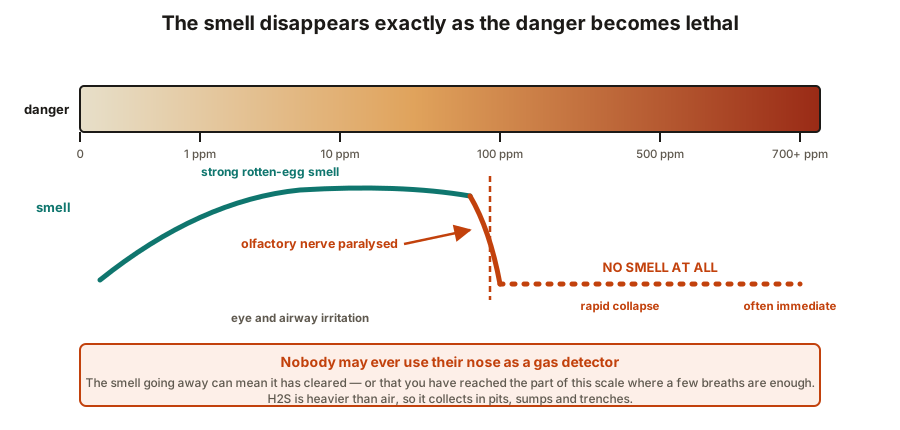
It is also heavier than air, so it collects in low-lying places — pits, sumps, trenches, the bottom of a vessel. A personal monitor worn at the collar can read clear while the atmosphere at the bottom of a trench is lethal, which is why atmospheres are tested at the depth people will actually be.
Escape sets are provided in some areas. They hold a very short duration of air, deliberately, because their only purpose is to get the wearer out — not to let them stay and work.
Exposure limits, and what they do not cover
An occupational exposure limit is an airborne concentration considered acceptable over a stated period — typically an eight-hour average, sometimes with a separate short-term limit for excursions.
Two things about them are worth holding onto.
They are averages, so a brief high exposure can be harmful even where the eight-hour figure looks fine. And they assume the dose arrives by breathing.
Glove material is matched to the specific chemical. A chemical can permeate a glove that shows no visible damage at all, and the figure that matters is breakthrough time rather than thickness.
Respiratory protection, and its one absolute limit
Two families, and confusing them is dangerous.
Air-purifying respirators filter the surrounding air. Cartridges are matched to the contaminant, and they have a finite life.
Supplied-air and self-contained apparatus provide breathing air from elsewhere.
Face fit testing is done for each individual, because air takes the easiest path. A leaking seal admits contaminated air around the edge rather than through the filter, and the protection collapses.
Facial hair at the sealing surface defeats the seal regardless of the test result. That is why clean shaven is a condition of wearing a tight-fitting respirator rather than a preference, and why loose-fitting powered hoods exist for people who cannot meet it.
The dusts and fumes that work slowly
Silica from cutting or grinding concrete causes irreversible lung disease. The dangerous fraction is respirable — too fine to see — so a job that looks clean can be well over the limit.
The effective control is capture at source: on-tool extraction or water suppression. That protects everybody nearby and does not depend on anybody remembering anything, which is exactly why it sits above PPE in the hierarchy.
Welding fume is now treated as carcinogenic, which has raised the standard of ventilation expected rather than leaving it to general air movement. Galvanised and coated steel is worse — heated zinc causes metal fume fever, and removing the coating back from the weld area both reduces the fume and improves the weld.
Asbestos is a survey question before it is a control question. Older plant has it in lagging and gaskets, and an ordinary day of demolition can expose everybody present. The survey happens before the work, not when somebody notices.
Local exhaust ventilation is the common control for all of these, and its capture distance falls away very fast — a hood a metre from the work is doing almost nothing however powerful the fan. It is also examined periodically, because ducts block and fans wear while the system still makes a reassuring noise.
Noise and vibration
Noise-induced hearing loss is permanent and painless as it develops, which is exactly why it needs a survey to find rather than a complaint. Reduce at source first; hearing protection is the last resort and it has to be worn continuously to deliver its rating.
Hand-arm vibration syndrome comes from prolonged use of vibrating tools and damages nerves and blood vessels irreversibly. The controls are tool selection and trigger time limits. Gloves are widely believed to help and do very little.
Both are managed by health surveillance — detecting early signs while the exposure can still be changed, which is the only point at which anything can be done.
Heat
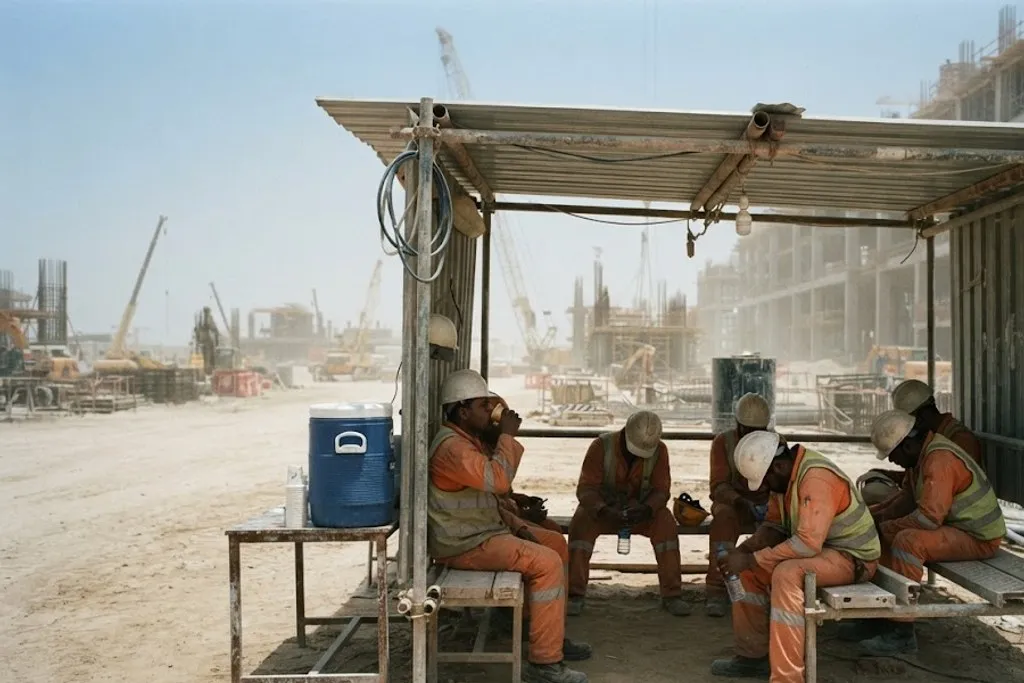
On a Gulf site this is the hazard most likely to injure somebody this week.
The controls are structural rather than personal:
- Work-rest cycles with shaded rest areas, because heat load accumulates through the shift. Somebody fine at ten can be in trouble at one doing identical work.
- Hydration, with electrolytes as well as water. Very large volumes of plain water against heavy sweating can dilute sodium dangerously.
- Midday work bans, set by each Gulf country for the summer months and enforced by inspection with real penalties. They are a compliance matter as well as a health one.
- Acclimatisation for new arrivals, who are at higher risk for the first week or two.
Health surveillance
Where exposure to a known hazard cannot be eliminated, surveillance detects early effects while they can still be acted on — audiometry for noise, lung function for dusts, vibration questionnaires, biological monitoring for absorbed substances.
What to take away
- H2S deadens the sense of smell as concentration rises. Never use your nose. It collects low.
- Exposure limits are averages, and a skin notation means air monitoring understates the dose.
- A filter cannot make oxygen. Oxygen deficiency requires supplied air, always.
- Face fit testing is per person, and facial hair defeats the seal whatever the test said.
- Capture dust and fume at source. The respirable fraction of silica is invisible.
- Noise and vibration damage is permanent and painless. Surveillance finds it while it still matters.
- Heat stroke is a medical emergency — hot dry skin and confusion, not heavy sweating. Cooling speed decides the outcome.
Check your understanding
6 questions. Nothing is recorded — this is just for you.