HSE
Emergency response and site welfare
Why muster points are chosen against the prevailing wind, what a headcount is actually for, why drills exist to find the problems rather than to demonstrate compliance, what a medical evacuation plan has to settle in advance, and why camp welfare is a safety matter rather than a comfort one.
Emergency arrangements are judged entirely by how they work on the worst day, and almost everything that fails on that day was decided in advance by somebody who thought it would not matter.
The plan has to be specific enough to act on
An emergency response plan defines the foreseeable emergencies, who does what, what resources exist and how they are called. It covers fire, gas release, medical emergency, evacuation, spill — and it names the arrangements for each.
An incident command structure gives clear command and communication under pressure. Its main job is preventing two people issuing different instructions to the same team, which is how an emergency becomes worse.
Muster points
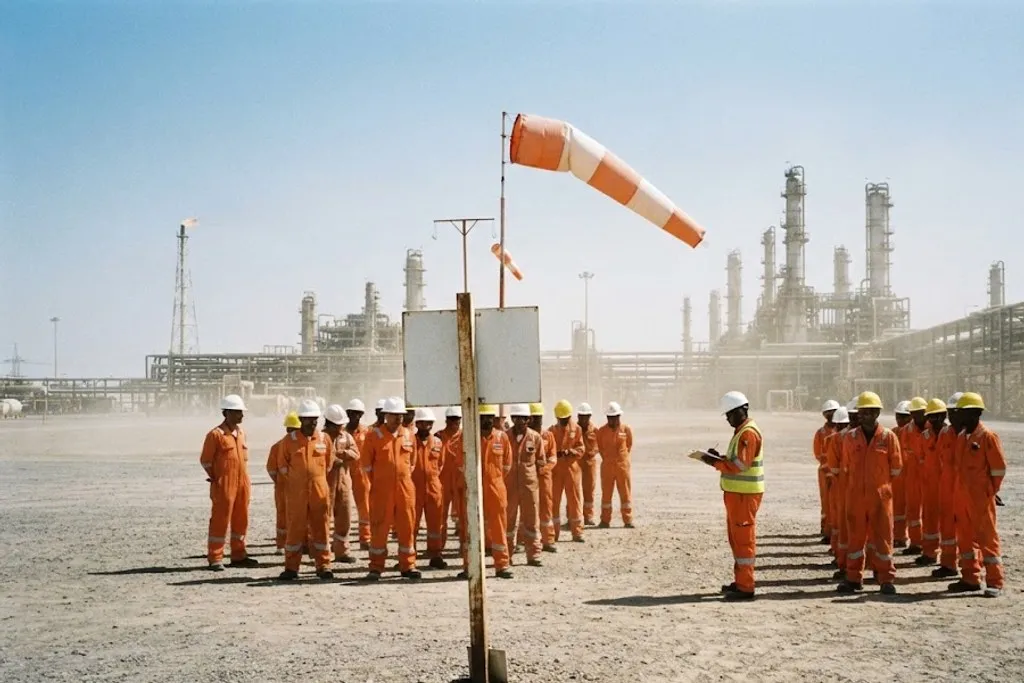
A muster point is a designated safe place where people assemble to be accounted for.
Knowing who is on site
A headcount — personnel on board, or whatever the site calls it — is the count of who is inside the boundary right now.
Visitors are escorted in operating areas for the same reason and one more: they do not know the alarms, the muster points, or why that pipe is lagged. The escort is who gets them to the muster point, which makes it a responsibility rather than a courtesy.
Drills
A written plan is a set of assumptions. A drill is the only way to find out which of them are wrong.
Alarm tones need to be distinguishable, and people need to know which is which — general alarm, fire, toxic gas, all-clear. That is part of induction and it is tested in drills, because a tone somebody cannot identify produces hesitation at the worst moment.
Communications get tested too. Coverage inside a vessel, in a substation, or behind a large structure is exactly where it fails, and those are exactly the places an emergency happens.
Medical provision
A first aid needs assessment decides what provision the site requires — based on the hazards, the number of people and how far away definitive care is. A remote desert site with a hundred people and hot work is a different problem from an office of thirty.
Defibrillators appear on larger sites because survival from cardiac arrest falls sharply with every minute of delay. The device instructs the user, so the limiting factor is how fast it reaches the casualty rather than who is holding it.
Medical evacuation
A helicopter landing site is kept clear and controlled, because downwash lifts anything loose across a wide area.
First aid basics that get forgotten
Check the scene is safe before approaching. A rescuer who becomes a second casualty helps nobody, and in confined space and electrical incidents that is precisely the pattern that repeats.
Do not move a suspected spinal injury unnecessarily — movement can turn a survivable injury into permanent paralysis. The exception is immediate danger, and that judgement is made deliberately.
Chemical splash to the eye: irrigate immediately, for a prolonged period, with clean water. Time matters more than identifying the chemical, and neutralising agents generate heat and can do more damage than the original splash.
Emergency showers and eye wash stations are tested regularly, because stagnant water and blocked outlets make them useless exactly when needed. In a hot climate the water standing in the pipe can also be scalding, which is another reason to flush them through.
Keep emergency equipment clear and marked. Scaffolding and material stacked in front of a fire point is among the commonest findings on any construction site, and it is never deliberate.
Impairing the systems that protect you
Firefighting systems get isolated for maintenance and modification. That isolation is controlled, because the area is unprotected while it lasts.
Compensating measures — a fire watch, restrictions on hot work — fill the gap, and an impairment register is what ensures the system is actually restored rather than left isolated because everyone moved on.
Welfare is a safety subject
What to take away
- Define emergency roles, not names — names are wrong by the next crew change.
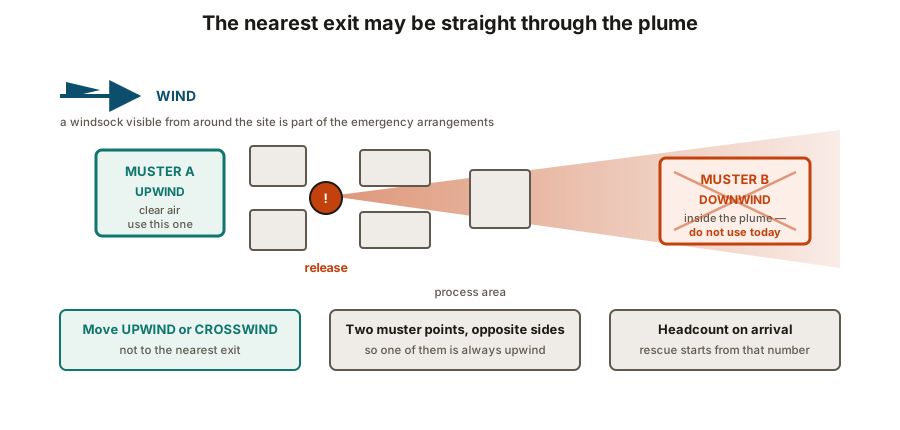
- Muster upwind. Primary and secondary points exist because wind direction decides which is safe, and a windsock is part of the arrangements.
- On a toxic gas alarm, move upwind or crosswind — not to the nearest exit.
- A headcount is what search and rescue starts from. Signing out matters as much as signing in.
- Drills exist to find problems. The debrief is the point; a flawless drill was too easy.
- Settle the medevac route, the receiving hospital and who authorises before anyone needs it.
- Check the scene is safe first. Irrigate eye splashes immediately. Test showers and eye washes.
- Fatigue, camp heat, water and food are safety matters with a delay of a day or two.
Check your understanding
6 questions. Nothing is recorded — this is just for you.