Civil & Structural
Reinforcement detailing and formwork — cover, laps and the things that move
Why cover is a durability dimension rather than a tolerance, what a lap length is actually doing, why site-made spacers cause the defect they were meant to prevent, which bars may be welded and which must never be, and why formwork rigidity decides whether any of it stays where it was put.
Reinforcement is the part of a structure that will never be seen again after the pour, and the part that decides whether the structure lasts forty years or fifteen.
Almost everything that goes wrong with it is a matter of position — a bar in the right quantity and the wrong place does very little.
Cover is a durability dimension
Cover is the distance from the face of the concrete to the outside of the nearest bar, and it is doing three jobs at once:
- Durability. It is the barrier carbonation and chloride must cross before they reach the steel. Its thickness is roughly how long that takes.
- Fire. Concrete insulates the steel, and reinforcement loses strength quickly when hot.
- Bond. Force transfers between bar and concrete by bond, and too little cover splits the concrete rather than developing the force.
Spacers, chairs and keeping bars where they were put
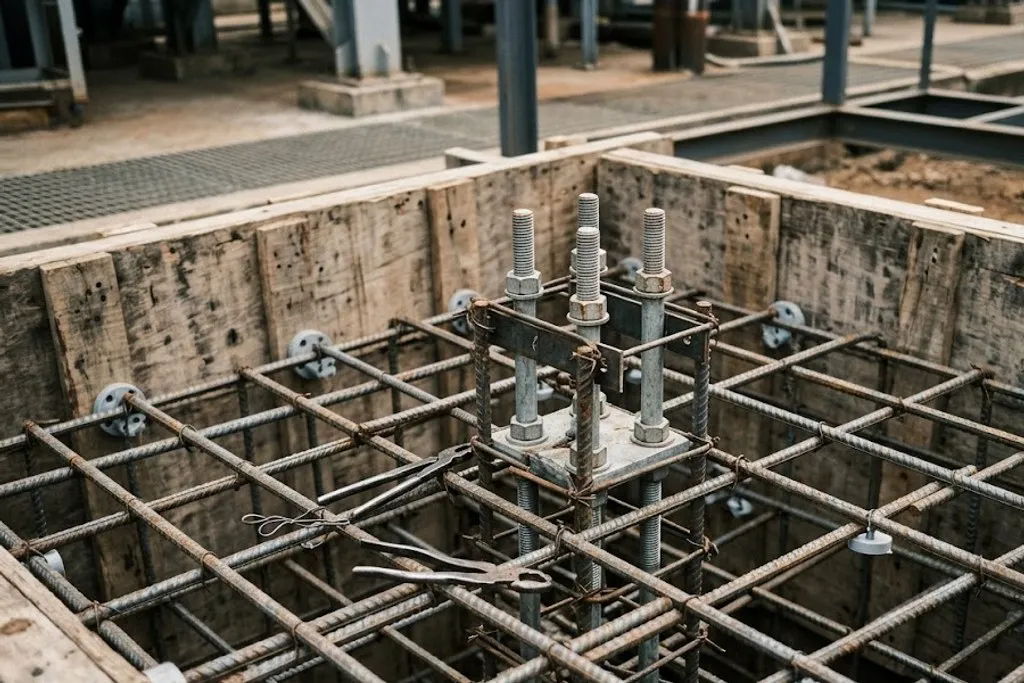
Reinforcement does not float. It is held by spacers against the formwork face and chairs holding upper layers off lower ones.
Spacing matters too. Chairs too far apart let the top mat sag between them under the weight of people and concrete, and the bars end up lower than drawn. On a cantilever, where the top steel is the structure, that is a serious defect.
Laps
Bars come in stock lengths, so force has to pass from one bar to the next. It does not pass through contact — two bars touching transfer nothing directly.
Force leaves one bar into the surrounding concrete by bond, and enters the other the same way. The lap length is how much bonded length that transfer needs, and it depends on bar diameter, concrete strength, cover and whether the bars are in tension or compression.
Which bars can be welded
Bending is a related question. Bars are bent to a minimum radius for their size, because a tighter bend cracks the steel on the outside of the curve. Re-bending — bent, straightened and bent again — work-hardens the steel and is controlled or prohibited, because cracks start at the bend and are invisible once it is cast in.
What to check before the pour
Reinforcement inspection is a hold point, and it is the last moment anything below can be seen.
- Size, number and spacing against the bar bending schedule
- Cover at the faces, with the spacers that are producing it
- Laps — length, stagger and position
- Chairs and supports at the right spacing, with the top mat properly held
- Cleanliness — loose rust and mill scale are acceptable, but oil, mud and released form oil on the bars are not; they prevent bond
- Embedded items — holding-down bolts, sleeves, waterstops, earthing tapes — in position and secured
Formwork holds the reference
Formwork is temporary, so it attracts less attention than it deserves. But cover is measured from the face, and the face is the formwork.
Fresh concrete is heavy and behaves as a fluid, exerting considerable lateral pressure that increases with pour rate. Formwork has to be designed for that, not assembled by eye.
Other formwork points that matter to the concrete rather than the carpentry: joints tight enough that grout does not escape and leave honeycombing at the edge; release agent on the form and not on the bars; and striking times that respect strength gain rather than programme, with props to vertical formwork struck well before anything carrying load.
What to take away
- Cover is a durability dimension. Under is far worse than over, and it is measured, not judged.
- Spacers become part of the cover. Site-made mortar blocks create the permeable path they were meant to prevent.
- A lap transfers force through the concrete, so its length, stagger and position are structural — not adjustable to suit delivered lengths.
- A706 is weldable; A615 is not. Tack welding a cage together is a real hazard, not a shortcut.
- Re-bending work-hardens steel and starts cracks at the bend.
- Check bar spacing against aggregate size. Congestion leaves voids exactly where the steel is densest.
- Formwork holds the reference for cover. A form that deflects moves the cover without moving a single bar.
Check your understanding
6 questions. Nothing is recorded — this is just for you.