Civil & Structural
Placing, curing and testing concrete in hot weather
Why curing is a chemical requirement rather than a finishing touch, what evaporation rate does to a slab before it has set, how cube specimens must be made and stored to mean anything, what the acceptance criteria actually say, and why a cold joint is a structural defect rather than a cosmetic one.
Concrete is the only material on a plant that arrives as a liquid and is finished by people who will never see whether they got it right. Everything that determines whether it lasts happens in the first few hours and the first week.
Before the truck arrives
Placing concrete is a hold point on any sensible ITP, and the inspection that matters happens before any concrete is on site — because afterwards none of it can be seen.
What is being checked: reinforcement position and cover, formwork line, level and rigidity, embedded items and their positions, cleanliness, and that the access, plant and people to finish the pour are actually there.
Hot weather, and the evaporation rate
Ambient temperature is only one of four things that decide whether a slab is in trouble. The others are concrete temperature, relative humidity and wind speed.
Together they give an evaporation rate, and ACI 305 treats that figure — not the air temperature — as the thing to manage.
A dry wind across a slab on a mild day can be worse than a still, humid, hot one. Wind is consistently the factor people underestimate.
Concrete temperature is normally capped — commonly 32 °C at placing. The usual means are chilled mixing water, ice replacing part of the water, shading the aggregate stockpile, and placing at night.
Placing
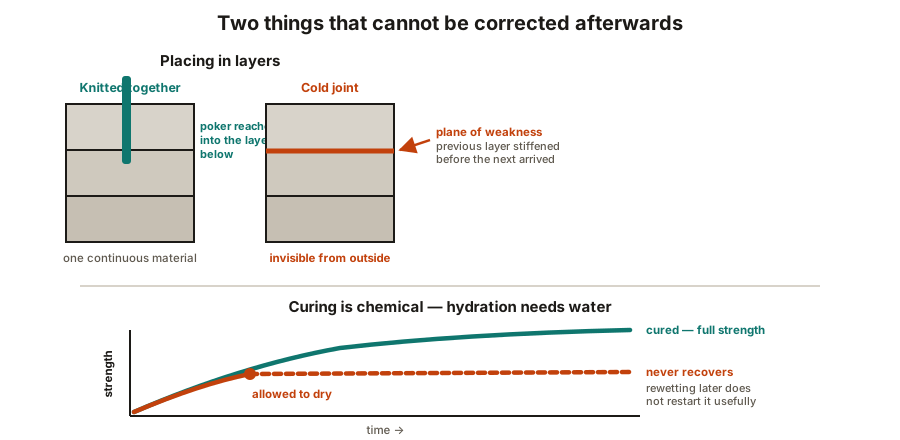
Concrete is placed in layers, each vibrated into the one below while that one is still workable.
Vibration does two things: it releases entrapped air, and it lets the material flow around congested reinforcement and into corners. Both matter — a void behind a bar is a direct path to the steel.
Over-vibration is its own error. Run the poker too long and the mix segregates: coarse aggregate settles, paste and water rise, and the top of the pour ends up weak and the bottom stony.
Curing is a chemical requirement
Cement hydrates by reacting with water. Take the water away and the reaction stops.
That is the whole of it, and it is why curing is not a finishing activity.
Curing means keeping water in the concrete for a defined period, by ponding, continuously wet hessian, plastic sheet, or a sprayed curing compound. Seven days is a common minimum and a mix with high pozzolan replacement needs longer, because the reaction it depends on is slower.
Intermittent wetting is worse than useless on a hot day. Wetting and drying cycles stress the surface, so hessian that dries out between visits does harm.
Testing: making the cubes mean something
Slump is tested at the truck, before discharge, and it is a consistency check rather than a quality one. Its real value is comparative: a load noticeably wetter than the last one from the same mix means something changed, and the usual something is water.
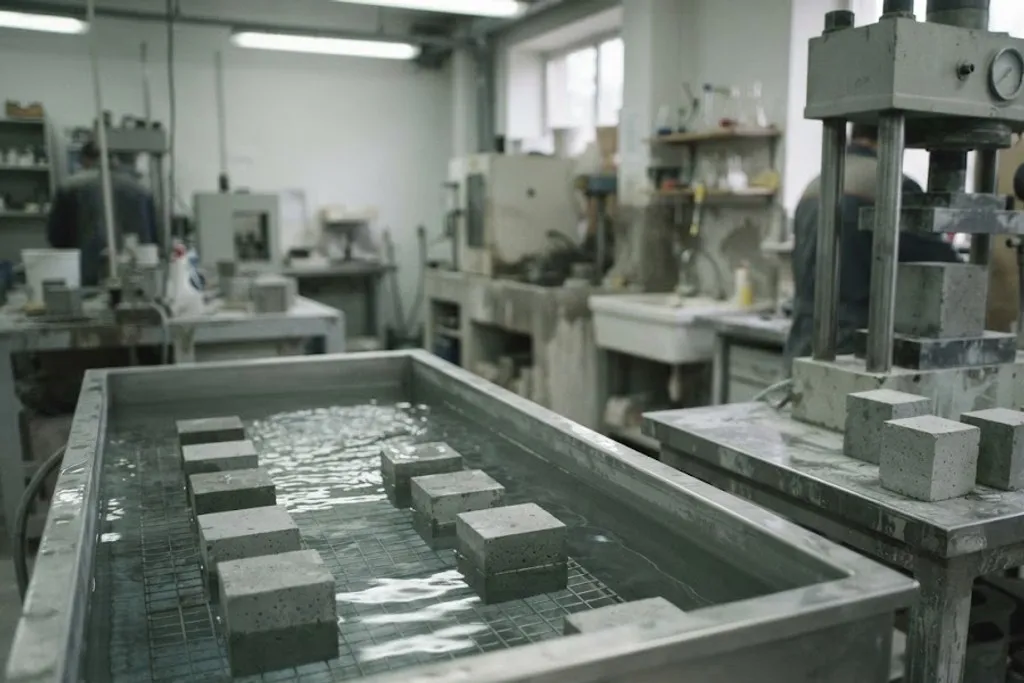
Cube or cylinder specimens are the strength record, and they are only evidence if they were made and stored correctly:
- Filled in specified layers, each compacted as specified
- Left undisturbed, protected and at controlled temperature, for the first 24 hours
- Then cured in water or a fog room until testing
- Identified unambiguously with the pour they came from
Acceptance is statistical
Concrete strength varies naturally, so acceptance criteria are written around averages of consecutive results together with a minimum for any individual result.
A single cube below the characteristic strength does not automatically condemn anything. It is investigated, and the criteria decide.
When results genuinely fail, the sequence runs: review batch records and curing, then non-destructive testing for uniformity, then cores from the element itself, and finally load testing or an engineering assessment. Each step costs more than the last, which is another argument for getting the cubes right.
What to take away
- Inspect before the concrete arrives. Afterwards, nothing inside can be seen.
- Manage the evaporation rate, not just the temperature — wind and humidity are half of it.
- Plastic shrinkage cracks form in the cover zone within hours, and only immediate measures prevent them.
- Vibrate to release entrapped air and reach the corners; over-vibration segregates.
- A cold joint is a built-in plane of weakness. Plan the pour rate and know where a construction joint would go.
- Curing is chemical. Concrete that dries has stopped hydrating, and that loss is permanent and invisible while the cubes still pass.
- Cubes only count if made and stored correctly. One left in the sun cannot be interpreted.
- Acceptance is statistical and at 28 days; seven-day results are early warning.
Check your understanding
6 questions. Nothing is recorded — this is just for you.