Civil & Structural
Piling and deep foundations — necking, founding stratum and integrity
How a pile carries load through end bearing and shaft friction, what necking is and why a bored pile can develop it without anyone seeing, why the founding stratum must be proved rather than assumed from depth, what pile trimming is for, and how equipment bases get grouted.
Standards referencedACI 318ASTM D5882ASTM D1143API 686
A shallow foundation spreads load onto ground near the surface. Where that ground will not carry it — soft clay, loose fill, sabkha — the load has to be taken somewhere better, and that means going deeper.
Piling is the least visible work on a site. Almost none of it can be inspected after construction, which shapes everything about how it is controlled.
How a pile carries load
Two mechanisms, usually both at once:
- End bearing — the toe rests on competent material and pushes down on it.
- Shaft friction — the sides grip the soil along the pile’s length.
Which dominates depends on the ground. A pile to rock is mostly end bearing. A pile in deep firm clay with no hard layer may be almost entirely friction, and is sometimes called a floating pile.
That distinction matters on site because it decides what has to be confirmed. For an end-bearing pile, what the toe is sitting on is the whole design. For a friction pile, the condition of the shaft along its length is.
The founding stratum is proved, not assumed
Bored piles, and what can go wrong out of sight
A bored pile is a hole filled with concrete, and both halves of that can fail invisibly.
The bore can close. In soft or unstable ground the sides squeeze inwards before concreting, or the concrete does not fill the full section as it rises. The result is necking — a waisted length somewhere down the shaft.
The concrete can be contaminated. Placed through water or drilling fluid, it must displace that fluid upwards rather than mix with it, which is why it is placed through a tremie with the pipe kept buried in the rising concrete. Lift the tremie clear and fluid gets in, leaving a weak or broken section.
The base can be dirty. Spoil left at the bottom sits between the pile and the stratum it is supposed to bear on, so the pile settles before it does anything useful.
Integrity and load testing
Low-strain integrity testing — a small hammer blow at the head and a sensor listening for reflections. A sound pile reflects from the toe. An earlier reflection means the stress wave met a change in section before then: a neck, a void, a discontinuity. It is quick and cheap enough to apply to a large proportion of piles, and it finds gross defects rather than measuring capacity.
Static load testing — apply load and measure settlement. It is the direct measurement of what the pile actually does, and it is slow and expensive, so a small number of piles are tested and the rest are inferred.
Dynamic testing sits between the two, using instrumented driving to estimate capacity.
Trimming and the connection to the cap
Cast-in-place piles are deliberately overpoured. The top of the concrete is laitance, bleed water and contamination, and overpouring pushes that weak material above the cut-off level where it can be removed.
Trimming cuts back to sound concrete at the right level, exposing clean projecting reinforcement.
Position and verticality
Piles are not placed accurately. Tolerances on position and rake are stated in the specification because the rig cannot do better, and the design allows for it.
What matters is what happens when the tolerance is exceeded. An out-of-position pile applies its load eccentrically to the cap, which the cap was not designed for. That is an engineering assessment — sometimes the cap is enlarged, sometimes another pile is added — and it is precisely why as-built pile positions are surveyed and recorded before caps are built.
Equipment bases and grouting
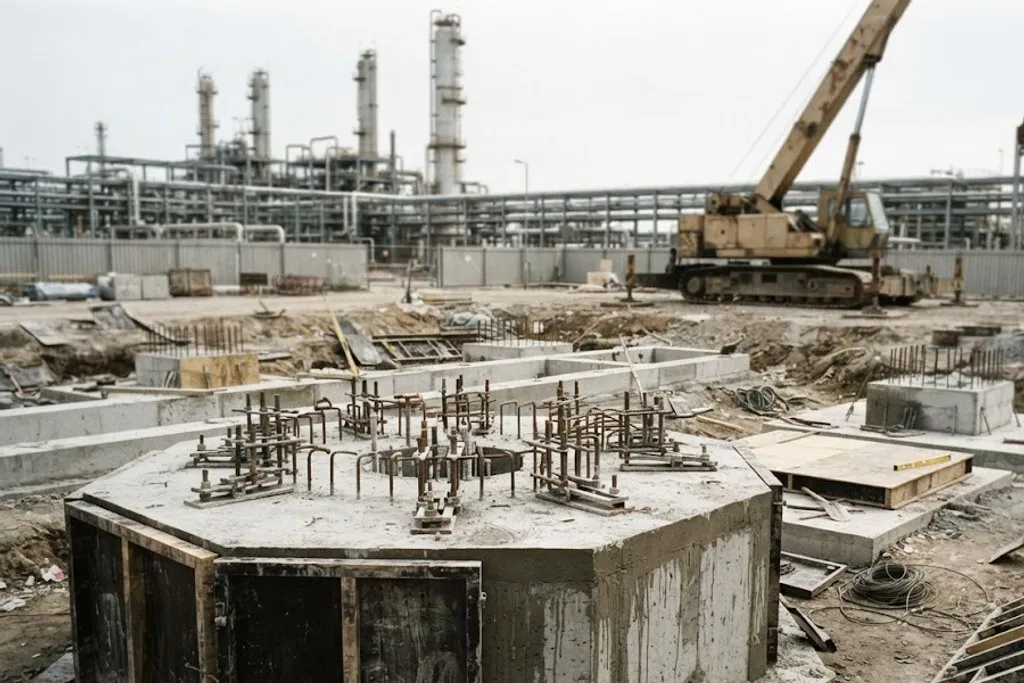
A machine foundation carries static weight plus dynamic load, and for rotating equipment it is designed so its natural frequency is well away from the running speed.
Holding-down bolts are cast in, usually in pockets or sleeves giving a little adjustment. The template that positions them is the difference between a baseplate that drops on and a week of argument, and it is worth checking against the vendor drawing rather than the civil drawing alone.
Grouting fills the gap between baseplate and concrete.
Cementitious grout is normal; epoxy grout is used where chemical attack or higher strength is needed, and it is far less forgiving about surface preparation and temperature.
What to take away
- A pile carries load by end bearing, shaft friction or both — and which one decides what must be confirmed on site.
- Prove the founding stratum, do not infer it from depth. The layer moves between boreholes.
- Necking, tremie contamination and a dirty base all produce a pile that looks perfect at ground level.
- Concreting records — volume against depth — often show a problem before any test does.
- Low-strain integrity testing finds defects; load testing measures capacity.
- Trim carefully. Over-heavy breaking damages the pile head, and bending projecting bars back and forth damages the connection.
- Survey as-built pile positions before building caps.
- Grout baseplates completely. A void under a baseplate is a vibration problem that outlives everyone on the project.
Check your understanding
6 questions. Nothing is recorded — this is just for you.