
Automotive
Suspension and steering geometry
What camber, caster, toe, kingpin inclination and scrub radius each actually do, why unsprung mass matters more than its weight suggests, how weight transfer and roll centres set the handling balance, and what understeer really is.
A suspension has two jobs that pull against each other. It has to keep the tyre pressed onto a surface that is moving up and down, and it has to hold the wheel at a useful angle to the road while the body leans, dives and squats. Almost every design decision below is a way of buying one of those without losing too much of the other.
Sprung and unsprung
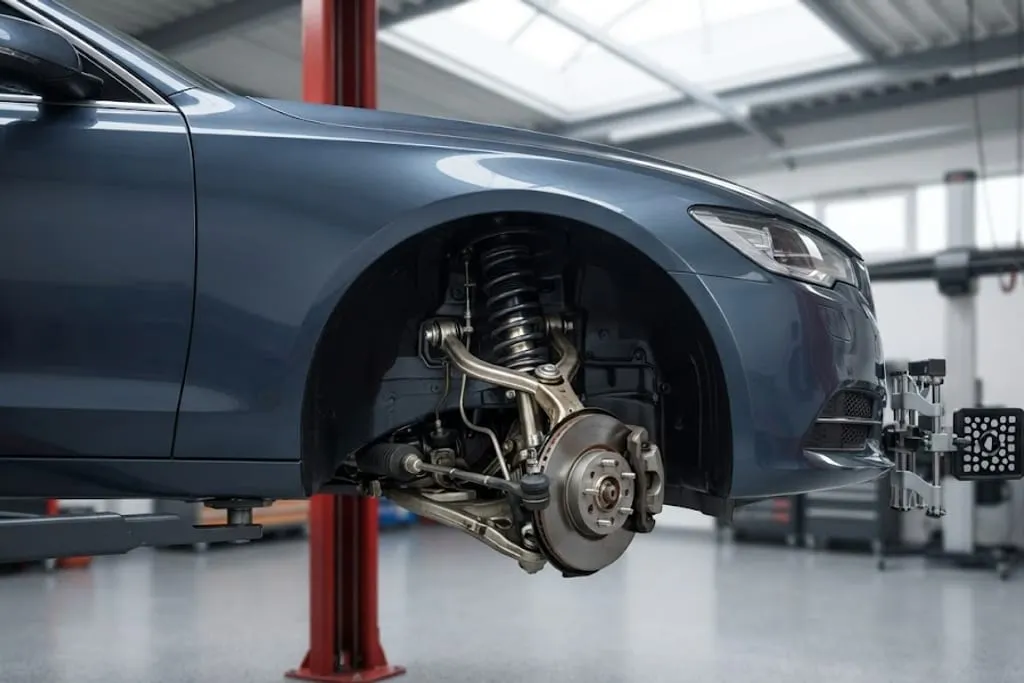
Sprung mass is everything the springs carry — body, powertrain, occupants. Unsprung mass is what they do not: wheels, tyres, brakes, hubs and roughly half of each suspension arm.
The ratio between them is what makes a suspension good or bad. A bump accelerates the unsprung mass directly, and the heavier it is the further the wheel is thrown and the longer the tyre spends off the road. Nothing works while the tyre is in the air — not grip, not braking, not steering. This is why aluminium hub carriers, inboard brakes and light wheels buy far more than their mass suggests, and why an unsprung kilogram is often said to be worth several sprung ones.
The alignment angles

| Angle | What it is | What it buys | What it costs |
|---|---|---|---|
| Camber | Wheel tilt from vertical, front view | Negative camber keeps the tyre flat as the body rolls | Inner edge wear, smaller patch in a straight line |
| Caster | Steering axis tilt, side view | Self-centring, straight-line stability, camber gain on turn | Heavier parking effort, more kickback |
| Toe | Convergence of the wheels, plan view | Compensates compliance so running toe is near zero | Very fast tyre wear if wrong |
| KPI / SAI | Steering axis tilt, front view | Self-centring by lifting the car as it steers, and sets scrub radius | Camber loss on the outside wheel with steering |
| Scrub radius | Offset at road level between axis and patch | Controls how contact-patch forces feed back into the steering | Wrong sign makes a failure steer the car badly |
| Ackermann | More steer angle at the inner wheel | Both wheels roll about one turn centre | Only correct at low speed; slip angles change the requirement |
Caster deserves the extra sentence. Tilting the steering axis rearwards means it strikes the road ahead of the contact patch, so the tyre is dragged behind it like a supermarket trolley castor and naturally trails into line. That trail distance is where steering feel comes from, and it is also why more caster gives useful negative camber to the outside wheel as the wheel is steered — a free gain exactly where it is wanted.
Suspension architectures, roll and weight transfer
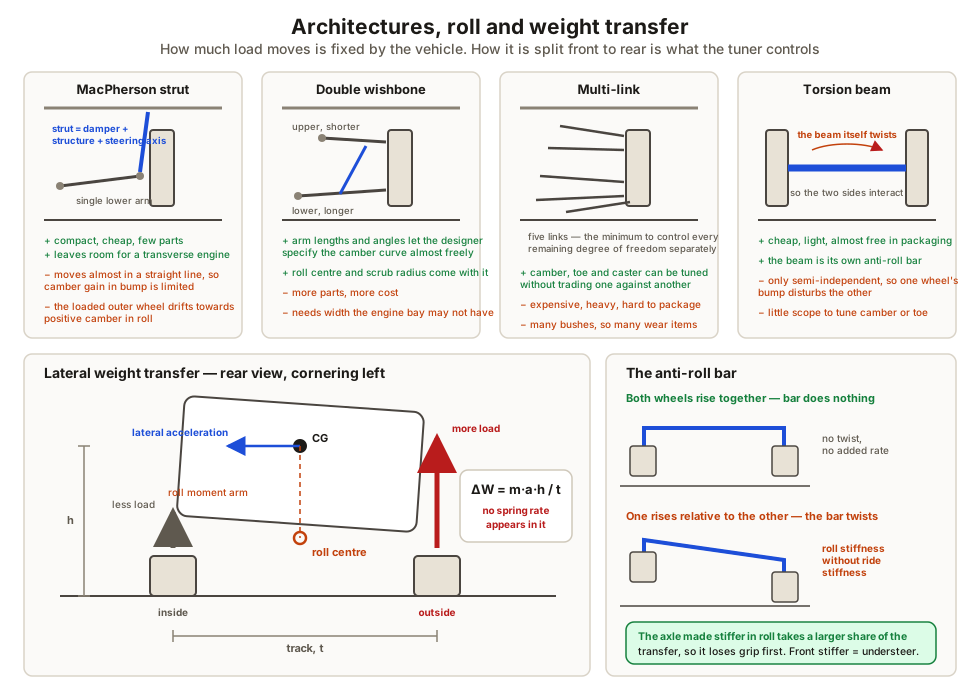
MacPherson strut — one lower arm and a strut that is both damper and structural member, and also the upper part of the steering axis. Compact, cheap, few parts, leaves room for a transverse engine. Because the strut moves in nearly a straight line, camber gain in bump is limited and the loaded outside wheel tends towards positive camber in roll.
Double wishbone — upper and lower arms whose lengths and angles let the designer specify the camber curve, the roll centre and the scrub radius almost independently. More parts, more cost, more width.
Multi-link — typically five links, which is the minimum to control all remaining degrees of freedom separately, so camber, toe and caster can be tuned without trading against each other. Expensive and hard to package; standard on anything with a serious ride and handling brief.
Torsion beam — a rear cross member that twists, so the two sides interact. Cheap, light, and almost free in packaging terms, which is why it survives on small front wheel drive cars despite being only semi-independent.
Weight transfer
Lateral load transfer is:
ΔW = m · ay · h / t
where h is centre of gravity height and t is track width. Longitudinal transfer under braking is the same expression with wheelbase in place of track.
The point that trips people up: the springs do not appear in it. Softer springs make the car roll further and dive more, but the same load moves. That is why lowering a car reduces transfer genuinely and stiffening a spring does not, and why a stiffer spring changes the balance rather than the total.
What the tuner controls is the split. Make one axle stiffer in roll — by spring, by anti-roll bar or by raising its roll centre — and that axle takes a larger share of the total transfer, so its tyres are more unevenly loaded and it reaches its limit first. Stiffer at the front means more understeer; stiffer at the rear means more oversteer. That single lever explains most chassis tuning.
Understeer, and why it is deliberate
A tyre generates side force by running at a slip angle — the difference between where it points and where it actually goes. Understeer means the front slip angles are larger than the rear, so the car turns less than the steering asks for. Oversteer is the reverse.
Almost every road car is built to understeer, and the reason is the driver’s instinct. Faced with a car that will not turn, an untrained driver lifts off. That slows the car and transfers load forward onto the front tyres, which is exactly the correct response. Faced with the rear letting go, the same instinct makes it worse, and the correction required — steer into the slide, hold the throttle — is the opposite of what feels natural. Stability control exists largely to intervene in that second case, braking individual wheels to generate a yaw moment that pulls the car straight.
What the suspension does to the tyre is only half the story; the other half is braking systems and hydraulics, which is where load transfer turns into stopping distance.
What to take away
- Unsprung mass matters out of proportion — the tyre cannot work while it is airborne.
- The spring sets ride height and rate; the damper controls the motion and is usually asymmetric in bump and rebound.
- Negative camber keeps the tyre flat under roll; caster provides self-centring and camber gain when steered.
- Toe compensates compliance, and small errors destroy tyres.
- Scrub radius is a lever arm; its sign decides how a braking or tyre failure steers the car.
- Ackermann puts both front wheels on one turn centre, correctly only at low speed.
- Load transfer = m · a · h / track (or wheelbase). Springs are not in the equation.
- An anti-roll bar adds roll stiffness without ride stiffness, and shifts the transfer split.
- Making an axle stiffer in roll makes that end lose grip first — the main handling tuning lever.
- Understeer is built in on purpose because the instinctive reaction to it is the correct one.
Check your understanding
10 questions. Nothing is recorded — this is just for you.