
Automotive
Fuel injection, PFI and GDI
Why moving the injector from the port into the cylinder raises compression ratio and fuel pressure by two orders of magnitude, what stratified charge buys and costs, why GDI engines make soot and need a particulate filter, and how lambda control and fuel trims actually work.
Moving a petrol injector about eighty millimetres — from the inlet port into the combustion chamber — raises the fuel pressure by two orders of magnitude, adds a mechanical high pressure pump driven off the camshaft, buys a compression ratio point, and creates a soot problem the engine never had. Almost nothing about direct injection is a free improvement, which is why the two systems now often appear on the same engine.
What the mixture has to be, and why
Combustion is a chemical reaction with a fixed recipe. For petrol it takes roughly 14.7 kg of air to burn 1 kg of fuel with nothing left over, and that ratio is called stoichiometric. Because the exact figure moves with fuel composition — an ethanol blend needs proportionally more fuel — control systems do not work in the ratio itself. They work in lambda:
λ = actual air / air required for complete combustion
So λ = 1 is stoichiometric, λ < 1 is rich (excess fuel) and λ > 1 is lean (excess air). The same control logic then works on any fuel.
Port injection against direct injection
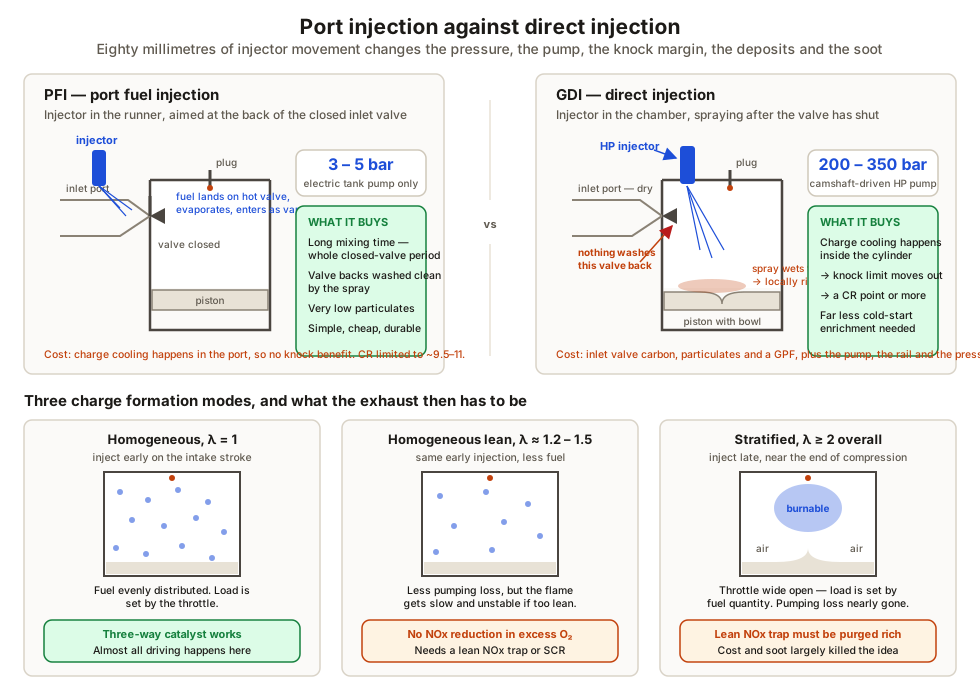
| Port injection, PFI | Direct injection, GDI | |
|---|---|---|
| Sprays into | The port, at the back of the closed inlet valve | The combustion chamber |
| Fuel pressure | 3 to 5 bar, electric pump only | 200 to 350 bar, camshaft driven high pressure pump |
| Time to mix | The whole valve closed period plus the intake stroke | A few milliseconds |
| Charge cooling | Happens in the port, cools air before it is measured | Happens in the cylinder, after the valve shuts |
| Compression ratio | 9.5 to 11 typical | A point or more higher |
| Inlet valve backs | Washed clean by the spray | Accumulate hard carbon |
| Particulates | Very low | High enough to need a filter |
| Cold start | Needs enrichment, fuel condenses on cold walls | Can inject late and light a rich cloud, so far less enrichment |
The charge cooling row is where the compression ratio comes from. Evaporating fuel absorbs latent heat. In a port injected engine that heat leaves the port air, some of which is then lost to the walls. In a direct injected engine it comes out of the trapped charge after the valve has shut, so the mixture at the point of ignition is genuinely cooler and denser and the knock limit moves out.
Charge formation modes
Homogeneous stoichiometric is the normal case: inject early on the intake stroke so the fuel has as long as possible to distribute, and hold λ = 1 so the catalyst works. Almost all driving happens here.
Stratified injects late, near the end of compression, so a small burnable cloud sits at the spark plug — usually shaped by a bowl in the piston or by the tumble of the intake charge — while the rest of the cylinder holds essentially air. Overall the mixture can be λ = 2 or leaner, the throttle can stay open, and the pumping loss largely disappears.
The reason it is not universal is the exhaust. A three way catalyst cannot reduce nitrogen oxides in excess oxygen, so a stratified engine needs a lean NOx trap, which must be purged rich periodically, or selective catalytic reduction with urea. The extra hardware, the sulphur sensitivity and the soot largely swallowed the benefit, and most manufacturers retreated to homogeneous operation with heavy exhaust gas recirculation instead.
Closed loop control, and what the trims are telling you
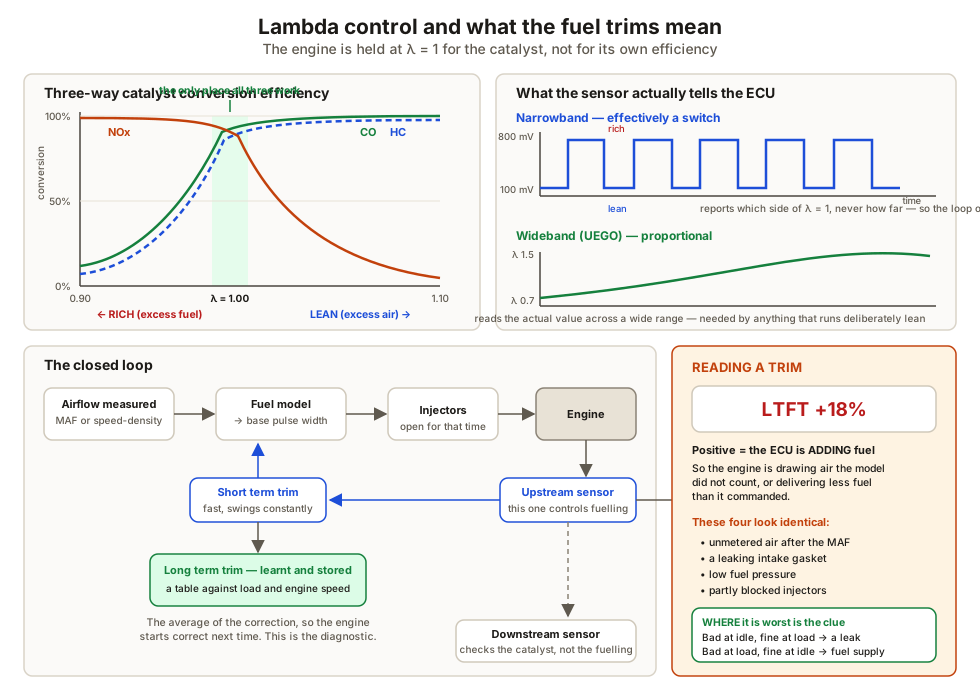
The ECU calculates a base pulse width from its airflow measurement and its fuel model, then corrects it from what the upstream oxygen sensor reports:
- A narrowband sensor is effectively a switch. It swings between roughly 100 mV (lean) and 800 mV (rich) and tells the ECU only which side of stoichiometric the exhaust is on. The control loop deliberately oscillates across λ = 1 because of this, which also suits the catalyst’s oxygen storage.
- A wideband (UEGO) sensor reports the actual lambda proportionally across a wide range, which is what any engine that has to run deliberately lean or rich needs.
Short term fuel trim is the fast correction, swinging a few per cent either way many times a second. That movement is normal and means the loop is closed and working.
Long term fuel trim is the average of that correction, learnt and stored in a table against load and engine speed so the engine starts correct next time. It is the diagnostic number.
The mixture the loop is chasing only exists because of what the valves let in, which is why valvetrain and variable valve timing and this topic are really two halves of one control problem.
A word on diesel injection
The diesel case is different in kind, not in degree, because injection is the combustion control. There is no throttle and no mixture to hold — load is set purely by how much fuel is injected into a cylinder full of air. Common rail systems decouple pressure from engine speed and run 1800 to 2500 bar, with several injections per cycle: a small pilot to soften the pressure rise and quieten the engine, the main event, and sometimes a post injection used to raise exhaust temperature and burn off the particulate filter. Everything else about a modern diesel — the soot against nitrogen oxide trade, the exhaust gas recirculation rate, the noise — is downstream of how that injection is shaped.
What to take away
- λ = 1 is held for the catalyst, not for efficiency.
- A three way catalyst only converts all three pollutants inside a narrow window around stoichiometric.
- PFI sprays at the back of the closed inlet valve at 3 to 5 bar and has plenty of time to mix.
- GDI sprays into the cylinder at 200 to 350 bar with milliseconds to work with.
- In-cylinder charge cooling is where GDI’s extra compression ratio comes from.
- GDI’s two costs are carbon on the inlet valves and particulates; dual injection answers both.
- Stratified charge escapes throttling but breaks the catalyst, so it needs lean NOx aftertreatment.
- A narrowband sensor is a switch; a wideband sensor reports lambda proportionally.
- Short term trim should move; long term trim is the learnt correction and the diagnostic.
- In a diesel, injection is the combustion control, and common rail runs 1800 to 2500 bar with pilot, main and post events.
Check your understanding
10 questions. Nothing is recorded — this is just for you.