
Automotive
Case hardening and surface engineering
Carburising, nitriding, induction and flame hardening compared, what case depth really means, why compressive residual stress is the point, and where plating and coatings help or cause hydrogen embrittlement.
Standards referencedISO 2639ISO 18203ISO 15787ASTM B849ISO 4042
A gear tooth has two incompatible jobs. Its flank must resist contact wear, which wants hard material. Its root must survive shock loading, which wants tough material. Through-hardening gives you the first and loses the second.
Case hardening solves it by making one part metallurgically two materials.
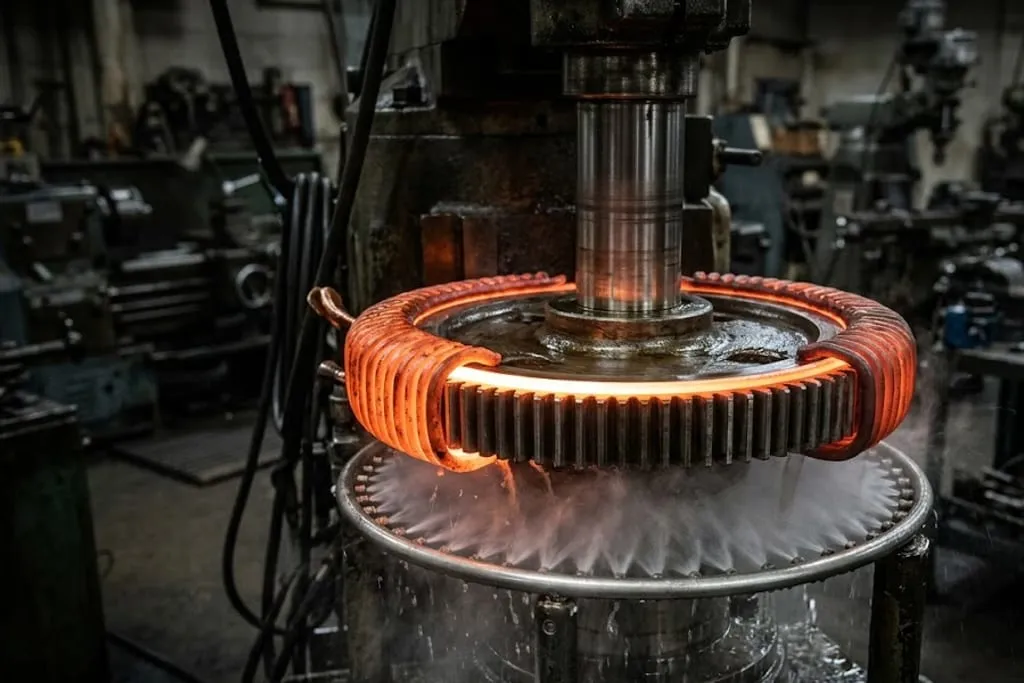
The four routes
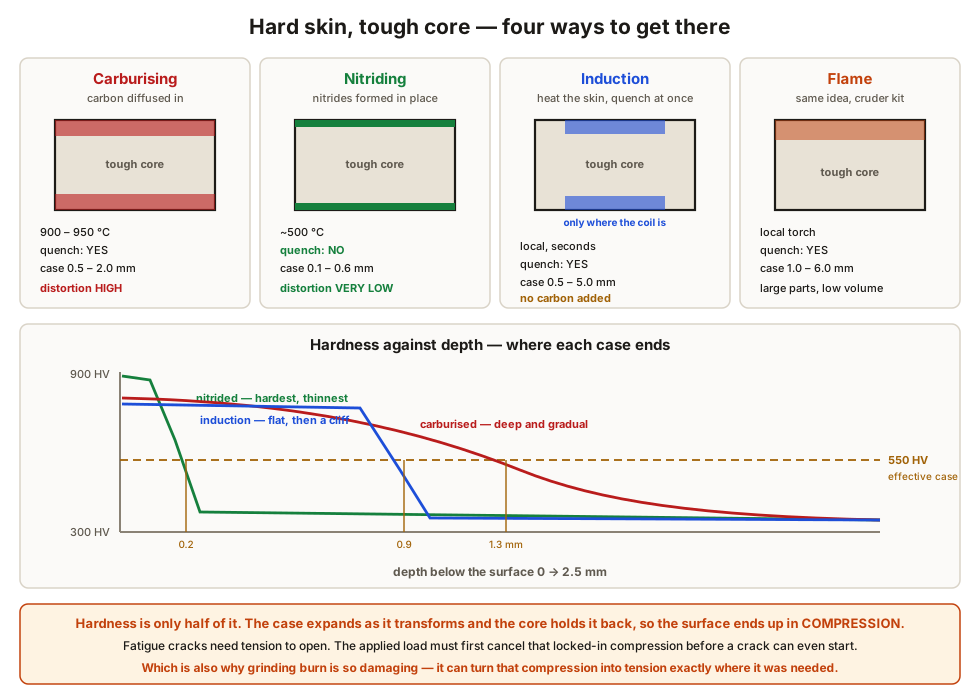
| Process | Temp | Quench | Case depth | Distortion | Suits |
|---|---|---|---|---|---|
| Carburising | 900 – 950 °C | Yes | 0.5 – 2.0 mm | High | Gears, heavy contact loads |
| Nitriding | ~500 °C | No | 0.1 – 0.6 mm | Very low | Crankshafts, dies, finished parts |
| Induction | Local, seconds | Yes | 0.5 – 5.0 mm | Moderate, local | Journals, shafts, selected areas |
| Flame | Local | Yes | 1.0 – 6.0 mm | Moderate | Large parts, low volume, ways |
Carburising adds carbon. The part starts as a low carbon steel that cannot harden much on its own; holding it hot in a carbon-rich atmosphere enriches the outer layer, and the quench then hardens that layer while the low-carbon core stays tough.
Nitriding forms hard nitrides at around 500 °C — below the transformation temperature, so there is no phase change and no quench. The part barely moves.
Induction and flame hardening add no chemistry at all. They heat a surface layer fast and quench it before the heat reaches the core, so the steel must already contain enough carbon to harden by itself.
The part nobody mentions — compressive residual stress
Hardness is only half of why a case works.
The case expands as it transforms, and the core restrains it. The surface ends up locked in compression. Fatigue cracks start at the surface and need tension to open — so the applied load has to first cancel that built-in compression before a crack can even begin.
On a gear root or a spring, that residual stress contributes as much fatigue life as the hardness does. It is also why shot peening works: each impact stretches the surface, the surrounding material resists, and compression is left behind. A purely mechanical route to the same benefit, which is why it goes exactly where cracks start.
Case depth means a specific thing
Hardness does not stop at an edge; it falls away gradually. So a case has no natural boundary and one has to be defined by a number.
- Effective case depth — the depth at which hardness falls to a stated limit, commonly 550 HV. This is what drawings normally mean.
- Total case depth — where the hardness merges into the core. A larger, different number.
Two ways to destroy a case you already paid for
Plating and coatings
Plating adds corrosion resistance or wear resistance, and brings one serious hazard with it.
What to take away
- Case hardening makes one part two materials — hard skin, tough core.
- Carburising adds carbon to a low-carbon steel, then quenches. Deep case, high distortion.
- Nitriding needs no quench, so it suits finished parts. Thin case, long cycle.
- Induction and flame add no chemistry — the steel must already have the carbon.
- The case ends up in compressive residual stress, and that is half of why it resists fatigue.
- Shot peening gets the same compression mechanically.
- Effective case depth is measured to a hardness limit, usually 550 HV. Say which you mean.
- Grinding burn can reverse the residual stress; over-grinding removes the case entirely.
- Bake high strength parts after plating or risk delayed hydrogen embrittlement fracture.
Check your understanding
10 questions. Nothing is recorded — this is just for you.