
Automotive
Battery cells, chemistries and packs
What separates LFP from NMC and NCA, why cell format changes how a pack is cooled and repaired, how cells become modules and packs, and what thermal runaway actually is.
Standards referencedUN 38.3ISO 6469-1IEC 62660-2SAE J2464
A traction battery is a few thousand small energy stores wired into one large one. Almost every difficulty in designing, cooling, managing and repairing a pack follows from that one sentence — because the pack can only ever be as good as its worst cell.

The cell is where everything starts
A lithium-ion cell is a sandwich. Lithium ions move from one electrode to the other through an electrolyte during discharge, and back during charge. The electrons cannot take that route, so they go round the external circuit instead, which is the useful part.
| Part | What it does | Typical material |
|---|---|---|
| Cathode | Holds lithium when discharged; sets most of the cell’s character | LFP, NMC, NCA |
| Anode | Holds lithium when charged | Graphite, sometimes with silicon |
| Electrolyte | Carries ions between them | Organic solvent with a lithium salt |
| Separator | Keeps the electrodes apart while letting ions through | Porous polymer film |
Nearly everything people mean by “the chemistry” is the cathode. That is what the abbreviations refer to.
LFP, NMC and NCA
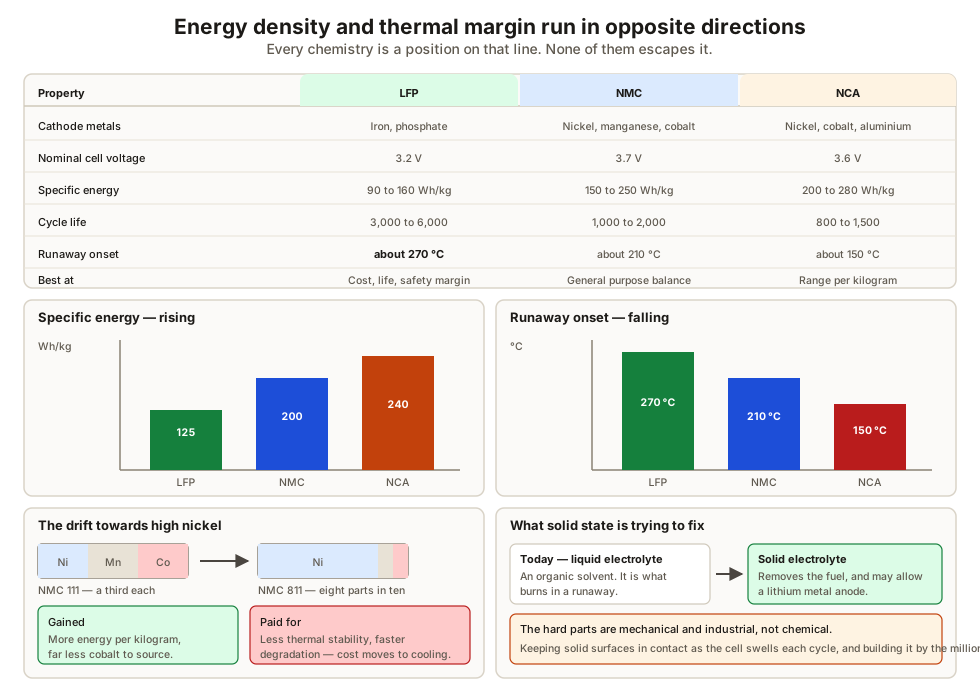
LFP — lithium iron phosphate. No cobalt, no nickel. Lower energy density, so the pack is heavier and bulkier for a given range. In exchange it cycles several thousand times instead of one to two thousand, costs less, and begins to decompose around 270 °C rather than 210 °C. Its decomposition also releases much less oxygen, so a runaway is slower and less violent.
NMC — nickel manganese cobalt. The general-purpose choice. Higher energy density than LFP, and the ratio between the three metals is a design lever rather than a fixed recipe.
NCA — nickel cobalt aluminium. Highest energy density of the three, shortest cycle life, and the least thermal margin. Used where range per kilogram matters most.
Thermal runaway
Runaway is not simply overheating. It is a reaction that feeds itself.
Above an onset temperature the cell chemistry starts to break down, and that breakdown is exothermic. The heat raises the temperature further, which speeds up the breakdown, which releases more heat. Once the loop closes, removing whatever started it changes nothing — the cell is now its own heat source.
Three things can start it:
- Mechanical — a crush or puncture creating an internal short.
- Electrical — overcharge, or an external short.
- Thermal — external heating, most often a neighbouring cell already in runaway.
Three formats, and why the shape matters
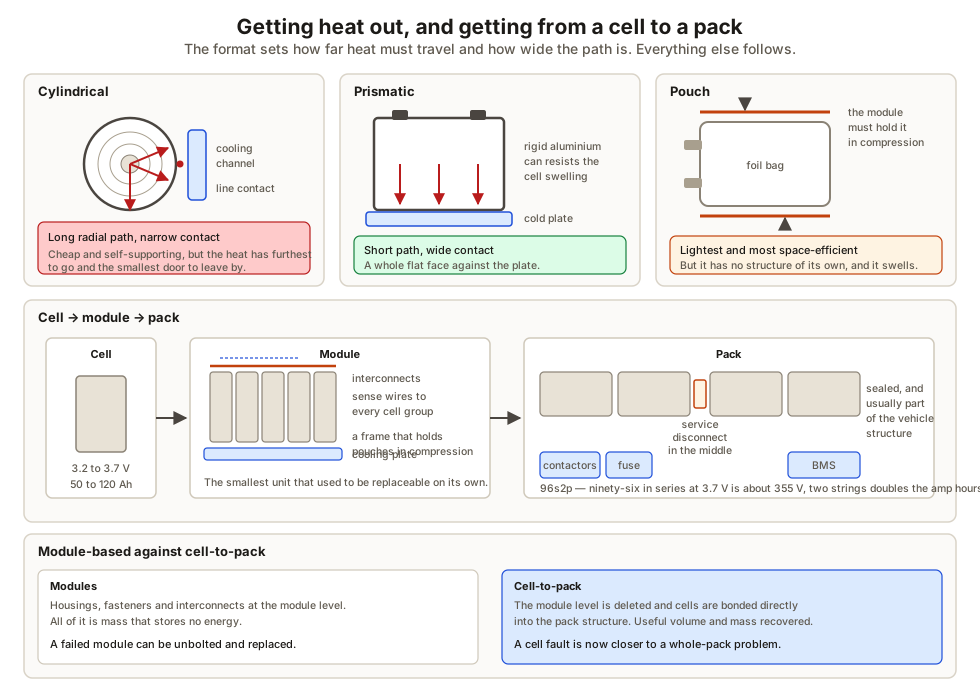
Cylindrical. A wound roll in a steel can. Cheap, mechanically self-supporting, extremely well understood. The difficulty is thermal — heat must travel radially outward to a curved surface that touches its cooling channel along a narrow line.
Prismatic. A rigid aluminium can with a large flat face. That face sits against a cold plate, giving a short, wide thermal path. The can also resists the swelling that cells undergo as they cycle.
Pouch. Electrodes in a foil bag with tabs at the edge. Lightest and most space-efficient, with good flat-face cooling, but it has no structure of its own. The module has to hold it in compression, and it must be given room to swell.
From cell to pack
The hierarchy is cell → module → pack.
A module holds cells in a frame with a cooling plate, the interconnects that join them, and the sense wires that let the management system see each cell group.
A pack holds several modules plus the contactors, the main fuse, the service disconnect, the management controller and the thermal circuit — inside a sealed enclosure that is usually also a structural member of the vehicle.
Packs are described in series and parallel counts. 96s2p means ninety-six cells in series, two such strings in parallel. Series adds voltage, parallel adds capacity:
| Series | Parallel | |
|---|---|---|
| Voltage | Adds | Unchanged |
| Capacity | Unchanged | Adds |
| 96s at 3.7 V | About 355 V | — |
| 2p of 50 Ah cells | — | 100 Ah |
Why the worst cell decides everything
A series string carries one current. Every cell in it sees the same amps.
So when the weakest cell reaches its upper voltage limit during charging, charging has to stop — even though every other cell still has room. On discharge the same cell hits its lower limit first and discharge has to stop, even though the rest have charge left.
The usable capacity of the pack is set by its worst cell, not its average. That single fact is the reason cell balancing exists, and it is taken up in battery management systems.
Cold is a charging problem, not just a range problem
Below about 5 °C the graphite anode cannot absorb lithium fast enough during a high charge current. The lithium deposits on the anode surface as metal instead — plating.
That metal does not come back. Capacity is permanently lost, and over repeated events the deposits grow structures that can eventually pierce the separator and cause an internal short.
Cell-to-pack, and what it costs
Module housings, fasteners and interconnects store no energy. Deleting the module level and bonding cells directly into the pack structure recovers a useful fraction of volume and mass.
The cost is repairability. Where a failed module could once be unbolted and replaced, a cell-to-pack assembly is closer to a single bonded unit. That shifts the economics of a pack fault from a module replacement to something much larger, and it is a live argument in the industry rather than a settled one.
Solid state
The liquid electrolyte is an organic solvent, and it is the main fuel in a runaway. Replacing it with a solid removes that fuel.
It may also permit a lithium metal anode in place of graphite, holding far more charge for its mass, because a solid electrolyte can resist the growth of the lithium structures that would otherwise short the cell.
The unsolved problems are mechanical and industrial rather than chemical — keeping solid surfaces in intimate contact as the cell swells and shrinks through every cycle, and manufacturing the thing by the million at a competitive price.
What to take away
- The cathode is what people mean by the chemistry. LFP trades energy density for safety margin, cycle life and cost; NCA trades in the opposite direction; NMC sits between them.
- Runaway feeds itself. Containment is about stopping one cell taking its neighbours, not about preventing the first failure.
- Cell format decides the thermal path. Flat faces against a cold plate beat a line contact on a curved can.
- Series adds voltage, parallel adds capacity, and the worst cell in a series string limits the whole pack.
- Charging a cold pack hard plates lithium onto the anode permanently. That is why the vehicle warms the pack before accepting full current.
- Cell-to-pack buys energy density and spends repairability.
Next, the electronics that watch every one of those cells — battery management systems.
Check your understanding
10 questions. Nothing is recorded — this is just for you.