Process
Water and effluent — the largest flow on the plant, and none of it is product
Why boiler feed water needs to be purer than anything else on site, what cooling tower chemistry is actually managing, and why effluent problems announce themselves months late.
Water is usually the largest mass flow on a site by a wide margin, and almost none of it is product. It arrives needing treatment, does several jobs at different qualities, and leaves needing treatment again.
It also gets far less attention than it warrants, right up until it stops a plant.
Several systems, several qualities
| Raw water intake | Whatever the river, sea or borehole provides | Screening, clarification, filtration | Everything downstream inherits what is missed here |
|---|---|---|---|
| Service and potable water | Drinking standard for potable, lower for service | Filtration and disinfection | Cross-connection with process water is a serious finding |
| Cooling water, recirculating | Controlled scaling, corrosion and biological growth | Inhibitors, biocide, and continuous blowdown | Fouled exchangers, or Legionella growth in the tower |
| Boiler feed water | Very high purity — conductivity in microsiemens | Demineralisation, deaeration, chemical dosing | Scale, tube failure, or carryover into the steam system |
| Condensate return | Already pure, if nothing has contaminated it | Polishing, and monitoring for process ingress | One leaking exchanger can contaminate the whole boiler system |
| Process water | Whatever the process demands, sometimes very pure | Demineralisation, or further to purified water in pharma | In pharma this is a validated system with its own standards |
| Effluent | Whatever the discharge consent permits | Separation, biological treatment, monitoring | Exceeding consent is a reportable regulatory breach |
No rows match that filter.
Water is usually the largest mass flow on a site by a wide margin, and almost none of it is product. It arrives needing treatment, does several jobs at different qualities, and leaves needing treatment again — and each of those steps is a plant in its own right.
The important point is that these are not one water system. Each has its own quality requirement, its own treatment and its own failure modes — and connecting two of them incorrectly causes problems that are expensive and slow to undo.
Boiler feed water: the purest water on site
A boiler continuously evaporates water and leaves everything dissolved in it behind. Even small concentrations therefore build up over time.
The consequences are:
- Scale on the tubes, insulating them so the metal runs hotter — the same self-accelerating mechanism as coking in a fired heater.
- Corrosion, particularly from dissolved oxygen, which is why feed water is deaerated before it goes anywhere near a boiler.
- Carryover, where high dissolved solids cause foaming and liquid is carried into the steam — depositing in turbines and control valves downstream.
So feed water is demineralised, deaerated, chemically dosed, and the boiler is continuously blown down to stop solids concentrating past their limit. Blowdown is a deliberate, continuous loss, and its rate is a controlled variable rather than a leak.
Cooling water: a chemistry problem, not a flow problem
Most plants use a recirculating system with a cooling tower rather than taking water once through. Water absorbs heat from the exchangers, is cooled by evaporation in the tower, and goes round again.
Evaporation is what does the cooling — and it leaves dissolved solids behind, exactly as a boiler does. So the circuit concentrates, and blowdown controls how far.
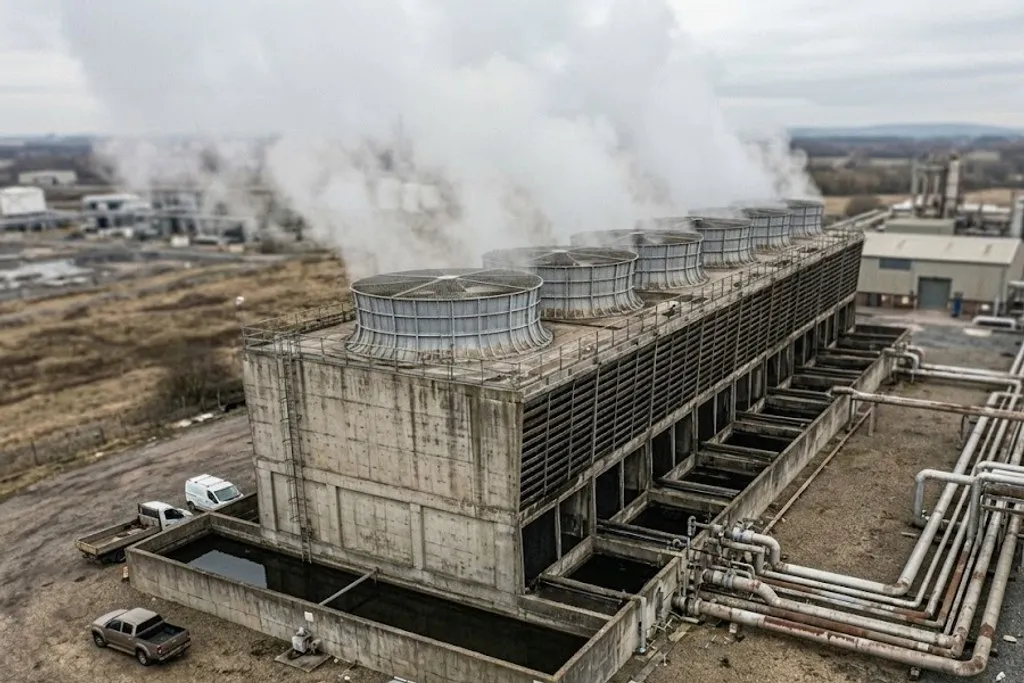
Three things are being managed continuously, and they pull against each other:
- Scaling — concentrate too far and hardness precipitates on the hot exchanger surfaces.
- Corrosion — treat too aggressively for scale and you attack the metal instead.
- Biological growth — warm, aerated, nutrient-rich water is ideal for it, and biofilm both insulates and drives under-deposit corrosion.
Fouled cooling water is also invisible in the way that matters: it shows up as exchangers slowly losing duty across the whole plant, which gets attributed to almost anything else first.
Effluent
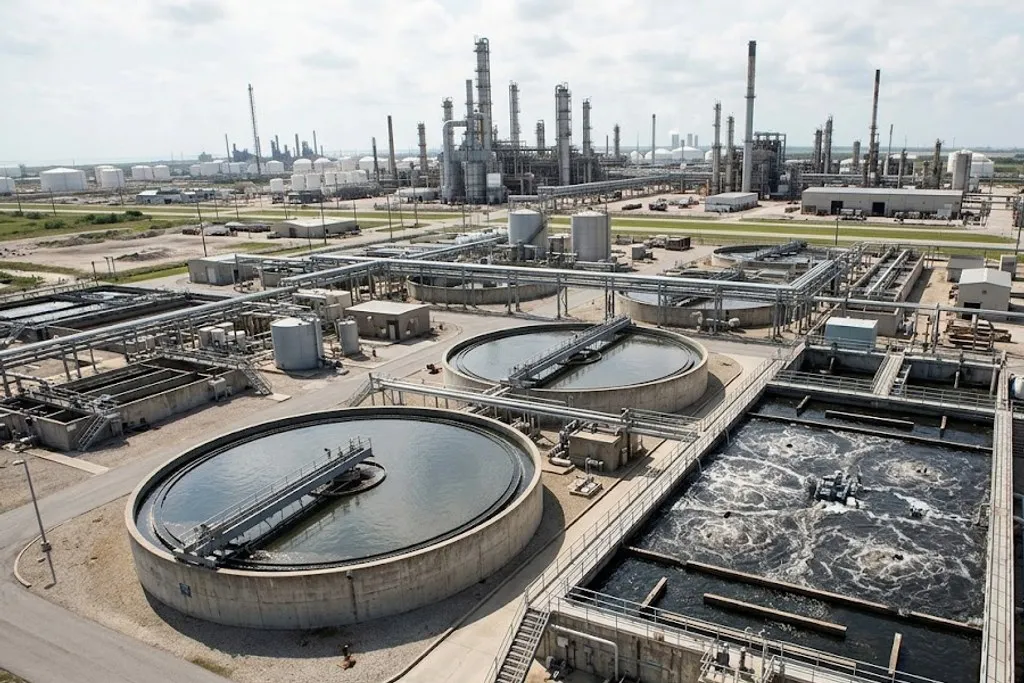
Everything eventually leaves, and what leaves is governed by a discharge consent — a legal limit on flow, and on the concentration of whatever the regulator cares about.
The separated drainage systems described in plant layout exist so that only genuinely contaminated water reaches treatment. What arrives there is typically handled in stages:
- Physical separation — interceptors and separators removing free oil and solids.
- Chemical treatment — neutralisation, flocculation, dissolved air flotation.
- Biological treatment — a living population of organisms consuming dissolved organic material.
- Final monitoring — continuous measurement before discharge.
| Scaling | Exchangers, boiler tubes, cooling tower fill | Hardness precipitating as water is concentrated or heated | Falling heat transfer, rising pressure drop |
|---|---|---|---|
| Corrosion | Cooling water circuits and boiler systems | Dissolved oxygen, low pH, or inhibitor allowed to run low | Tube leaks, often first seen as contamination elsewhere |
| Biological fouling | Cooling towers and low-velocity exchanger circuits | Warm nutrient-rich water and insufficient biocide | Slime, blocked tubes, and under-deposit corrosion |
| Legionella growth | Cooling towers, and any warm stagnant water | Temperature in the growth range plus poor control | Detected by sampling — this is a public health matter |
| Boiler carryover | Steam system downstream of the drum | High dissolved solids, foaming, or level control problems | Wet steam, deposits in turbines and control valves |
| Condensate contamination | The returned condensate header | A leaking exchanger putting process fluid into the steam side | Conductivity rising at the return — a monitored alarm |
| Oil in effluent | The oily water system | A leak or drain upstream, or an interceptor beyond capacity | Sheen at the outfall, and a consent exceedance |
| Biological treatment upset | The effluent plant | A slug of toxic or strong material killing the biomass | Treatment performance collapsing for weeks while it recovers |
No rows match that filter.
Water problems are slow. Nothing fails on the day the chemistry drifts — the consequence arrives months later as a fouled exchanger, a failed boiler tube or a discharge that has quietly gone out of consent. That delay is exactly why the monitoring exists.
Why water problems arrive late
Almost nothing in this topic fails on the day it goes wrong.
Chemistry drifts for weeks. Scale builds over months. Corrosion runs invisibly until a tube leaks. Biofilm accumulates until an exchanger’s duty is measurably down. A biological plant declines gradually and then fails.
That delay is precisely why these systems are monitored continuously and trended rather than checked when something looks wrong — by the time anything looks wrong, the cause is months behind you.
What to take away
- Water is the largest flow on the plant and none of it is product.
- Boiler feed must be pure because evaporation concentrates everything left behind.
- Rising conductivity on the condensate return is a leaking exchanger until proved otherwise.
- Cooling water chemistry balances scaling, corrosion and biological growth against each other.
- Legionella control is a public health obligation, not housekeeping.
- A biological effluent plant can be killed by one slug, and takes weeks to recover.
- Water problems are slow. Trend them, because the symptom arrives long after the cause.
Check your understanding
10 questions. Nothing is recorded — this is just for you.