Mechanical
Storage tanks — the simplest equipment with the largest consequences
Why the vapour space is the whole design question, how a tank breathes, why overfill protection must be independent of the gauge, and why a tank is far weaker against vacuum than pressure.
Standards referencedAPI 650API 620API 653API 2350IEC 60079-32
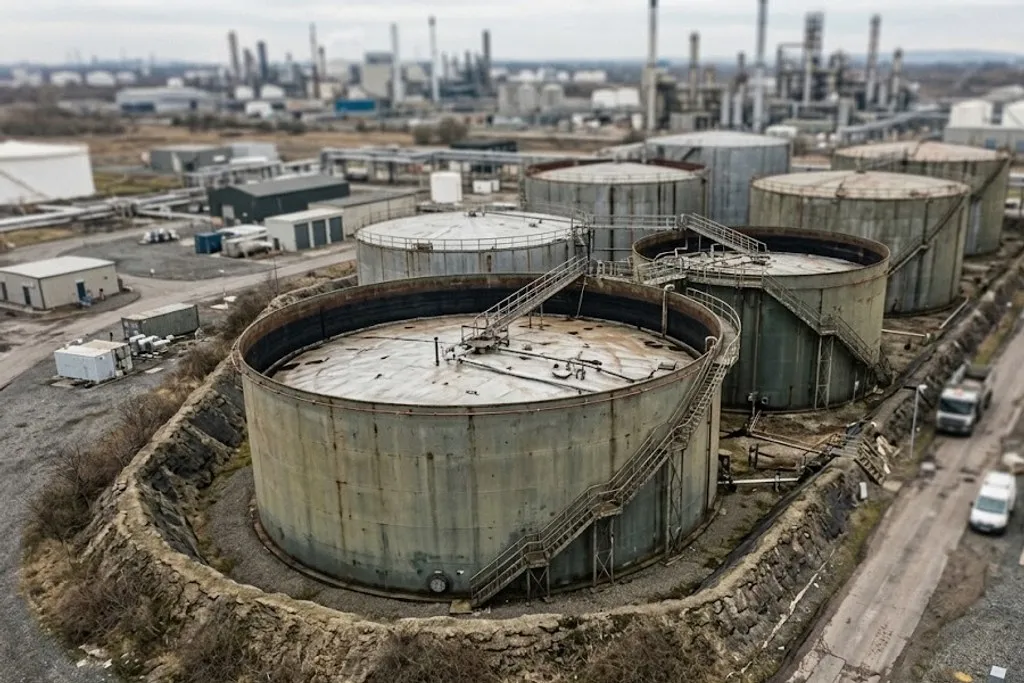
A storage tank is the simplest-looking equipment on a site — a large welded steel cylinder holding liquid at atmospheric pressure. It is also responsible for several of the largest incidents the industry has had.
The reason is scale. Everything else on a plant holds a few cubic metres in a pipe or a vessel. A tank farm holds the inventory.
The vapour space is the whole question
| Fixed roof, cone or dome | A permanent roof with a vapour space beneath it | Low volatility products — water, diesel, heavy oils | Breathing losses, and a vapour space that may be flammable |
|---|---|---|---|
| Fixed roof with blanketing | The vapour space is held under nitrogen | Products needing protection from air, or kept out of the flammable range | Blanketing gas supply becomes a safety system |
| External floating roof | The roof floats on the liquid, so there is no vapour space | Volatile products — crude, gasoline, naphtha | Rim seals degrade; rainwater must drain off the roof |
| Internal floating roof | A floating deck inside a fixed roof | Volatile products where weather or dust must be kept out | The space above the deck needs ventilation and gas detection |
| Dome roof over floating deck | A fixed geodesic dome over an internal floater | Retrofits, and sites with heavy rain or snow | Access for inspection is more restricted |
| Pressure storage, sphere or bullet | A pressure vessel, not a tank — contents kept liquid under pressure | LPG, butane, propane | A different code, different relief, and a very different hazard |
No rows match that filter.
The whole question is the vapour space. A fixed roof leaves a volume of air and vapour above the liquid that breathes in and out with temperature and level — losing product, and sometimes sitting in the flammable range. Floating roofs remove that space entirely.
A fixed roof leaves a volume of air and vapour above the liquid. That space causes two problems:
- It breathes. As the tank warms during the day, or fills, vapour is pushed out. As it cools, or empties, air is drawn in. That is product lost and emissions released — and it brings fresh oxygen into the tank.
- It may be flammable. Depending on the product and the temperature, the mixture in that space can sit in the explosive range.
A floating roof removes the vapour space entirely by sitting on the liquid surface. That is why volatile products — crude, gasoline, naphtha — are stored under floating roofs, and why heavier products that do not evaporate much are not.
Breathing, and the two ways it goes wrong
A fixed roof tank must be able to let vapour out and air in. That is what the pressure-vacuum (PV) valve on the roof does.
On the pressure side, emergency venting is sized for the fire case, exactly as relief devices are in vessels and relief. And the roof-to-shell joint is often deliberately frangible — designed to fail before the shell does, so an overpressure lifts the roof rather than splitting the tank and releasing the whole inventory.
Overfill
| Overfill | Product overflows the roof and forms a large vapour cloud at ground level | Independent high level alarm and trip, separate from the gauging system | The cause of several of the industry's largest vapour cloud explosions |
|---|---|---|---|
| Vacuum collapse | The tank is sucked inward and buckles as it empties or cools | Vacuum relief on the pressure-vacuum valve, kept clear | A tank is far weaker against vacuum than against pressure |
| Overpressure | Roof lifts or the shell splits as vapour is generated faster than it can vent | PV valve and emergency venting, sized for a fire case | The roof-to-shell joint is usually designed to fail first, deliberately |
| Floor corrosion | The underside of the floor corrodes where nobody can see it | Cathodic protection, a liner, and out-of-service inspection | Leaks go straight into the ground and may run undetected for years |
| Differential settlement | The tank tilts or the shell distorts as the foundation consolidates | Levelling surveys against fixed datum points | Floating roofs jam if the shell goes out of round |
| Rim seal fire | Vapour at the floating roof seal ignites, often from a lightning strike | Seal maintenance, bonding, and rim seal fire protection | The commonest tank fire, and usually survivable if caught early |
| Sunken floating roof | The roof takes on rainwater or product and sinks | Roof drains kept clear, pontoon inspection | Creates a large exposed liquid surface with no vapour control at all |
| Static ignition during filling | Charge accumulates on the liquid surface and discharges | Bonding, low initial fill velocity, bottom filling | Worst at the start of a fill, when splashing generates most charge |
No rows match that filter.
Tanks look like the simplest equipment on a site and have caused some of the largest incidents in the industry. Almost none of the failures below are exotic — they are ordinary things happening to a very large inventory.
Overfill deserves its own treatment, because it has caused several of the industry’s largest vapour cloud explosions.
The sequence is always similar. A tank is filled beyond capacity. Product cascades over the roof or out of vents. It falls as a spray, evaporates readily, and forms a large, dense vapour cloud at ground level that spreads across the site until it finds an ignition source.
What sits underneath
Two failure modes come from below the tank, where nobody can see.
Floor corrosion. The underside of the floor sits on the foundation, in contact with whatever moisture is there. It corrodes from the outside in, invisibly. A leak goes straight into the ground and can run for years before anyone notices. Defences are cathodic protection, an impermeable liner, a leak detection layer, and out-of-service inspection under API 653.
Settlement. A full tank is an enormous distributed load, which is why tanks sit on compacted pads with ring beams rather than slabs, and why they settle measurably when first filled — the point made in foundations.
Uniform settlement is tolerable. Differential settlement tilts the tank and distorts the shell, and a floating roof in an out-of-round shell will jam. That is why tanks are levelled against fixed datum points on a routine cycle.
Floating roof specifics
Rim seals close the gap between the roof and the shell. They degrade, and vapour escapes through them — which makes a rim seal fire the commonest tank fire there is, frequently started by a lightning strike. It is also usually survivable if caught early, which is why rim seal fire protection exists.
Roof drainage takes rainwater off the roof through a flexible drain to the shell nozzle. Block that drain and water accumulates until the roof sinks — leaving a large exposed liquid surface with no vapour control at all.
Static during filling is a real ignition source, particularly at the start of a fill when splashing generates most charge. Bonding, low initial velocity and bottom filling are the controls, as covered in earthing and bonding.
What to take away
- The vapour space is the design question. Floating roofs remove it; fixed roofs breathe.
- A tank is far weaker against vacuum than pressure. The vacuum side of the PV valve is the one that folds it flat.
- The roof-to-shell joint is often deliberately the weak point, so overpressure lifts the roof rather than splitting the shell.
- Overfill protection must be independent of the gauge, or one failure removes both the warning and the defence.
- Floor corrosion and settlement happen where nobody can see.
- Keep roof drains clear and rim seals maintained.
Check your understanding
10 questions. Nothing is recorded — this is just for you.