
Mechanical
Scaffold access and handover tags — access as a scheduled resource
Why access is a resource with dates rather than a condition of the site, what a scaffold tag actually certifies and what it does not permit, why an untagged scaffold is a red one, and the load class that stacking materials quietly exceeds.
Standards referencedEN 12811-1
Access is the resource that decides a piping sequence more often than crane time, welder numbers or materials, and it is the one most often left out of the plan — because it does not feel like a resource. It feels like a property of the place.
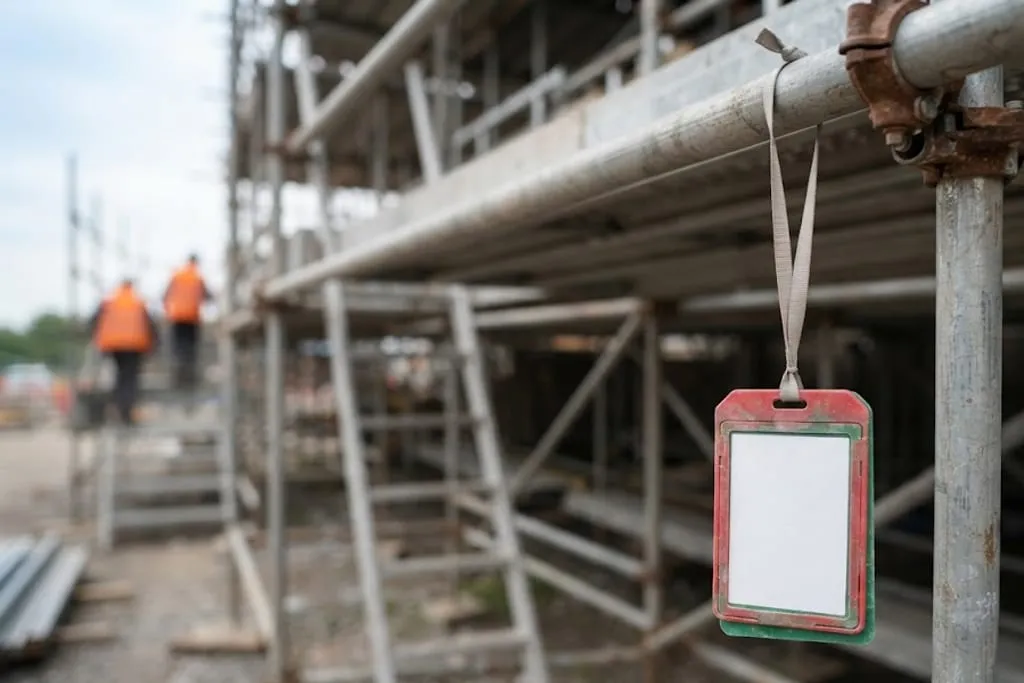
It is not. A scaffold is hired, erected, inspected, handed over, occupied, altered, re-inspected and struck. Every one of those is a date, and the dates belong to a different contractor with a different programme and somebody else’s priorities.
Access on the look-ahead
The habit worth building is to put access on the three-week look-ahead as a line of its own, alongside labour and materials. Three questions for each front of work:
| Question | Why |
|---|---|
| Does the access exist yet? | If not, it has a lead time and a request that must already be in |
| How long is it needed? | Scaffold left standing is cost; scaffold struck early is a crew standing idle |
| Who else wants it? | Insulation, painting and electrical want the same platforms, usually later |
The third is the one that bites, because the other trades’ need for your scaffold arrives after you have finished with it and after somebody has booked it to be struck.
What a tag actually certifies
A scaffold tag is a handover certificate. It records that a competent person inspected this structure, in this configuration, on this date, and that it is fit for a stated duty.
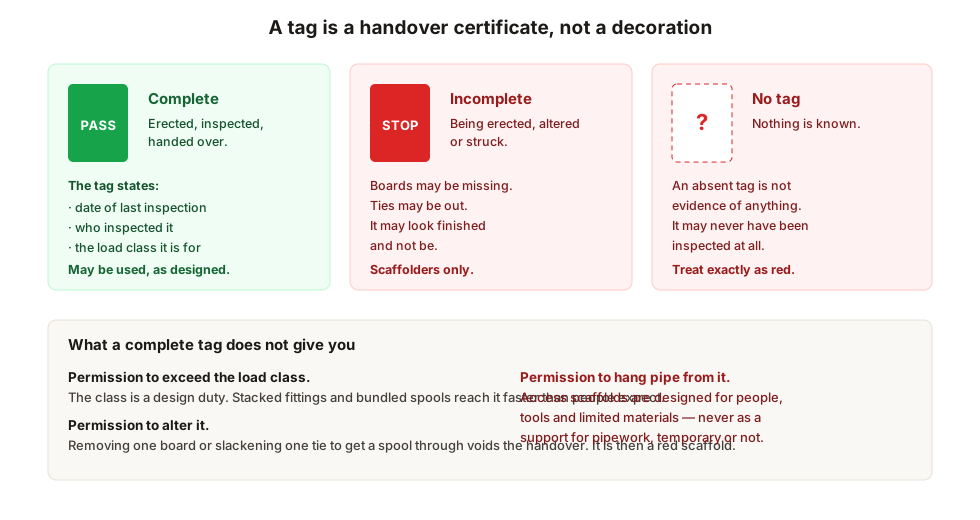
The third case is the one that causes trouble. A scaffold with no tag is frequently read as “probably fine, nobody has got round to tagging it”. It may equally be a scaffold that was never finished, or one that somebody is part way through striking. The tag is the only thing that distinguishes those, and when it is missing the distinction is unavailable.
What a complete tag does not give you
Three things, and all three get assumed.
It does not permit exceeding the load class. The class is a design duty — people, tools and a defined quantity of materials. A platform used as a staging area for fittings, bundled small bore and drums of consumables will reach its class long before it looks crowded, because materials are heavy and nobody is counting them.
It does not permit alteration. Removing one board to pass a spool through, or slackening a tie for clearance, voids the handover. What was certified no longer exists. Only a scaffolder may alter a scaffold, and only a re-inspection restores the tag.
Requesting access well
A scaffold request that says “access to line 6 inch P-1502” will produce something, and it will frequently be the wrong thing. A request that gets what is needed states four things:
- What work is being done from it — welding needs different space and different protection from bolting
- Where exactly, including the height of the working position rather than the height of the pipe
- For how long, so that it can be programmed and struck
- What has to pass through or under it, which is what prevents the alteration that voids the tag on day one
The fourth is the one experienced supervisors add and everybody else learns to add. A scaffold that boxes in the route a spool has to travel is a scaffold that will be altered before it is used.
Check your understanding
6 questions. Nothing is recorded — this is just for you.