Mechanical
Plate materials — what vessels and tanks are actually made from
A516, A240, Monel, Hastelloy and titanium — why a plate specification is not a pipe specification, what each alloy is bought to survive, and why you almost never buy a solid exotic vessel.
Standards referencedASTM A36ASTM A516ASTM A240ASTM B127ASTM B575ASTM B265ASME BPVC VIIIEN 10204EN 10164
Pipe materials covered what a grade on a line list means. This is the same question for the other half of the plant.
Pipe arrives in fixed diameters and wall thicknesses, off a shelf. Plate arrives as a flat rectangle and becomes whatever shape is wanted — a vessel shell, a tank course, a head, an exchanger shell, a base plate. Nearly every piece of equipment on a site started as plate.
Because plate is cut and formed to order, it is also where the unusual alloys appear. You will rarely meet a run of Hastelloy pipe. You will meet a Hastelloy-clad vessel.
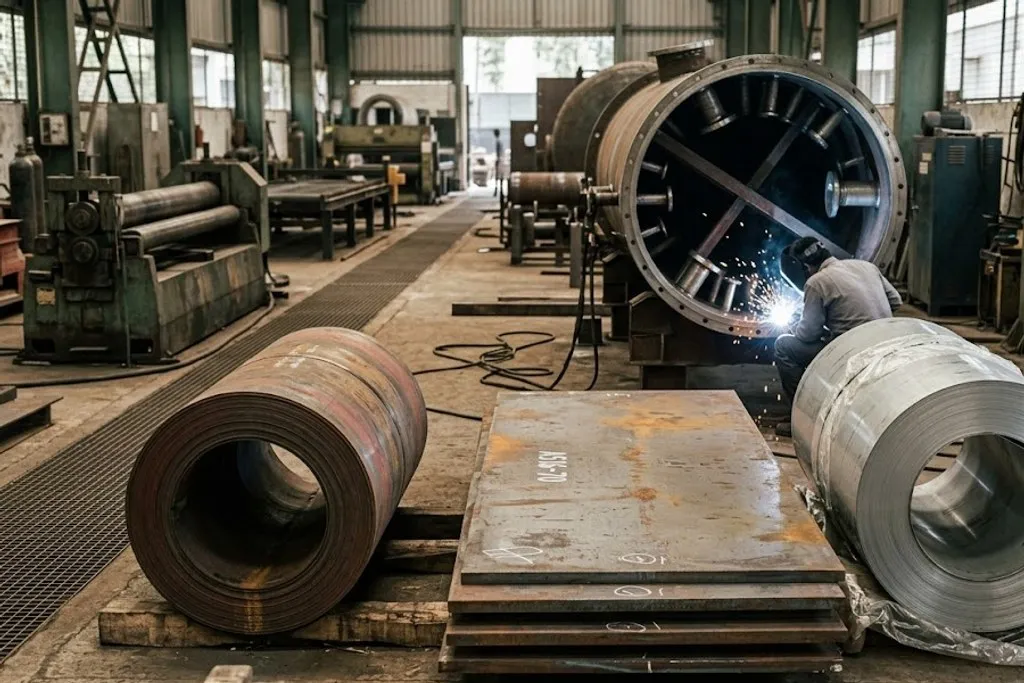
A plate specification is not a pipe specification
An ASTM specification fixes the product form as well as the metal. A106 is seamless pipe. A516 is plate. They are close relatives metallurgically and completely different documents — different manufacturing route, different tests, different tolerances.
So “A106 plate” is not a thing that can be ordered, and hearing it asked for is a reliable sign that somebody is reading across from a line list without checking.
The grades you will meet
| ASTM A36 | Structural carbon steel | Structural steelwork, base plates, brackets, non-pressure parts | Not a pressure vessel plate. Ordinary structural quality, with none of the vessel testing. |
|---|---|---|---|
| ASTM A285 Gr C | Low-strength carbon steel | Storage tank shells and low-pressure vessels | Low strength, so any real pressure needs thick sections. Largely displaced by A516. |
| ASTM A516 Gr 70 | Carbon steel, vessel quality | The default pressure vessel plate — shells, heads, exchanger shells | Untested it runs out of toughness near −29 °C. Below that it must be impact tested. |
| ASTM A537 Cl 1 | Normalised carbon-manganese steel | Where A516 lacks toughness when cold, or more strength is wanted | The heat-treated condition is the product. Welding and PWHT have to respect it. |
| ASTM A203 Gr E | 3½ % nickel steel | Cryogenic service — cold vessels and low-temperature storage | Expensive, and it buys toughness only. It is not a corrosion answer. |
| ASTM A387 Gr 11 / Gr 22 | Chromium-molybdenum alloy steel | Hot hydrogen service, hydroprocessing reactors, high-temperature vessels | Needs post-weld heat treatment, and can suffer temper embrittlement in service. |
| ASTM A240 Type 304 / 304L | Austenitic stainless | General corrosion resistance, clean utilities, cryogenic service | Chloride stress corrosion cracking — warm chlorides will crack it. |
| ASTM A240 Type 316 / 316L | Austenitic stainless with molybdenum | Chlorides and acids, and the default for pharma product contact | Better than 304 in chlorides, but still not immune to cracking in hot ones. |
| ASTM A240 UNS S32205 | Duplex stainless | Seawater and produced water, where chlorides meet a strength requirement | Embrittles if held in the wrong temperature band, and welding heat input is controlled tightly. |
| ASTM B127 UNS N04400 | Nickel-copper, commonly called Monel 400 | Hydrofluoric acid, seawater, caustic, and cold service needing toughness | Sulphur attacks it at temperature, and oxidising acids defeat it. |
| ASTM B575 UNS N10276 | Nickel-chromium-molybdenum, commonly called Hastelloy C-276 | Wet chlorine, hypochlorite, and mixed or contaminated acid service | Cost. It is rarely justified as solid plate and is usually applied as a layer. |
| ASTM B265 Gr 2 | Commercially pure titanium | Seawater, wet chlorine, bleach, and oxidising chloride service | Ignites in dry chlorine, is attacked by reducing acids, and can absorb hydrogen and embrittle. |
No rows match that filter.
Every one of these names a specification document for a product form — flat rolled plate — not a chemical formula. The allowable stress at temperature comes from ASME Section II Part D and always governs the actual design. Treat the last column as the reason the material gets rejected, because that is the conversation you will actually be in.
Read the last column first. Selecting a plate material is nearly always an argument about what the candidate material fails at, not about what it resists.
Carbon steel, then the four exceptions
Carbon steel plate is the answer most of the time, for exactly the reasons it is the answer in piping — cheap, strong, weldable everywhere, and thoroughly understood. A516 Gr 70 is the default pressure vessel plate, and the majority of vessels and exchanger shells on a site are made from it.
What pushes you off it is the same short list as piping — cold, heat, corrosion and sour service. Where plate differs is what you upgrade to, because vessels see conditions that piping is rarely asked to survive.
Monel (nickel-copper) is bought for hydrofluoric acid, seawater and caustic, and it keeps its toughness down to cryogenic temperatures. It is defeated by sulphur at temperature and by oxidising acids.
Hastelloy (nickel-chromium-molybdenum) is what is specified when the chemistry has beaten everything else — wet chlorine, hypochlorite, and mixed or contaminated acid where the composition varies and nothing else stays passive. It is extraordinarily expensive.
Titanium is the standard answer for seawater and for bleach and chlorine service, and it is the usual tube and plate material for seawater-cooled exchangers. Its failures are the least intuitive of any material on the site.
Duplex stainless sits between the stainless grades and the nickel alloys — considerably stronger than 316 and far better in chlorides, which makes it common in seawater and produced water. The cost is in the welding, where heat input has to be controlled within a narrow band to keep the two-phase structure balanced.
You almost never buy a solid alloy vessel
This is the practical point that governs most of what you will actually see fabricated.
Corrosion resistance is a surface property. Strength is a bulk property. They can therefore be bought separately — a few millimetres of expensive alloy on the wetted face, and carbon steel behind it doing the structural work.
That is done in one of two ways:
- Clad plate — an alloy layer bonded to a carbon steel backing plate at the mill, then formed and welded as one.
- Weld overlay — the alloy deposited onto the carbon steel by the fabricator, typically where geometry makes clad plate impractical.
What has to be on the order
| Specification and grade | Chemistry, strength and the test regime — ASTM A516 Gr 70, say | Names the product form as well as the metal. A plate spec is not a pipe spec. |
|---|---|---|
| Thickness | The plate thickness, and the tolerance on it | Drives forming, welding, heat treatment, examination and most of the cost. |
| Heat treatment condition | As-rolled, normalised, or quenched and tempered | The condition is the product. It is what the certified properties describe. |
| Impact testing | Charpy test temperature and the minimum energy required | The only evidence the plate stays tough when cold. Not supplied unless called for. |
| Through-thickness quality | A Z grade to EN 10164, where plate is loaded through its thickness | Defends against lamellar tearing under heavy welded attachments. |
| Ultrasonic examination | Volumetric examination for laminations, to a stated acceptance class | Rolled-in laminations are invisible from the surface and ruin a machined edge. |
| Surface condition | Pickled and passivated, roughness limit, sometimes electropolished | For pharma and clean service the surface is a product requirement, not cosmetic. |
| Material certificate | EN 10204 type 3.1 or type 3.2 | A contractual item. Type 3.2 needs independent validation and takes longer to get. |
| Marking and traceability | Heat number marked, and transferred as the plate is cut | Once a plate is cut into parts, untransferred marking loses the traceability. |
| Cladding detail | The clad alloy, its thickness, and the bond test required | Clad plate is two materials with one certificate. Both have to be stated. |
No rows match that filter.
A grade on its own is not a specification. Most of the items below are supplied only if they are asked for, which is why they end up as change orders — the plate is already rolled and certified by the time anyone notices the impact test was never called for.
Most of that list is supplied only if it is asked for. Impact testing, through-thickness quality and ultrasonic examination are not defaults, and the moment to discover one was omitted is not after the plate has been rolled, certified and cut.
What to take away
- A specification names a product form. A106 is pipe, A516 is plate, and they are not interchangeable.
- A36 is structural plate and A516 is vessel quality. That distinction is a code matter.
- Carbon steel plate is the default. Everything else is bought to survive one specific thing.
- Monel is for HF, seawater and caustic. Sulphur at temperature defeats it.
- Hastelloy is the last resort for mixed and contaminated acids, and it is priced accordingly.
- Titanium needs moisture to stay passive, and can ignite in dry chlorine.
- Clad and overlaid vessels are the norm. The alloy layer is not structural and not forgiving.
- Impact testing, Z quality and UT are supplied only if the order asks for them.
- Plate is weakest through its thickness. Design joints so they do not pull on it that way.
Check your understanding
10 questions. Nothing is recorded — this is just for you.