Mechanical
Pipe sizes and schedules — why NPS 2 is not 2 inches
NPS, DN and schedule numbers explained. Why the outside diameter is fixed, what changes when the schedule goes up, and how to read a pipe size chart.
Standards referencedASME B36.10MASME B36.19MASME B31.3
This is the first thing that confuses everyone new to piping, so let us deal with it immediately: an NPS 2 pipe is not 2 inches anywhere. Not the outside, not the inside. It is 60.3 mm on the outside, and the bore depends on the wall thickness.
That is not a mistake. It is a historical convention that stuck, and once you understand the logic behind it, it becomes useful rather than annoying.
NPS and DN are labels
NPS (Nominal Pipe Size) is the North American label. DN (Diametre Nominal) is the metric equivalent used in European and ISO practice. They describe the same pipes:
| NPS | DN | Outside diameter |
|---|---|---|
| 1/2 | 15 | 21.3 mm |
| 2 | 50 | 60.3 mm |
| 6 | 150 | 168.3 mm |
| 12 | 300 | 323.8 mm |
| 24 | 600 | 610.0 mm |
Note two things. First, DN 50 is not 50 mm either — it is a label too. Second, from NPS 14 upward the number does equal the outside diameter in inches: NPS 24 is 610 mm, which is 24 inches. The odd sizing only applies below 14.
The outside diameter is fixed. That is the whole point.
This is the single most important idea on this page:
For a given NPS, the outside diameter never changes. Only the wall thickness changes.
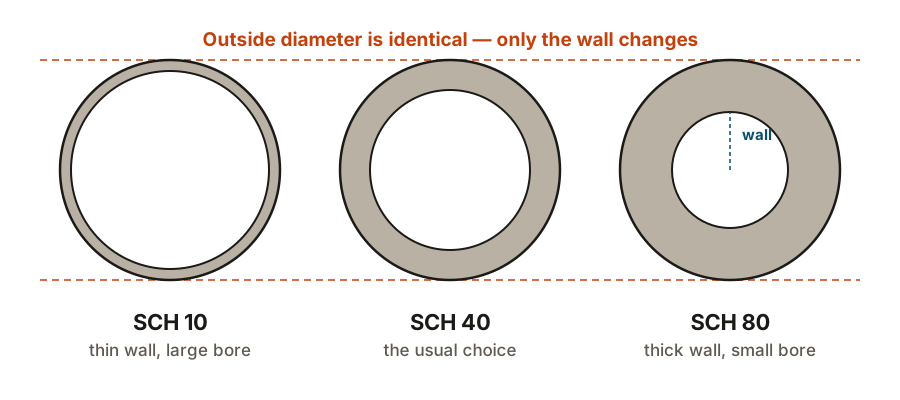
Because the OD is fixed, one set of fittings, flanges and valves serves every wall thickness in that size. A SCH 80 pipe welds to the same elbow as a SCH 40 pipe. The fabricator’s tooling, the welder’s preparation and the pipe support dimensions all stay the same. If the OD varied with wall thickness, every combination would need its own fittings — an unmanageable catalogue.
Schedule sets the wall
The schedule number sets the wall thickness for a given NPS. Higher schedule means:
- thicker wall
- smaller bore (the wall grows inward)
- higher pressure capability
- more weight, more cost, more welding time
| 1/2 | 15 | 21.3 | 2.11 | 2.77 | 3.73 | 4.78 |
|---|---|---|---|---|---|---|
| 3/4 | 20 | 26.7 | 2.11 | 2.87 | 3.91 | 5.56 |
| 1 | 25 | 33.4 | 2.77 | 3.38 | 4.55 | 6.35 |
| 1 1/2 | 40 | 48.3 | 2.77 | 3.68 | 5.08 | 7.14 |
| 2 | 50 | 60.3 | 2.77 | 3.91 | 5.54 | 8.74 |
| 3 | 80 | 88.9 | 3.05 | 5.49 | 7.62 | 11.13 |
| 4 | 100 | 114.3 | 3.05 | 6.02 | 8.56 | 13.49 |
| 6 | 150 | 168.3 | 3.4 | 7.11 | 10.97 | 18.26 |
| 8 | 200 | 219.1 | 3.76 | 8.18 | 12.7 | 23.01 |
| 10 | 250 | 273 | 4.19 | 9.27 | 15.09 | 28.58 |
| 12 | 300 | 323.8 | 4.57 | 10.31 | 17.48 | 33.32 |
| 14 | 350 | 355.6 | 6.35 | 11.13 | 19.05 | 35.71 |
| 16 | 400 | 406.4 | 6.35 | 12.7 | 21.44 | 40.49 |
| 18 | 450 | 457 | 6.35 | 14.27 | 23.83 | 45.24 |
| 20 | 500 | 508 | 6.35 | 15.09 | 26.19 | 50.01 |
| 24 | 600 | 610 | 6.35 | 17.48 | 30.96 | 59.54 |
No rows match that filter.
Outside diameter is fixed for a given NPS — only the wall thickness changes with schedule. That is why a SCH 80 pipe fits the same fittings as a SCH 40 pipe of the same size, but has a smaller bore.
Play with the table above. Sort by outside diameter, then look across a row: at NPS 8 the OD is 219.1 mm whether the wall is 3.76 mm or 23.01 mm. That is the fixed-OD rule in numbers.
The older names still in use
Before schedules were numbered, three weight classes were named, and you will still hear them on site:
- STD (Standard) — matches SCH 40 up to NPS 10
- XS (Extra Strong) — matches SCH 80 up to NPS 8
- XXS (Double Extra Strong) — heavier than SCH 160 in most sizes
Above those sizes the names and numbers diverge, which is exactly the kind of trap that produces a wrong material requisition. Where it matters, quote the wall thickness in millimetres, not the name.
How the schedule is chosen
Nobody guesses. The wall thickness comes from a calculation in ASME B31.3, driven by:
- Design pressure and temperature — the pressure the line must hold, at the temperature it will run at, which sets the allowable stress of the material.
- Corrosion allowance — extra metal, typically 1.5 mm or 3 mm, deliberately sacrificed over the design life.
- Mechanical strength — a thin small-bore line may be strong enough for the pressure and still get crushed by a scaffolder standing on it. Minimum wall rules exist for this reason.
- Manufacturing tolerance — pipe is permitted to be up to 12.5% thinner than nominal, and the calculation must assume the worst case.
The calculated thickness is then rounded up to the next commercially available schedule. That is why so many lines end up SCH 40 or SCH 80: those are the stocked walls.
Reading a pipe callout
A requisition might read:
PIPE, 6" NPS, SCH 40, ASTM A106 Gr B, SMLS, BE, ASME B36.10MDecoded:
6" NPS— nominal size, OD 168.3 mmSCH 40— 7.11 mm wall, so the bore is 168.3 − (2 × 7.11) = 154.08 mmASTM A106 Gr B— seamless carbon steel for high-temperature serviceSMLS— seamless, as opposed to weldedBE— bevelled ends, prepared for butt weldingASME B36.10M— the dimensional standard fixing the OD and wall
Every one of those six elements has to be right. Getting the material correct and the schedule wrong still yields a pipe that cannot be installed.
What to take away
- NPS and DN are labels, not measurements — below NPS 14 the number matches nothing you can measure.
- The outside diameter is fixed for a given NPS. This is what makes standard fittings possible.
- Schedule sets the wall thickness. Higher schedule means thicker wall, smaller bore.
- Stainless uses S-suffixed schedules, which are not interchangeable with the plain ones.
- Bore = OD − (2 × wall). Know this by heart; you will use it constantly.
Check your understanding
10 questions. Nothing is recorded — this is just for you.