Mechanical
Insulation, tracing and coatings — the layers outside the pipe
Four different reasons to insulate and why confusing them causes corrosion, how steam and electric tracing differ, why tracing fails silently, and why surface preparation is most of a paint system.
Several topics on this site have referred to insulation, tracing and coatings in passing —
the IH code on a line number, the weight insulation adds
in pipe supports, the freezing impulse line in
instrument installation, and above all
corrosion under insulation.
This is the topic those all point at.
Four reasons to insulate, and they are not the same
| Heat conservation | Keeping process heat in, so less fuel is burned | Economics — the value of heat saved against the cost of insulation | There is an optimum thickness; more is not automatically better |
|---|---|---|---|
| Personnel protection | Stopping people burning themselves on hot surfaces | Surface temperature limit, typically around 60 °C | A guard or a barrier often does this job better, with no CUI risk |
| Process control | Holding a line at temperature, or stopping it freezing | Heat loss against the tracing available | Insulation and tracing are designed together, not separately |
| Cold and cryogenic | Keeping heat out, and stopping condensation or icing | Preventing the outer surface reaching dew point | Needs a vapour barrier, or moisture migrates inward and destroys it |
| Acoustic | Reducing noise from high-velocity lines and machines | Noise target at a stated distance | Uses a different construction from thermal insulation |
| Fire protection | Keeping a vessel or structure cool during a fire | Rating in minutes against a hydrocarbon fire curve | A different product entirely — see fireproofing, not insulation |
No rows match that filter.
The code on the line number tells you which of these is intended, and it matters — the thickness, the material and even whether insulation is the right answer at all depend on which job it is doing. Insulating for the wrong reason is how a plant ends up with more CUI than it needed.
The insulation code on the line number says which one applies. It matters, because the thickness, the material and even whether insulation is the right answer at all depend on the reason.
Materials and construction
Mineral wool is the general-purpose choice — cheap, easy to fit, and it holds water readily, which is exactly the CUI problem. Calcium silicate takes higher temperatures and is rigid. Cellular glass is closed-cell and does not absorb water, which makes it the usual choice for cold service and for lines where CUI risk is serious. Aerogel is very efficient and very expensive, used where space is tight.
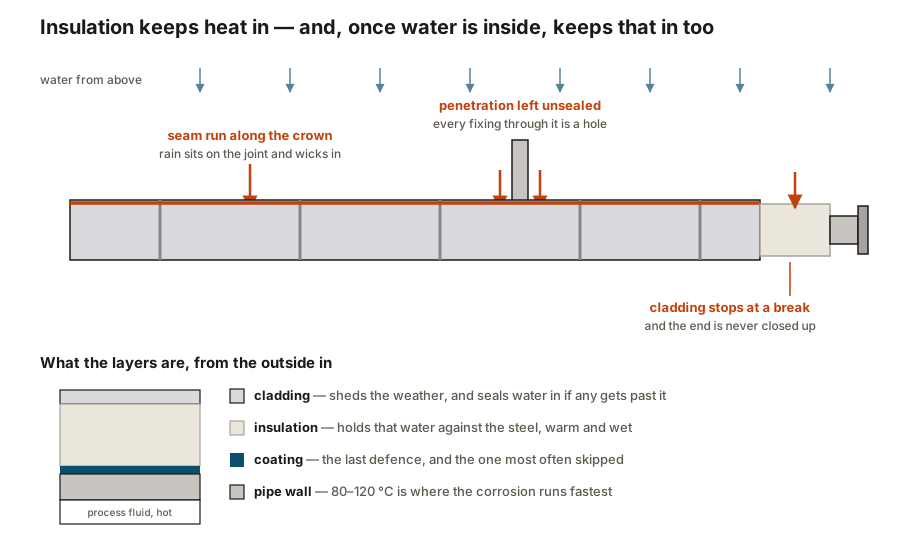
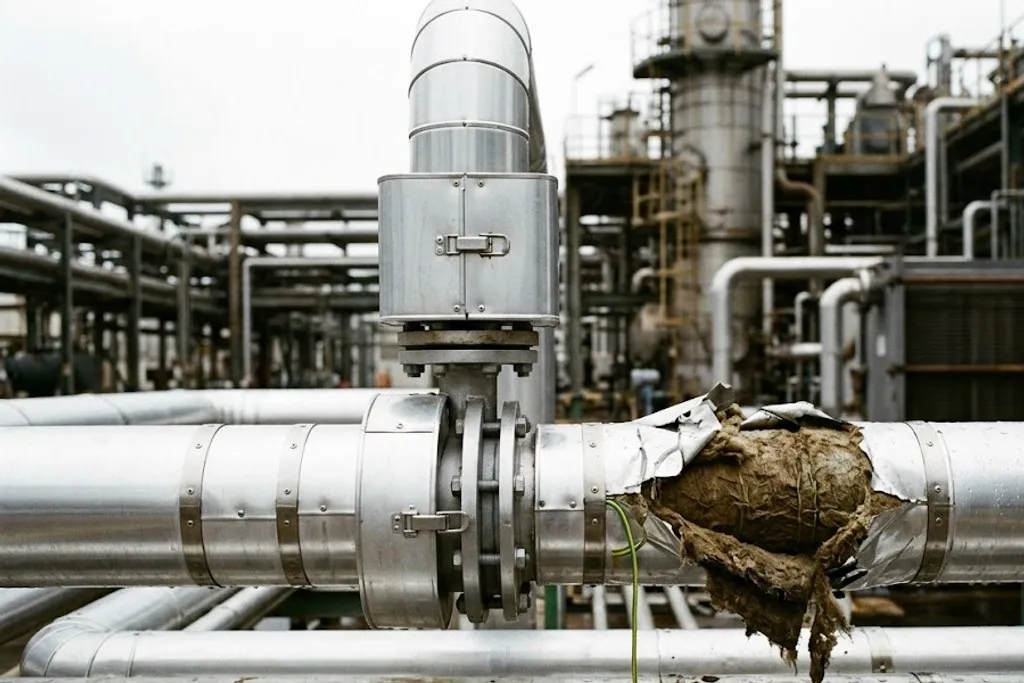
Over the top goes cladding — aluminium or stainless sheet — which is not decoration. It is the weatherproofing, and it is where CUI starts:
- laps facing the wrong way, so water runs in rather than off
- open ends at terminations, valves and supports
- damaged or missing sections nobody has reported
- penetrations for supports and nozzles that were never resealed
Tracing
Insulation slows heat loss. It does not add heat. Where a line must be held above freezing, or above a product’s pour point, it needs tracing underneath the insulation.
| How it works | A small steam tube run alongside the pipe, under the insulation | A heating cable run along the pipe, under the insulation |
|---|---|---|
| Temperature control | Crude — set by steam pressure, the same along the whole run | Precise — thermostats, or self-regulating cable |
| Best for | Long runs, high heat duty, sites with plenty of LP steam | Precise temperature holding, remote lines, no steam available |
| Hazardous areas | No electrical certification needed at all | Certified cable, glands and junction boxes throughout |
| Running cost | Steam is consumed continuously whether needed or not | Only draws power when the thermostat calls for it |
| Maintenance | Steam traps — numerous, and a known failure point | Cable degradation, and faults are hard to locate under cladding |
| How it fails | A failed trap floods or starves the tracer, silently | Cable fails or the breaker trips, silently |
No rows match that filter.
The two do the same job by very different means, and the choice usually comes down to what the site already has. What they share is the failure mode: tracing stops working silently, and the first symptom is a line that has already blocked or frozen.
The choice usually comes down to what the site already has — a plant with surplus LP steam traces with steam, one without traces electrically.
Two distinctions worth keeping straight:
- Freeze protection keeps a line above 0 °C, or above the point a product waxes or solidifies. It runs when the weather demands it.
- Temperature maintenance holds a line at a specific process temperature. It runs continuously and needs proper control.
Cold and cryogenic is a different problem
On a hot line, moisture tends to be driven outward. On a cold line the gradient reverses: water vapour migrates inward toward the cold surface, where it condenses and freezes.
Without a sealed vapour barrier on the warm side, insulation on a cold line gradually fills with ice. It loses its performance, and the pipe beneath it corrodes.
That is why cold insulation uses closed-cell materials, why the vapour barrier is continuous and sealed at every joint and penetration, and why a single unsealed penetration can ruin a whole section.
Coatings
Steel corrodes, so it is painted. ISO 12944 classifies the environment from C1 indoors to CX offshore, and the system follows from that — typically a zinc-rich primer, an epoxy intermediate and a polyurethane topcoat.
Galvanising — hot dip zinc — is used for handrails, gratings and small steelwork. It is sacrificial, so minor damage still leaves the surrounding steel protected.
And under insulation, the coating matters more than anywhere else, because it is the last defence once water gets in. Coating specifications for insulated lines are deliberately more demanding than for exposed ones — which is the opposite of what intuition suggests.
What to take away
- Four reasons to insulate, and the line number says which. They need different answers.
- Do not insulate unless there is a reason. A guard beats insulation for personnel protection.
- Cladding is weatherproofing, and its laps, ends and penetrations are where CUI starts.
- Tracing adds heat; insulation only slows loss. They are designed together.
- Tracing fails silently. The first symptom is the line that stopped flowing.
- Cold insulation needs a sealed vapour barrier, because moisture moves inward.
- Surface preparation is most of a coating’s life, and it looks fine on handover either way.
Check your understanding
10 questions. Nothing is recorded — this is just for you.