Civil & Structural
Inspecting and repairing structures — the other forty years
Construction is a small part of a plant's life. What degrades, why the worst mechanisms are the hidden ones, how risk-based inspection decides where to look, and why structures quietly become overloaded.
A plant is built in three years and operated for forty. Everything so far in this section has been about the three.
What degrades
| Atmospheric corrosion | Exposed steelwork, worst at crevices and bolted joints | Yes, visible | Visual inspection, coating condition surveys |
|---|---|---|---|
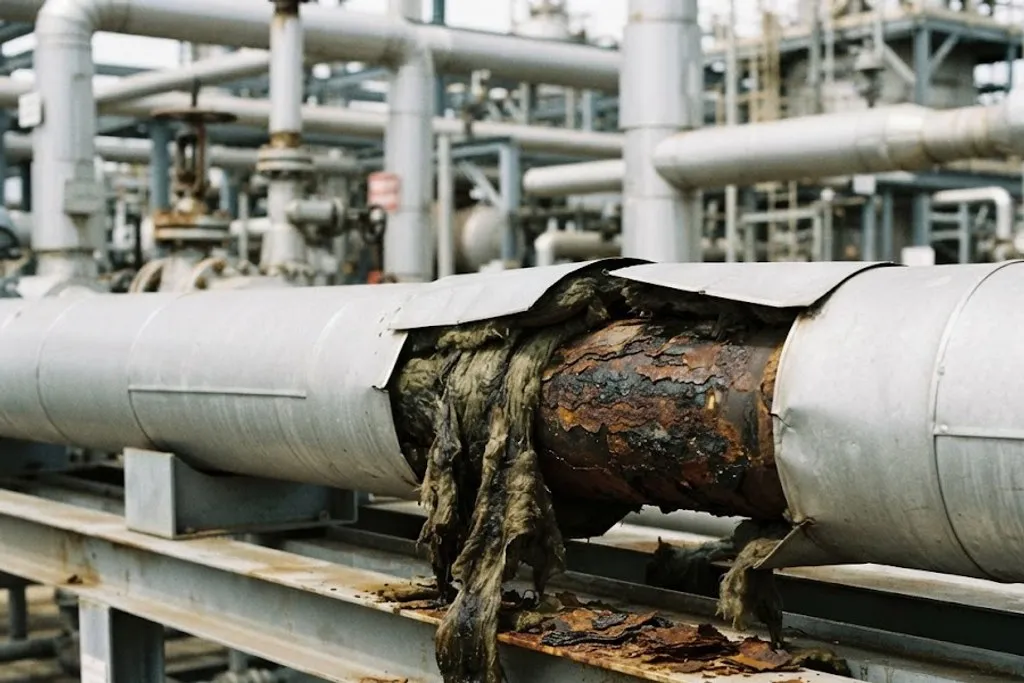
| Corrosion under insulation (CUI) | Insulated pipe and vessels, worst around 50 to 150 °C | No — completely hidden | Stripping insulation at targeted locations, or profile radiography |
| Corrosion under fireproofing (CUF) | Fireproofed columns and legs, where the coating has cracked | No — hidden until the fireproofing is broken out | Hammer testing for hollowness, then local removal |
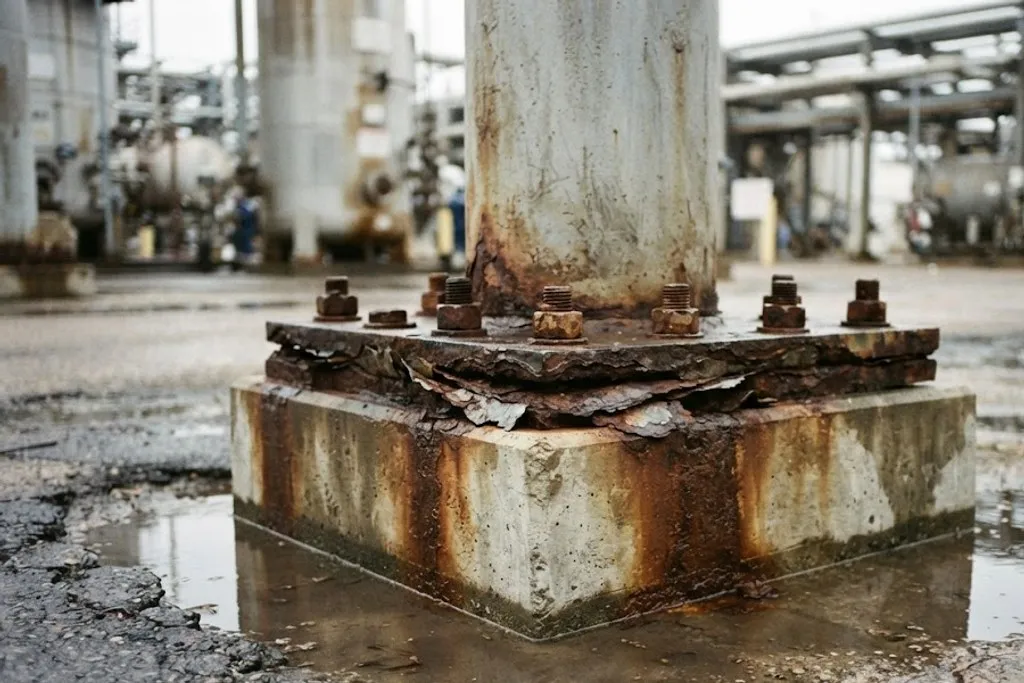
| Base plate and grout line corrosion | Where a column meets its foundation and water sits | Partly | Close visual inspection at ground level, often after clearing debris |
| Reinforcement corrosion | Concrete with inadequate cover, or chloride exposure | Only once it spalls | Cover meter, half-cell potential survey, hammer tapping |
| Sulphate and chemical attack | Buried concrete in aggressive ground, bund floors | Partly | Visual, core sampling, ground chemistry testing |
| Fatigue cracking | Vibrating supports, crane runways, small-bore connections | Barely | MT or PT at known hot spots; vibration surveys |
| Settlement | Tanks, structures on fill, anything near recent excavation | Yes, once it is significant | Precise levelling against established datum points |
| Impact and overload damage | Bracing, handrails, columns near vehicle routes | Yes, visible | Visual inspection — and it is often simply never reported |
No rows match that filter.
The pattern worth noticing is that the worst mechanisms are the hidden ones. Visible corrosion gets painted; corrosion under insulation or fireproofing runs for years with nothing showing, which is why inspection targets what cannot be seen rather than what can.
The pattern in that table is the important part: the dangerous mechanisms are the hidden ones.
Visible corrosion gets noticed, reported and painted. Corrosion beneath insulation or fireproofing proceeds for years with a perfectly sound-looking exterior — which is why inspection programmes target what cannot be seen rather than what can.
Corrosion under insulation
CUI deserves its own section because it causes more unplanned shutdowns than any other single mechanism on an ageing plant.
Water gets under the cladding — through damaged sheeting, poor sealing, a missing end cap, or simply condensation. The insulation then holds it against warm steel, and keeps it there.
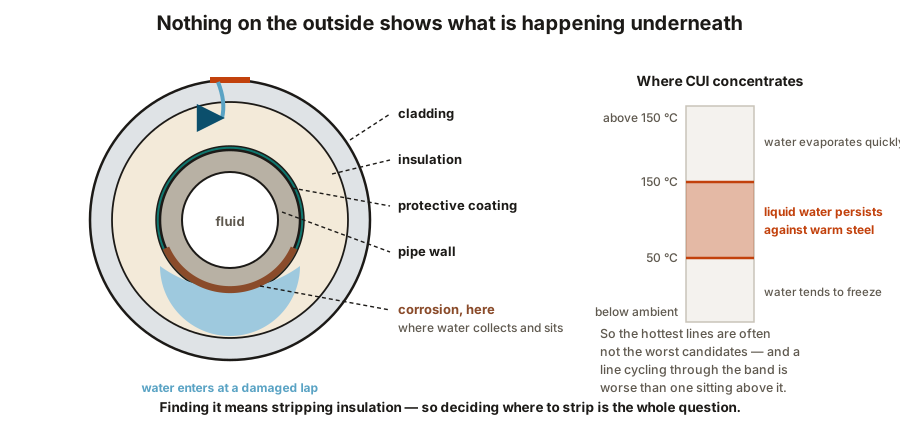
The controls are unglamorous: sound coatings under the insulation, weatherproof cladding properly sealed and maintained, and avoiding insulation altogether where it is not needed. Personnel protection can often be achieved with a guard rather than a full insulation jacket.
Finding it means stripping insulation at targeted locations — which is expensive, so where to strip becomes the whole question.
Risk-based inspection
You cannot inspect everything, so RBI directs the effort. Each item is ranked by:
- Likelihood of failure — its mechanism, age, environment, coating condition and history.
- Consequence of failure — what it holds, what it supports, who is nearby.
High likelihood with high consequence gets frequent, detailed attention. Low with low gets a long interval and a visual check. API 580 sets out the method, and API 583 deals specifically with CUI.
The point of RBI is not to inspect less. It is to stop spending the same effort on a handrail as on a pipe rack leg carrying a hydrocarbon header.
The same reasoning applied to pressure equipment — where it originated, and where most of the effort goes — is covered in risk-based inspection.
Findings that recur everywhere
Base plates at the grout line. Water sits where a column meets its foundation, often under accumulated debris. The corrosion is at the most heavily loaded point in the member and it is routinely hidden by whatever has piled up around it. Clearing the base of columns before inspection finds more than any instrument.
Blocked drainage on steelwork. Hollow sections and channels that were meant to drain fill with water and debris. In cold climates that water freezes and splits the section.
Cracked fireproofing. Water enters, cannot leave, and corrodes the steel it was protecting — the point made in structural steel. Any breach is a structural inspection item, not a cosmetic one, and it is among the most commonly deferred findings on an ageing plant.
Damaged bracing nobody reported. A vehicle strike or a dropped load bends a member. It gets noticed, it does not obviously matter, and it is never written down.
Concrete
The mechanisms were covered in concrete and reinforcement. In service they are found by:
- Visual survey — cracking patterns, spalling, rust staining.
- Hammer tapping — hollow sounds mean delamination before anything is visible.
- Cover meter — measures actual cover, which is often not what was specified.
- Half-cell potential — maps where reinforcement is actively corroding, before it shows.
Repair means breaking out to sound concrete, going behind the reinforcement rather than just to it, cleaning or replacing the steel, and reinstating with a compatible repair mortar.
Records
Inspection is only useful if it builds a picture over time. A thickness reading means very little on its own; the same location measured over fifteen years gives a corrosion rate and a remaining life.
That requires stable reference points, consistent locations, and records that survive changes of contractor and personnel. A plant with twenty years of patchy, inconsistent inspection data is, for practical purposes, starting again.
The same principle as an as-built drawing, and it fails the same way: the information exists right up until the moment somebody needs it.
What to take away
- A plant is built in three years and operated for forty. Most of its life is this topic.
- The dangerous mechanisms are hidden ones. Visible corrosion gets fixed.
- CUI is worst between about 50 and 150 °C, so the hottest lines are not always the worst.
- RBI directs finite inspection effort by likelihood and consequence.
- Clear the base of columns before inspecting. That is where it is worst and least visible.
- Structures get overloaded a little at a time, and nobody adds it up.
- Patch repairs over contaminated concrete fail, and can accelerate the next failure.
- Inspection data is only valuable as a series. Keep it consistent and keep it.
Check your understanding
10 questions. Nothing is recorded — this is just for you.