Instrumentation & Control
Measuring flow — orifice plates and the alternatives
Why most flow measurement is really a pressure measurement, what the square root relationship means for turndown, why straight lengths are a measurement requirement rather than a layout preference, and how to choose between orifice, vortex, magnetic, Coriolis and ultrasonic meters.
Standards referencedISO 5167API MPMSASME MFC-3M
A plant measures flow more often than it measures anything else, and most of those measurements are not really flow measurements at all. They are pressure measurements with some arithmetic on the end.
Understanding that one fact explains most of what follows — including why so many flow readings are quietly wrong.
The differential pressure family
Put a restriction in a pipe. The fluid speeds up to get through it, and as it speeds up its pressure drops. Measure the pressure before and after, and the difference tells you how fast it was going.
The commonest restriction is an orifice plate: a flat disc with a hole, clamped between two flanges. It is cheap, it has no moving parts, it can be pulled out and checked, and it has been the industry default for a century.
Somewhere in the loop the square root has to be taken to turn differential into flow. Modern transmitters do it internally; older systems did it in the control system. Applying it in both places is a classic commissioning error, and it produces a reading that looks plausible at full flow and is badly wrong everywhere else.
| Orifice plate | Differential pressure across a sharp-edged restriction | 3:1 to 4:1 | High | Clean gas, steam and liquid — the industry default | Low flow, dirty or erosive fluid, and anywhere the straight lengths cannot be found |
|---|---|---|---|---|---|
| Venturi | Differential pressure across a gradual contraction | 3:1 to 4:1 | Low — most of it is recovered | Large lines where pumping cost over plant life outweighs capital cost | Long, heavy and expensive for the same measurement |
| Averaging pitot | Velocity profile sampled across the pipe | 3:1 | Very low | Large ducts, retrofits, anywhere the line cannot be broken into | More sensitive to a distorted profile than a full-bore meter |
| Vortex | Frequency of vortices shed behind a bluff body | 10:1 to 20:1 | Moderate | Steam and clean gas or liquid over a wide range | Signal disappears at low flow; vibration can be read as flow |
| Magnetic | Voltage induced as a conductive fluid crosses a magnetic field | 20:1 or better | None — full bore | Water, slurries, conductive chemicals | Hydrocarbons. They are not conductive, so there is no signal at all |
| Coriolis | Twist of a vibrating tube, which gives MASS directly | 20:1 or better | Moderate | Custody transfer, varying density, anywhere mass is what is wanted | Cost, size, and entrained gas in a liquid upsets it |
| Turbine | Rotor speed in the stream | 10:1 | Moderate | Clean, low-viscosity liquids; hydrocarbon custody transfer | It is a bearing in the process. Particles wear it and viscosity shifts its calibration |
| Ultrasonic (clamp-on) | Transit time of a pulse with and against the flow | 10:1 or better | None | Temporary survey, retrofit, no shutdown available | Depends on assumed pipe and fluid properties it cannot see for itself |
No rows match that filter.
Turndown is the ratio of the largest to the smallest flow a meter measures usefully. It is the number that most often decides the choice, because a meter that is accurate at design flow and blind at 20 % of it is no use on a plant that spends half its life turned down.
Straight lengths are not negotiable
The published coefficient for an orifice plate assumes the flow arriving at it has a fully developed velocity profile — fastest in the middle, slowest at the wall, symmetrical.
A bend, a tee, a partly open valve or a reducer close upstream leaves the profile lopsided. The plate still produces a differential, the transmitter still produces a number, and the number is wrong by an amount nobody can calculate after the fact.
The plate itself
- The sharp edge faces upstream. Always. It is what creates the defined contraction.
- The tab is marked so the orientation can be verified without dismantling anything.
- A worn or nicked edge reads low, because the contraction is no longer sharp. Erosive service dulls a plate steadily and the drift is gradual enough to go unnoticed.
- Drain and vent holes sit at the bottom for gas service and the top for liquid, so condensate or gas cannot collect against the plate.
The impulse lines will beat the meter
Everything in the installation topic about impulse lines applies doubly here, because a differential device is measuring a small difference between two large pressures. Anything that affects one leg and not the other appears as flow.
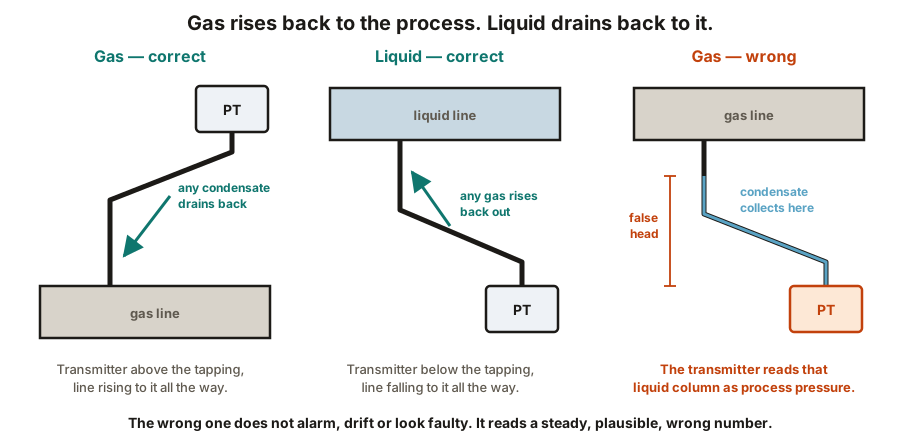
Keep the two legs the same length, on the same route, at the same temperature. One leg in the sun and the other in shade produces a differential that changes with the weather — and the resulting fault is reported as an unstable flow transmitter for months.
The meters that are not differential pressure
Vortex. A blunt body in the stream sheds vortices, and the frequency is proportional to velocity. Good turndown, no moving parts, popular on steam. Its weakness is the bottom of the range, where shedding stops and the signal vanishes. Pipe vibration can also be read as flow.
Magnetic. A conductive fluid moving through a magnetic field induces a voltage. Full bore, no pressure loss, unbothered by solids — excellent on water and slurries. Useless on hydrocarbons, which conduct nothing.
Coriolis. A vibrating tube twists in proportion to mass flow. It gives mass directly, so no density figure is needed. That is why it dominates custody transfer. It is expensive, bulky, and upset by gas entrained in a liquid.
Turbine. A rotor spun by the flow. Accurate on clean light liquids, and it is a bearing sitting in the process — particles wear it and viscosity changes its calibration, so it drifts in a way that looks like a process change.
Variable area — the rotameter. A float rides in a tapered glass or metal tube; the greater the flow, the higher it sits, and you read the scale beside it. It needs no power and no signal, which is why purge and seal flows all over a plant are set with one.
It must be mounted vertically, because the measurement is a balance between the drag of the flow pushing up and the weight of the float pulling down. Fit one horizontally and the float simply rests against the tube wall — the reading has no meaning at all.
Ultrasonic clamp-on. Times a pulse with and against the flow. Nothing enters the pipe and nothing has to be shut down, which makes it ideal for a survey. The price is that it is working from assumed pipe wall and fluid properties it cannot actually see.
Density, and why gas flow needs compensating
An orifice plate responds to the kinetic energy of the stream, which depends on density as well as velocity. On a liquid, density barely moves and can be treated as fixed. On a gas it moves with pressure and temperature, and it moves a lot.
Without compensation, the indicated flow changes when the line pressure changes although the actual flow has not moved. Compensated measurement takes pressure and temperature signals and corrects continuously — which is why a gas flow measurement is often three instruments, not one.
What to take away
- Most flow measurement is a differential pressure measurement with a square root on it.
- Flow goes as the square root of differential. That relationship is what limits an orifice meter to roughly 3:1 or 4:1 turndown.
- Straight lengths are a measurement requirement. Lose them and the error cannot be calculated afterwards — only estimated.
- The sharp edge faces upstream; the tab exists so you can check without pulling the plate.
- Both impulse legs must be the same length, route and temperature. A difference between them is read as flow.
- Magmeters do not work on hydrocarbons. Coriolis gives mass directly. Vortex loses the signal at low flow. Turbine is a bearing in your process.
- Gas flow needs pressure and temperature compensation, or the reading moves when the pressure does.
- A flat trend on a live process usually means a blocked impulse line, not stability.
Check your understanding
6 questions. Nothing is recorded — this is just for you.