Instrumentation & Control
Measuring level — why most level readings are really weight
How differential pressure, displacers and radar each infer level, why a wet leg that partially drains makes the tank read full, what a bridle is for and how it lies on hot service, and why a gauge glass disagreeing with the transmitter is information rather than a nuisance.
Ask what a level transmitter measures and the honest answer, most of the time, is weight.
It measures how heavy the column of liquid above the tapping is, and then reports that as a level on the assumption that the liquid weighs what somebody said it would. When that assumption breaks, the instrument does not fail, alarm or behave oddly. It reports a wrong level, steadily and plausibly.
Almost every level problem below comes from that one sentence.
Hydrostatic head: the workhorse
Put a pressure transmitter at the bottom of an open tank and it reads the head of liquid above it. Head is depth × density × gravity, so with density known, depth follows.
That works well and cheaply, and it is the default on most plants. The catch is in the middle term.
Closed tanks and the reference leg
A closed tank has pressure in the vapour space, and that pressure pushes down on the liquid just as it pushes on anything else. Measure only at the bottom and you get head plus vessel pressure, which is not what you want.
The fix is a differential transmitter: the high side at the bottom, the low side connected to the vapour space. The vessel pressure appears on both sides and cancels, leaving head alone.
That low-side connection is the reference leg, and it comes in two forms:
- A dry leg, kept empty — simple, but only usable where nothing will condense in it.
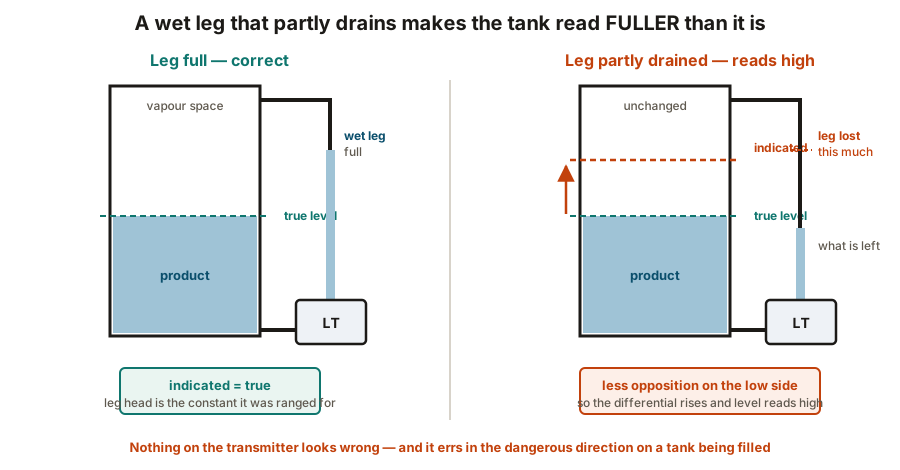
- A wet leg, deliberately filled — needed wherever the vapour will condense, because a leg that fills itself is a leg whose contents nobody knows.
A wet leg exerts a constant head on the low side, so the transmitter is ranged with that offset built in. Which leads directly to the classic failure.
| Differential pressure | Hydrostatic head of the liquid column | Yes, directly | Yes | The general-purpose default, open or closed vessels | Product or temperature changes density; a closed tank needs a reference leg |
|---|---|---|---|---|---|
| Bubbler | Pressure needed to blow air out at the bottom | Yes, directly | Yes, via the dip tube | Corrosive or dirty liquids in open vessels | Needs a continuous air supply; the tube blocks in sludgy service |
| Displacer | Buoyant force on a partly submerged element | Yes, directly | Yes | Interface measurement between two liquids of different density | Narrow range fixed by the displacer length; moving parts to stick |
| Guided wave radar | Time for a pulse to travel a probe and reflect off the surface | No | Yes, the probe | Almost anything, including where density varies | Heavy coating on the probe; very low dielectric products |
| Non-contacting radar | Time for a pulse to reflect off the surface through free space | No | No | Corrosive, sticky or hot products; nothing enters the liquid | Foam, agitators and internal structures give false echoes |
| Capacitance | Dielectric between a probe and the vessel wall | No, but depends on dielectric | Yes | Simple, robust, inexpensive | Coating changes the dielectric it sees, so it drifts as the probe fouls |
| Radiometric | Attenuation of radiation across the vessel | Yes | No — nothing penetrates the wall at all | Where nothing may enter or pierce the vessel | A licensed radioactive source, with survey and disposal obligations |
| Gauge glass | You look at it | No | Yes | Independent local check on everything above | Local only, and it fouls — but when it disagrees with the transmitter, that disagreement IS the diagnosis |
No rows match that filter.
The column that decides most arguments is 'depends on density'. A method that infers level from weight is really measuring the product as well as the level, so a change of grade or a change of temperature moves the reading with nothing in the tank having changed.
Bridles and standpipes
A bridle is a length of pipe hung off the side of a vessel, connected top and bottom, so the liquid in it sits at the same height as the liquid inside. Level instruments and a gauge glass mount on the bridle rather than on the vessel.
The advantage is maintenance. The bridle has its own isolation valves, so instruments can be worked on without opening the vessel.
The disadvantage is temperature.
Displacers
A displacer is a weighted cylinder hanging in the liquid. As the level rises it becomes more submerged, buoyancy increases, and the apparent weight falls. The instrument reads that change.
It has a fixed range set by the displacer length, and it has moving parts that can stick. But its density sensitivity, which is a nuisance for total level, is exactly what makes it the natural choice for interface measurement — finding the boundary between oil and water in a separator, where the whole job is to detect a change in what the element is sitting in.
Radar, and not touching the product
Guided wave radar sends a pulse down a probe and times the reflection from the surface. Non-contacting radar does the same through free space from the top of the vessel.
Neither cares what the liquid weighs. That single property is why radar has taken over so much level measurement — it removes the density assumption that causes most of the trouble above.
Their weaknesses are the mirror of their strength. Because they work on reflections, they see reflections they were not looking for: foam, agitator blades, internal pipework, the sidewall of a narrow vessel. Setting one up properly means telling it which echoes to ignore, and a radar commissioned in an empty vessel can behave differently once the internals are wetted.
Switches, and why they are separate
A level transmitter gives a continuous reading for control. A level switch does one thing at one point, usually for alarm or trip.
On a critical vessel you will find both, and they will be independent — different devices, different tappings, often different principles.
The gauge glass earns its place
A gauge glass is local, needs cleaning and cannot be trended. It is also the only device on the vessel that is not inferring anything.
When the glass and the transmitter disagree, that disagreement does not tell you which is right — but it tells you that one of them is wrong, which a plant with a single measurement would never discover at all. That is worth the maintenance.
What to take away
- Most level measurement is weight measurement. Change the density and the reading moves with nothing in the vessel having changed.
- A closed tank needs a reference leg. A wet leg that partially drains makes the level read high — plausibly, steadily, and in the dangerous direction.
- A bridle buys maintainability and costs you accuracy on hot service, because the stagnant column cools and gets denser. Insulate or trace it.
- A displacer is density sensitive, which makes it well suited to interface measurement.
- Radar does not care about density, which is why it displaced so much else — but it sees foam and internals as surfaces.
- Trip switches must be genuinely independent of the control transmitter. Sharing a bridle or a tapping quietly removes that independence.
- When the gauge glass disagrees with the transmitter, that is information, not an annoyance.
Check your understanding
6 questions. Nothing is recorded — this is just for you.