Civil & Structural
Soil investigation and compaction — the tests behind the report
What a Proctor test actually establishes and why field density is meaningless without it, the difference between Standard and Modified, why optimum moisture content is a target rather than a maximum, what sabkha does to buried concrete, and how a compaction result gets flattered without anyone lying.
Standards referencedASTM D698ASTM D1557ASTM D1586ASTM D6938
Everything on the plant is carried by ground that nobody designed. The only way to know what it will do is to test it — and most arguments on a civil job come down to a test that was run on the wrong material, at the wrong depth, or against the wrong reference.
Two different questions
Compaction testing is where this confusion does the most damage, because two tests sound similar and ask completely different things.
- The Proctor test, in a laboratory, asks: what is the best density achievable with this soil?
- The field density test, on site, asks: what density did we actually get today?
The specification is the ratio between them — “95 % of maximum dry density”. Which means a field result on its own is not an answer to anything.
| Standard Proctor (D698) | Laboratory | Maximum dry density and optimum moisture content, at standard compactive effort | Must be run on the SAME material as the fill, not a similar one from another stockpile |
|---|---|---|---|
| Modified Proctor (D1557) | Laboratory | The same, at roughly 4.5 times the compactive effort | Gives a higher MDD, so 95 % Modified is a much harder target than 95 % Standard. Check which the spec means |
| Field density — sand replacement or nuclear gauge | Field | The dry density actually achieved in the layer just placed | Test at the specified depth. A gauge reading the top 50 mm of a 300 mm layer flatters the result |
| Standard penetration test (SPT) | Field, in a borehole | Blows per 300 mm — a rough index of density or consistency with depth | An index, not a strength. Correlations to bearing capacity are approximate and soil-specific |
| Atterberg limits | Laboratory | Liquid and plastic limits — how the fines behave with water | A high plasticity index signals a soil that shrinks, swells and stays wet |
| Particle size distribution | Laboratory | Whether the material is granular or fine, and how well graded | A well-graded granular fill compacts readily; a uniform one never reaches the density |
| Consolidation / oedometer | Laboratory | How much a compressible layer will settle, and over what period | The test that matters when there is clay below the founding level |
| Chemical suite — sulphate, chloride, pH | Laboratory | Whether the ground will attack concrete and reinforcement | Decides cement type and cover. Critical in sabkha and any saline ground |
| CBR | Lab or field | Subgrade strength for pavement design | Soak it if the subgrade may ever be saturated — a dry CBR is optimistic |
No rows match that filter.
Two quite different questions get confused on site. The laboratory compaction test asks what the BEST achievable density is for this soil. The field density test asks what was ACHIEVED today. The specification is a ratio between the two, so getting either one from the wrong material makes the ratio meaningless.
Standard or Modified?
There are two Proctor tests and they are not interchangeable.
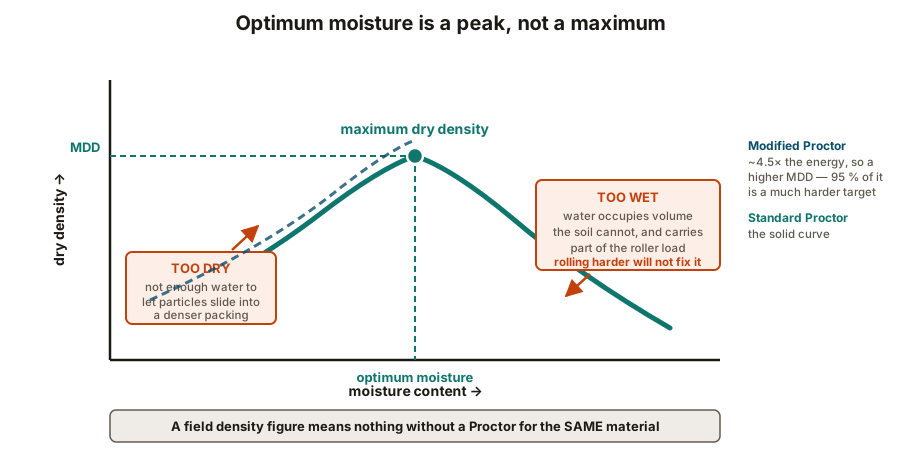
Standard Proctor uses a defined, modest compactive effort. Modified Proctor uses roughly four and a half times as much energy, and so produces a higher maximum dry density for the same soil.
Which means 95 % Modified is a substantially harder target than 95 % Standard.
Optimum moisture is a peak, not a limit
The Proctor test is really a curve. Compact the same soil at a range of moisture contents and the density rises, reaches a maximum, and falls again. The moisture at that peak is the optimum moisture content.
The shape explains a lot of site behaviour:
- Too dry and there is not enough water to let particles slide past one another into a denser packing. Rolling it more does not help much.
- Too wet and the water occupies volume that soil particles cannot, and it carries some of the roller load instead of transmitting it. The peak density is simply unreachable.
So fill that arrives too wet is dried, turned or replaced. Rolling harder is the intuitive response and it is the wrong one.
Layers, and where the bad compaction hides
Compaction energy dies away with depth. The top of a layer always gets more than the bottom, which is why layer thickness is specified — typically 200 to 300 mm loose — and why it is worth actually measuring rather than eyeing.
Reading the ground investigation report
The report arrives before anything is designed, and it decides the foundations.
Boreholes and SPT. Blow counts with depth, giving a picture of density or consistency. It is an index — turning an N value into a bearing capacity takes soil-specific correlation and judgement, and the report’s recommendations matter more than the raw numbers.
Particle size and Atterberg limits. Whether the material is granular or fine, and how the fines behave with water. A high plasticity index means a soil that shrinks, swells and holds water — the kind that moves seasonally under a light structure.
Consolidation. If there is compressible clay below founding level, this is the test that says how much settlement and over how long. Most settlement problems on a plant come from a layer nobody tested because it was below the depth of interest.
The chemical suite. Sulphate, chloride and pH.
Subgrade, sub-base and CBR
Under paving and roads, the question changes from “will it settle” to “will it carry wheel loads without rutting”. That is answered by CBR.
The subgrade is the prepared natural ground; the sub-base is imported granular material above it. Both are tested, and the CBR is run soaked wherever the ground could ever become saturated — a dry CBR flatters a subgrade that will spend part of its life wet.
What to take away
- A field density result means nothing without a Proctor for the same material. New material, new Proctor.
- Modified Proctor is a harder target than Standard. Confirm which one the percentage refers to.
- Optimum moisture is a peak. Too wet or too dry both reduce achievable density, and rolling harder does not fix wet fill.
- Compaction is worst at the bottom of a layer. Specified layer thickness and test depth exist so the bad part cannot hide under a good reading.
- Sabkha and saline ground are chemically aggressive, not just weak. The sulphate and chloride results decide cement type and cover.
- SPT gives an index, not a bearing capacity.
- Test CBR soaked where the subgrade might ever be saturated.
Check your understanding
6 questions. Nothing is recorded — this is just for you.