
Automotive
V2X communication
Why a vehicle that can talk to other vehicles and to the roadside sees things no sensor can reach, how DSRC and C-V2X differ, and why the hardest part of the problem is trust rather than radio.
Standards referencedIEEE 802.11pETSI EN 302 663SAE J2735IEEE 1609.2
Every sensor on the previous three topics shares one limit — it can only detect what it can see. V2X is the attempt to get past that, and its difficulties turn out to be much less about radio than you would expect.

What it adds
A radar sees the vehicle in front. It does not see the one four ahead that has just braked hard, or the ambulance approaching the junction from a road hidden behind buildings, or the black ice that a car reported two minutes ago on the bend you are about to enter.
None of that is a resolution problem. It is a line of sight problem, and no improvement in sensing solves it.
The naming is mechanical — the V is always the vehicle, the second letter is whatever it is talking to:
- V2V — another vehicle
- V2I — infrastructure, typically a signal or a roadside unit
- V2P — a pedestrian or cyclist carrying a device
- V2N — the wider network, for traffic and hazard information
- V2X — all of it, when the counterpart does not matter
The heartbeat

The foundation is the basic safety message — and the surprising thing about it is that it is not an alert.
Every equipped vehicle broadcasts, roughly ten times a second, a short packet saying where it is, how fast it is going, which way it is heading, and whether it is braking. Nothing is requested. No connection is set up. Receivers simply listen and assemble their own picture from whatever they hear.
Alerts are then derived locally from that picture. A vehicle that notices three broadcasts ahead of it reporting hard braking can warn its driver before anything is visible.
Alongside it:
| Message | From | Carries |
|---|---|---|
| Basic safety message | Every vehicle | Position, speed, heading, braking |
| Signal phase and timing | A junction | Current phase and seconds to change |
| Map data | A junction | Lane geometry, so the phase means something |
| Decentralised notification | Anything | A specific event — ice, a stopped vehicle, roadworks |
Latency, and why the network is not in the path
At motorway speed a vehicle covers about 28 metres every second. A hundred milliseconds is nearly three metres, and a warning that arrives after the event it warns about is worse than no warning at all.
A message routed up to a server and back can easily cost several hundred milliseconds — fine for traffic information, useless for collision warning. So the safety messages are transmitted directly between vehicles, never through the network.
This has a second benefit that is easy to miss: direct transmission keeps working in a tunnel, in a car park, and on a road with no mast within twenty miles.
DSRC and C-V2X
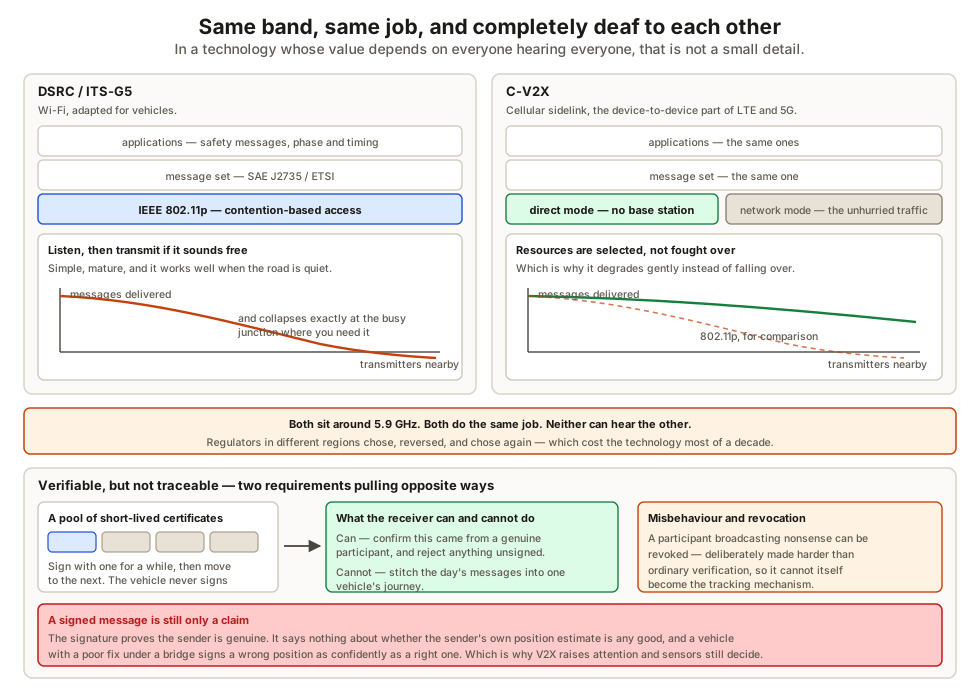
Two families, occupying roughly the same band around 5.9 GHz, doing the same job, unable to hear each other.
DSRC derives from IEEE 802.11p — Wi-Fi, adapted for vehicles. Channel access is contention-based: a station listens, and transmits if the channel seems free. Simple and mature, but it degrades as the number of transmitters rises, which is precisely the busy junction where you want it most.
C-V2X derives from cellular sidelink, the device-to-device part of LTE and later 5G. Access is scheduled rather than contended, which holds up better under load. It has two modes:
- Direct mode — vehicle to vehicle, no base station, the safety-critical path.
- Network mode — through the cellular network, for the less urgent traffic.
Trust without traceability
Two requirements that pull against each other.
A receiver must be able to verify that a message came from a legitimate participant. Otherwise anyone with a transmitter can broadcast a phantom emergency brake and empty a motorway.
But a permanent signature would let anyone with a receiver follow a particular car all day — every junction it passed, every time it left home.
The resolution is rotating pseudonym certificates. Each vehicle holds a pool of short-lived certificates, signs with one for a while, then switches. Messages remain verifiable; the sequence of them cannot be stitched into a journey. A misbehaving participant can still be revoked, through a process deliberately made harder than ordinary verification.
Why so little of it is on the road
The technology has been ready for years. The obstacle is arithmetic.
The benefit to a vehicle depends on meeting other equipped vehicles, so it grows roughly with the square of the equipped fraction of the fleet. At 2% penetration, two equipped vehicles meet about one time in 2,500. The first buyers pay in full and receive almost nothing.
Two things break the deadlock. Regulation, by mandating fitment so penetration rises regardless of individual return. And infrastructure — a junction that broadcasts its phase is useful to the very first equipped vehicle that passes it, with no dependence on the fleet at all. That is why the roadside is frequently equipped before the cars are.
What to take away
- V2X supplies what sensors structurally cannot — information from beyond line of sight.
- The basic safety message is a heartbeat, not an alert. Warnings are derived locally by receivers.
- Safety traffic goes directly, never through the network, because the latency budget is tens of milliseconds.
- DSRC is 802.11p-derived and contention-based; C-V2X is sidelink-derived and scheduled. Same band, same job, mutually deaf.
- Rotating pseudonym certificates make messages verifiable without making vehicles trackable.
- A signed message is still a claim — sensors confirm before anything acts.
- Benefit scales with the square of penetration, which is why infrastructure and regulation, not technology, decide the pace.
Last in this module, what makes all of this updatable after the vehicle has been sold — software-defined vehicles and cybersecurity.
Check your understanding
10 questions. Nothing is recorded — this is just for you.