
Automotive
Active safety and driver assistance
How adaptive cruise, autonomous emergency braking and lane keeping actually decide to act, why false positives matter more than they sound, and what drive-by-wire has to guarantee underneath all of it.
Perception tells the vehicle what is out there. This topic is about the far harder second question — given that picture, and given that the picture is sometimes wrong, when should the vehicle actually take control away from the person driving it.

Adaptive cruise control
Ordinary cruise control holds a set speed regardless of the world. Adaptive cruise adds an outer loop regulating the gap to the vehicle ahead.
That gap is held as a time, not a distance — typically 1.5 to 2.5 seconds. The reason is that the distance you need grows faster than linearly with speed. A fixed 30 metres would be suicidal at 100 km/h and absurd at 30. A two-second gap becomes roughly 17 metres at 30 km/h and 55 at 100, automatically.
Two nested loops:
- The outer loop looks at the gap and the closing rate, and produces a target speed.
- The inner loop achieves that speed through the drivetrain and, if needed, the brakes.
Comfort constrains both. The system could brake far harder than it does, but the point is to relieve the driver, not to alarm them, so ordinary operation is limited to gentle rates. When more is genuinely required, that is no longer cruise control’s job — it is emergency braking’s.
Autonomous emergency braking

The core quantity is time to collision — the gap divided by the closing rate. It collapses a distance and a speed into one number that can be compared against a threshold.
Ten metres means nothing on its own. Ten metres at walking pace is comfortable; ten metres closing at 25 m/s is 0.4 seconds and already too late.
The intervention is deliberately staged:
| Stage | Roughly | If it was unnecessary |
|---|---|---|
| Warning | TTC below ~2.5 s | Almost nothing — a chime and a light |
| Brake pre-fill | Nothing the driver notices | |
| Partial braking | TTC below ~1.5 s | Mild deceleration, mildly annoying |
| Full braking | TTC below ~1.0 s | Possible collision from behind |
Each stage buys time for confirmation and leaves control with the driver as long as possible. Only the last is genuinely disruptive — and that is exactly the one whose threshold gets argued over.
Lane keeping
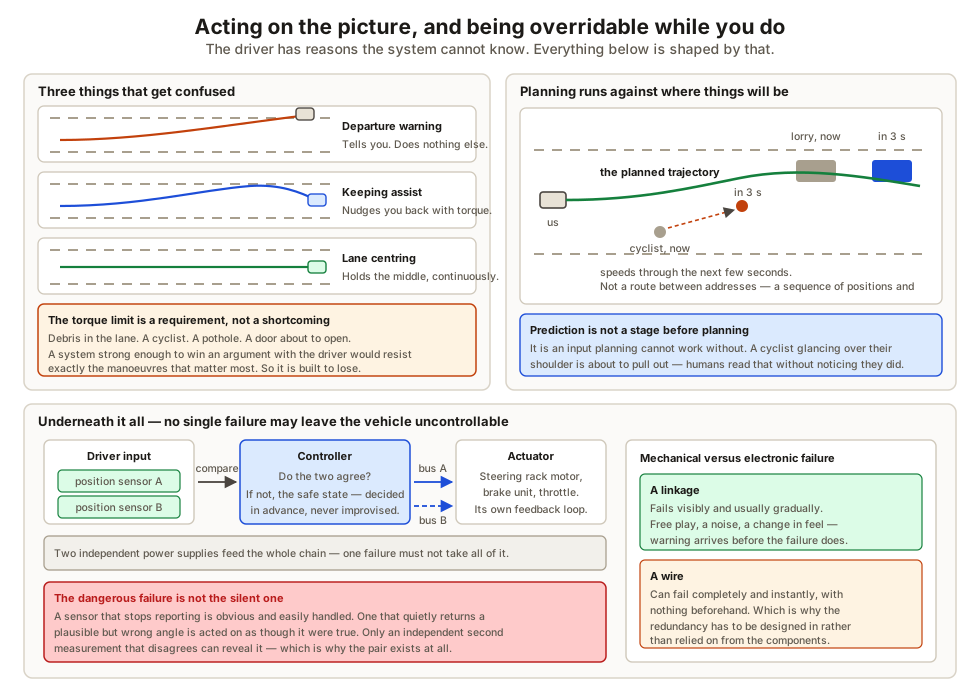
Three things often confused:
- Lane departure warning — tells you, does nothing.
- Lane keeping assist — applies steering torque when you approach a marking.
- Lane centring — continuously holds a position in the middle of the lane.
The applied torque is deliberately limited, and this is the point that matters. The driver has reasons the system cannot know: debris in the lane, a cyclist, a pothole, a door about to open. A system strong enough to win an argument with the driver would resist exactly the manoeuvres that matter most.
So the limit is not a shortcoming of the motor. It is a safety requirement.
Planning, and why prediction comes with it
Path planning produces a trajectory through the next few seconds — a sequence of positions and speeds, not just a direction.
It cannot be laid out against where other road users are now, because by the time the vehicle gets there they will have moved. So motion prediction is not a separate step that precedes planning; it is an input planning cannot work without.
Prediction is genuinely hard because it depends on intent. A cyclist looking over their shoulder is probably about to pull out. A car edging forward at a junction is probably about to emerge. Humans read these signs constantly and barely notice doing it.
Drive-by-wire underneath
All of this assumes the vehicle will actually do what it is told. A mechanical linkage fails visibly and usually gradually. An electronic one can fail completely and instantly.
So the requirement is that no single failure leaves the vehicle uncontrollable:
- Duplicated sensors, cross-checked. A steering angle sensor is read twice by independent means and the readings compared.
- Separate power paths, so one supply failure does not take everything.
- Independent communication, so a failed bus is not the end of it.
- A defined safe state — what the system does when a disagreement is detected, decided in advance rather than improvised.
What to take away
- Adaptive cruise holds a gap in seconds, not metres, so the distance scales with speed by itself.
- Time to collision — gap divided by closing rate — is the number everything in AEB is built on.
- The intervention is staged so each step buys confirmation time and only the last is disruptive.
- A false positive risks a collision from behind and, worse, gets the system switched off.
- Lane keeping torque is limited by design so the driver can always win. That is a requirement, not a limitation.
- Planning works against predicted positions, so prediction is part of planning rather than prior to it.
- Drive-by-wire must survive any single failure — duplicated sensing, separate supplies, and a safe state agreed in advance.
Next, what the vehicle can learn from beyond its own sensors — V2X communication.
Check your understanding
10 questions. Nothing is recorded — this is just for you.