
Automotive
Passive safety and crash engineering
Why a crumple zone is a distance and not a cushion, how a soft front and a hard cell work together, what a pretensioner and a load limiter each do, and the millisecond timeline an airbag has to hit.
Everything up to here has been about avoiding the collision. This topic starts at the moment that has failed, and the problem becomes arithmetic that cannot be argued with.

The one equation
You cannot reduce the kinetic energy of a moving vehicle. Mass and speed have already decided it. What you can decide is the distance over which it is shed, and deceleration follows directly:
a = v² / 2s
| Speed | Crush distance | Deceleration |
|---|---|---|
| 50 km/h (13.9 m/s) | 50 mm | ≈ 1930 m/s², about 197 g |
| 50 km/h | 300 mm | ≈ 322 m/s², about 33 g |
| 50 km/h | 600 mm | ≈ 161 m/s², about 16 g |
That is the whole of crash engineering in one line. A crumple zone is not a cushion and it does not absorb the impact so you feel nothing. It is 600 mm of purchased distance, and it divides the deceleration by twelve.
Soft at the front, hard in the middle
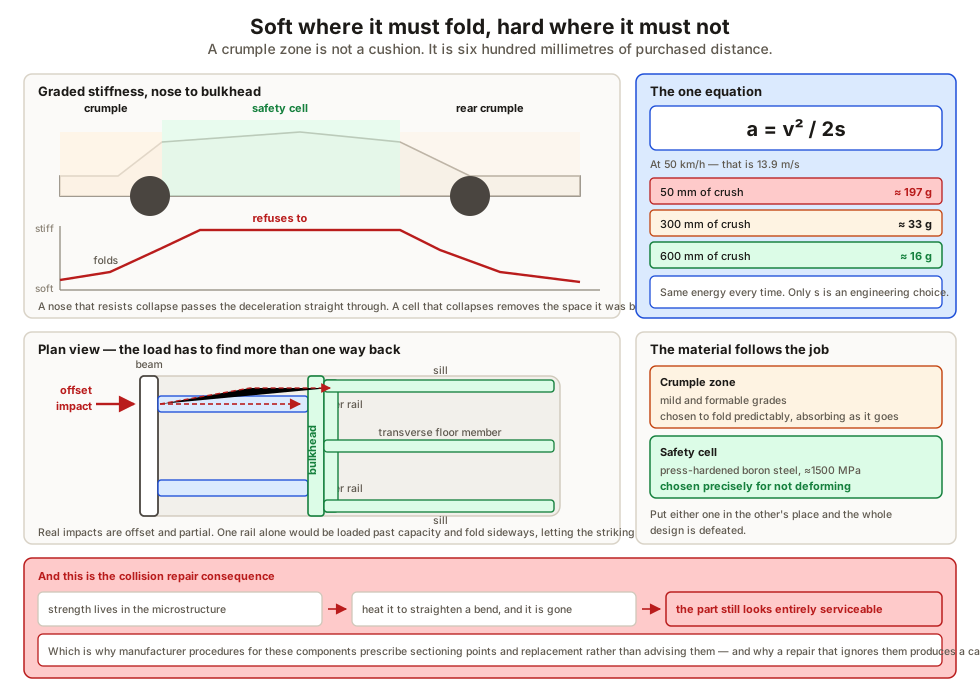
The front structure and the passenger cell have opposite requirements.
The front must collapse, in a controlled and predictable order, to provide the distance. A nose that resists collapse passes the deceleration straight through to the occupants.
The cell must keep its shape. Survival space, the position of the steering column, the geometry the belt and airbag were designed around — all of it depends on the cell still being the shape it was. A cell that deforms has removed the thing the crumple zone was buying time for.
So the structure is graded: soft at the nose, progressively stiffer rearward, very stiff at the bulkhead.
Load paths
Real impacts are rarely square and rarely full width. A single front rail can be loaded past its capacity by an offset impact and simply fold sideways, letting the striking object into the cell.
So the load is spread — upper rail, lower rail, a transverse bumper beam tying them together, the sills, the A-pillars, transverse members across the floor. An impact anywhere across the front finds structure to engage.
The material follows the job
| Region | Material | Chosen for |
|---|---|---|
| Crumple zone | Mild and formable grades | Folding predictably, absorbing energy as it goes |
| Safety cell | Press-hardened boron steel, ≈1500 MPa | Not deforming |
Restraints, in milliseconds

| Time | What happens |
|---|---|
| 0 ms | First contact |
| ~10–15 ms | The algorithm recognises the deceleration signature and commits to firing |
| ~15 ms | Pretensioners fire — webbing slack removed |
| ~30 ms | Airbag fully inflated |
| ~40–60 ms | The occupant arrives at the bag |
| ~60–80 ms | Load limiter paying out, bag venting |
Why slack is expensive
A pretensioner removes belt slack in the first few milliseconds. Slack sounds trivial — 40 mm of loose webbing, a thick coat, a belt not properly seated.
But slack is time, and at these speeds time is distance. An occupant who begins moving forward before the belt takes up has already spent part of the crush distance bought for them, and will meet the restraint harder when it finally engages.
Why the belt then lets go a little
A load limiter allows webbing to pay out at a controlled force once belt load exceeds a threshold.
That is not a contradiction of the pretensioner. The pretensioner removes slack that serves no purpose. The limiter releases webbing once the force itself would do the injuring — trading a little extra forward movement for a large reduction in chest loading. Engage early, then refuse to crush.
The airbag is a surface, not a push
The bag is something the occupant arrives at. It is not a device that pushes them backwards.
Which is why the timing is absolute. A bag still inflating when the occupant reaches it strikes them with an expanding surface, and that is considerably more dangerous than no bag at all. It is the entire reason an out-of-position occupant — leaning forward, too close to the wheel, a rearward child seat in front of a live airbag — is at such risk.
Telling a crash from a pothole
Both produce a sharp deceleration spike. The algorithm does not look at the peak; it looks at the shape over time. A kerb strike spikes and stops. A crash spikes and keeps going.
Getting that wrong in either direction is a safety failure — firing pyrotechnics during ordinary driving would itself cause a loss of control — which is why the decision is taken from several sensors, including satellite sensors mounted well forward, rather than from one.
How it is measured
Crash protocols instrument a dummy and read injury measures from it:
- HIC, the head injury criterion — derived from head acceleration over time, not peak alone
- Chest compression and chest acceleration
- Femur load
- Neck tension and shear
What to take away
- You cannot reduce the energy, only the distance. a = v² / 2s.
- 600 mm of crush instead of 50 mm divides the deceleration by twelve.
- Soft front, hard cell. They have opposite jobs and both are deliberate.
- Multiple load paths exist because real impacts are offset and partial.
- Boron steel is chosen for not deforming — and generally cannot be heated and straightened.
- Pretensioner removes slack early; load limiter caps force late. Both, together.
- The airbag is a surface the occupant arrives at, so 30 ms is not a target but a requirement.
- The algorithm reads the shape of the deceleration, not its peak.
Next, the discipline that decides how much of any of this is enough — ISO 26262, HARA and ASIL.
Check your understanding
10 questions. Nothing is recorded — this is just for you.