
Automotive
EV and hybrid topologies
How the engine, motor, battery and wheels are arranged in series, parallel and power-split hybrids, what changes in a pure battery vehicle, and why the layout decides what the vehicle is good at long before any component is sized.
Standards referencedSAE J1715SAE J1711SAE J2344ISO 6469-1
There are only a handful of ways to arrange an engine, a motor, a battery and a set of driven wheels, and each arrangement decides what the vehicle will be good at before a single component is sized. Get the topology wrong and no amount of efficient hardware will rescue it.

The four questions that define a layout
Every topology is an answer to the same four questions.
- Can the engine reach the wheels mechanically? If yes, it is some kind of parallel. If no, it is series or pure electric.
- Can the motor alone move the vehicle? This separates a full hybrid from a mild one.
- Where does the electrical energy come from? Only from the engine and braking, or also from an external supply.
- How much of the braking can be recovered? This follows from where the motor sits and how big it is.
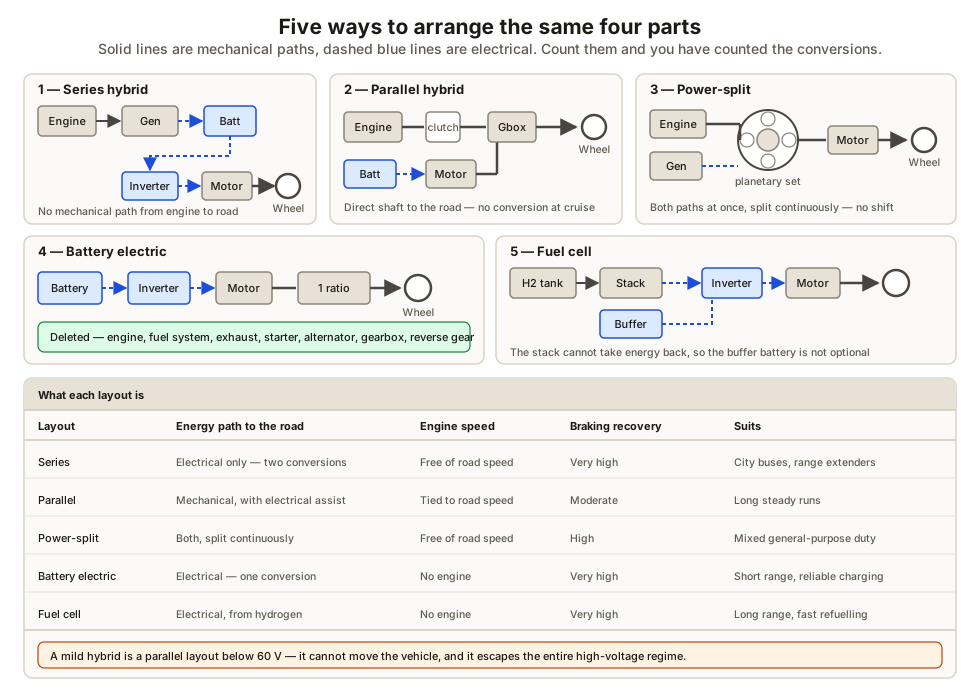
Series — the engine never touches the road
The engine turns a generator. That is its entire job. Everything that reaches the wheels does so as electricity, through the inverter and the traction motor.
The cost is obvious: two conversions, each perhaps ninety-five percent efficient, so about ten percent of the engine’s output is gone before the vehicle moves. The benefit is less obvious but larger in the right duty. Because the engine is mechanically disconnected from road speed, it can sit at whatever speed and load makes it most efficient, or switch off entirely, regardless of what the vehicle is doing.
Parallel — keep the shaft
Put the engine and a motor on the same shaft, usually either side of a clutch and ahead of a conventional gearbox, and you keep a direct mechanical path to the road. At a steady cruise the engine drives the wheels with no conversion at all.
The motor now does four jobs — it restarts the engine, it fills in torque while the engine catches up, it recovers braking energy, and if it is big enough it moves the vehicle on its own at low speed. The gearbox stays, because the engine still needs ratios.
Power-split — both paths at once
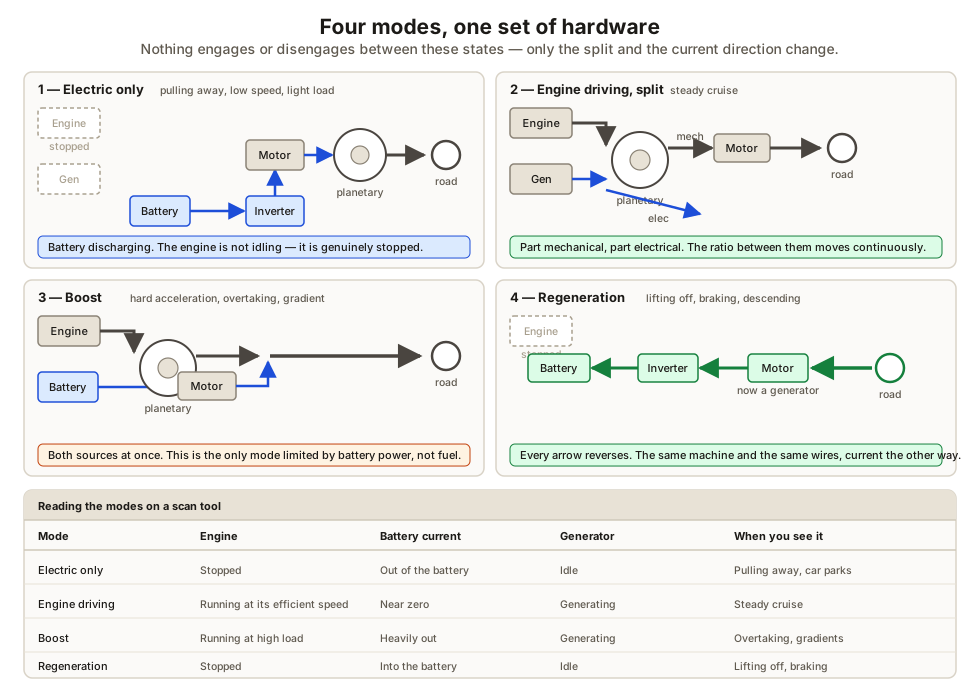
The planetary gear set is the trick. Engine, generator and traction motor connect to the three elements of the set, which means engine speed, generator speed and wheel speed are locked in a fixed arithmetic relationship — but only two of them are ever independent.
Control the generator and you control where the engine sits. The road can ask for 30 km/h or 100 km/h and the engine can stay at its efficient speed throughout, because the generator absorbs the difference and sends it round the electrical path to the motor.
Part of the engine’s output therefore reaches the road mechanically and part electrically, in a ratio that varies continuously. There is no clutch pack, no belt and nothing to shift, which is why these transmissions have proved extraordinarily durable.
Battery electric — what gets deleted
Remove the engine, the generator, the fuel system, the exhaust and the multi-ratio gearbox. What remains is a battery, an inverter, a motor and a single reduction gear.
The single ratio is possible because of the shape of a motor’s torque curve:
| Engine | Traction motor | |
|---|---|---|
| Torque at zero speed | None | Full |
| Useful speed range | About 3 to 1 | About 15 to 1 |
| Efficiency at part load | Poor | Good |
| Ratios needed | 5 to 9 | 1 |
| Reverse | A gear | Change direction of rotation |
Fuel cell — a series hybrid with a different generator
A fuel cell vehicle is architecturally a series hybrid in which the engine and generator have been replaced by a stack that makes electricity directly from hydrogen.
The stack responds slowly and cannot accept energy in reverse, so a buffer battery is not optional. It takes the peaks when the driver demands more than the stack can ramp to, and it catches the braking energy the stack would otherwise waste as heat in a resistor.
Mild hybrids — the cheap fraction
A 48 volt belt-driven machine of perhaps 12 kW cannot move the vehicle. What it can do is restart the engine so smoothly the driver never notices, fill the torque hole while a turbocharger spools, and recover a useful slice of braking energy.
Choosing between them
The duty cycle decides, and it decides almost entirely on two numbers — how much of the time the vehicle is stopping and starting, and how far it travels between opportunities to charge.
- Heavy stop-start, short range, frequent charging — battery electric, or series if a charging opportunity cannot be guaranteed.
- Long steady runs — parallel, because the conversion losses of a series layout are paid on every kilometre and there is little braking energy to recover in exchange.
- A mixture of both — power-split, which is why it suits a general-purpose family car better than either extreme.
- Cost-constrained, incremental improvement — mild hybrid.
What to take away
- The layout fixes which losses exist. Component efficiency only shrinks losses the architecture has already committed you to.
- A mechanical path to the wheels avoids conversion losses at steady speed. An electrical path frees the engine from road speed. Power-split refuses to choose and keeps both.
- Braking recovery depends on the motor being permanently coupled and large enough to take the torque, not on the cleverness of the control software.
- The battery’s size, not its chemistry, is what separates a hybrid from a plug-in hybrid.
- Below 60 V a system escapes the entire high-voltage regime, and that threshold shapes the 48 volt mild hybrid more than any engineering consideration.
Next, the safety systems that surround anything above that threshold — high-voltage safety and isolation.
Check your understanding
10 questions. Nothing is recorded — this is just for you.