
Mechanical
Variations, backcharges and notice — the difference between noticing and notifying
How to recognise an instruction that is really a variation, why the entitlement usually depends on the notice rather than the change, what a backcharge is and how it runs in both directions, and the one-sentence note that protects a position without starting an argument.
Standards referencedISO 21508
This is the part of supervision nobody is trained for and everybody is judged on. It is not contract law, and nothing here is about drafting, entitlement theory or jurisdiction. It is about the three or four things a supervisor does on an ordinary Tuesday that decide, much later, whether work that was genuinely done gets paid for.

The instruction that is really a variation
Variations do not announce themselves. They arrive as reasonable requests from people the supervisor works with every day.
“While you’re there, could you move those two supports?” “Can your crew just clear that so the scaffolders can get in?” “Use the 316 for now, we’ll sort the paperwork out later.”
Each is small. Each is easier to do than to discuss. And each is, in contract terms, either work outside the scope or a change to it.
The test is not size and it is not difficulty. It is two questions: was this in the agreed scope, and was it instructed by the other side? If the answers are no and yes, it is a variation, whatever anybody calls it at the time.
Noticing against notifying
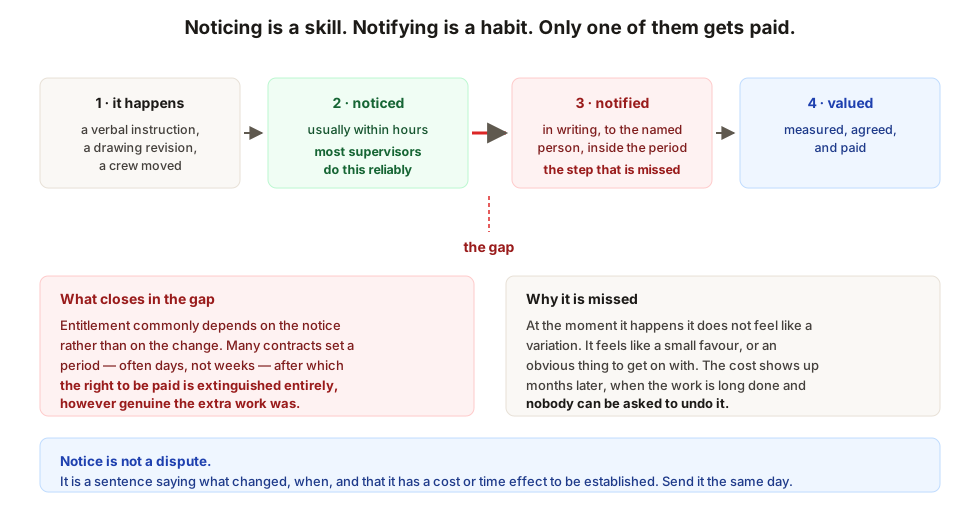
Almost every supervisor notices. Very few notify, and the gap between the two is where money is lost.
The reason the gap matters is that most contracts tie the entitlement to the notice, not to the change. There is a stated period — frequently days rather than weeks — and after it the right to recover can be extinguished entirely, however genuine the extra work was and however clearly it is now documented.
That can feel unfair and it is not arbitrary. The purpose of a notice period is to let the other party decide whether to proceed differently while they still can. A claim produced six months later removes that choice, which is exactly why contracts refuse it.
What a notice has to get right
Less than people think, and the elaborate ones are often the ones that fail.
| Requirement | Note |
|---|---|
| In time | The only one that is usually fatal if missed |
| To the named person | Contracts name a recipient; a notice to a friendly engineer is not a notice |
| In writing | Email ordinarily suffices unless the contract says otherwise |
| Identifying the change | What, where, when, and that it is outside the scope |
| Stating an effect | That there is a cost or time consequence, not necessarily what it is |
The last row matters. A notice does not need to carry a price. On the day, the cost is usually unknown. Saying there will be an effect and that it will be quantified is both honest and sufficient.
Backcharges, in both directions
A backcharge is the cost of remedying somebody else’s failure, recovered from them. Another contractor leaves debris in your work area and your crew clears it. They damage completed work and you repair it. They fail to provide access they were obliged to provide and you hire the scaffold.
All recoverable, in principle. In practice recoverable only with records.
And the direction is worth emphasising, because supervisors tend to think of backcharges as something they do to others. They run both ways. Debris left by a piping crew in an electrical area is exactly the same event seen from the other side. The habit that protects against receiving a backcharge is the same habit that supports making one — knowing and recording what state the area was left in.
What makes a backcharge stick
Three things, and all three are cheap on the day:
- A dated photograph showing the condition and enough context to locate it
- A written record of what was found, whose it was, and when it was raised
- A record of what it cost to put right — hours, people, equipment
A photograph alone shows a mess and proves nothing about whose it was. A complaint alone is a grievance. The three together are a recoverable cost.
The NCR from the other side
Worth naming explicitly, because it is the point where the supervisor’s world meets the inspector’s.
When a non-conformance is raised, the inspector’s job is largely finished at the point the finding is recorded. The supervisor’s is just beginning: the work has to be reworked or dispositioned, the crew resequenced around it, the examination repeated, and the time accounted for.
That time is real and it is frequently not recorded anywhere, because rework feels like an internal failure rather than an event. If the non-conformance arose from something outside the crew’s control — wrong material issued, incorrect drawing, a design change — then the time spent is recoverable, and the only thing that will establish it afterwards is the diary entry made on the day.
Check your understanding
6 questions. Nothing is recorded — this is just for you.