Civil & Structural
Underground services and excavation — the part of the plant nobody can see
What is buried under a plant and how it is protected, why trench collapse is the hazard that kills, and why backfill compaction decides whether a road is still level in ten years.
The layout topic placed things on the surface. Below it is a second plant, just as congested, that nobody can see once it is covered.
What is down there
| Earthing grid | 0.6 – 1.0 m | Bare copper, no marker — it needs soil contact | Test it before backfill; excavating to find a bad joint later is painful |
|---|---|---|---|
| Instrument and control cables | 0.6 – 0.8 m | Sand bed, tiles or ducts, marker tape above | Kept apart from power cables to avoid interference |
| LV power cables | 0.8 – 1.0 m | Sand bed, protective tiles, marker tape | Deeper under roads, and usually in ducts at crossings |
| HV power cables | 1.0 – 1.2 m | Sand bed, tiles, marker tape, often a concrete duct bank | Spacing matters — bunched cables derate each other |
| Drainage (gravity) | Varies — it must fall | Bedded and surrounded in granular material | Gradient governs the depth, so it usually wins any clash argument |
| Firewater ring main | 1.0 – 1.5 m | Below frost line, bedded, marker tape | A ring, so any single break can be isolated and water still reaches every hydrant |
| Process underground piping | 1.0 m and below | Coated and wrapped, often cathodically protected | Minimised where possible — buried process pipe cannot be inspected |
| Foundations and pile caps | 1.5 m and below | Not a service, but it is in the way of everything | Fixed first, so services route around them, not the reverse |
No rows match that filter.
Everything on this list competes for the same volume, and most of it is invisible once backfilled. That is why the underground model is frozen early and why a clash found during excavation costs far more than one found on a screen.
All of it competes for the same volume, and there is a rough hierarchy when they clash:
- Foundations win. They are fixed by what stands on them, so services route around them.
- Gravity drainage wins next. It has to fall continuously, so its depth is not negotiable.
- Cables and pressurised services give way. They can be re-routed, ducted or dropped.
This is why the underground model is frozen early, and why a clash found during excavation costs many times one found on a screen — the point made in foundations.
Excavation: the hazard that kills
| Trench collapse | Soil weighs over a tonne per cubic metre and falls without warning | Battering, benching, trench boxes or sheet piling — chosen by the soil | A person buried to the chest cannot breathe against the load |
|---|---|---|---|
| Striking a buried service | A live cable, a gas line or a firewater main may be anywhere | Permit to excavate, drawings, cable detection, trial holes by hand | Detection finds most things, not all. Hand-dig near anything known. |
| Water ingress | It undermines the walls and hides the trench bottom | Dewatering with pumps or well points, monitored continuously | Dewatering can settle neighbouring foundations — it is a designed activity |
| Falls into the excavation | People and vehicles fall in, particularly after dark | Edge protection, barriers, lighting, covers | Applies to everyone passing, not just the people working in it |
| Spoil and plant near the edge | Surcharge load from a heap or a machine collapses the wall | Keep spoil and plant well back from the edge | The commonest cause of a collapse in a trench that was otherwise fine |
| Hazardous atmosphere | Heavy gases collect in a deep excavation and displace air | Gas testing, ventilation, confined space procedure where it applies | A deep trench in a process area can meet confined space criteria |
| Access and escape | No safe way out when something goes wrong | Ladders within a short distance of every working position | Climbing the shoring is not access |
| Poor backfill compaction | The ground settles later under paving, roads and foundations | Specified material, placed in layers, compacted and tested | The failure appears years later as a sunken road or cracked paving |
No rows match that filter.
Collapse is the hazard that kills. A cubic metre of soil weighs well over a tonne, and a trench wall fails without warning — there is no time to climb out. Everything else on this list is serious; that one is the reason excavation needs a permit at all.
Read the first row again, because it is the one that matters.
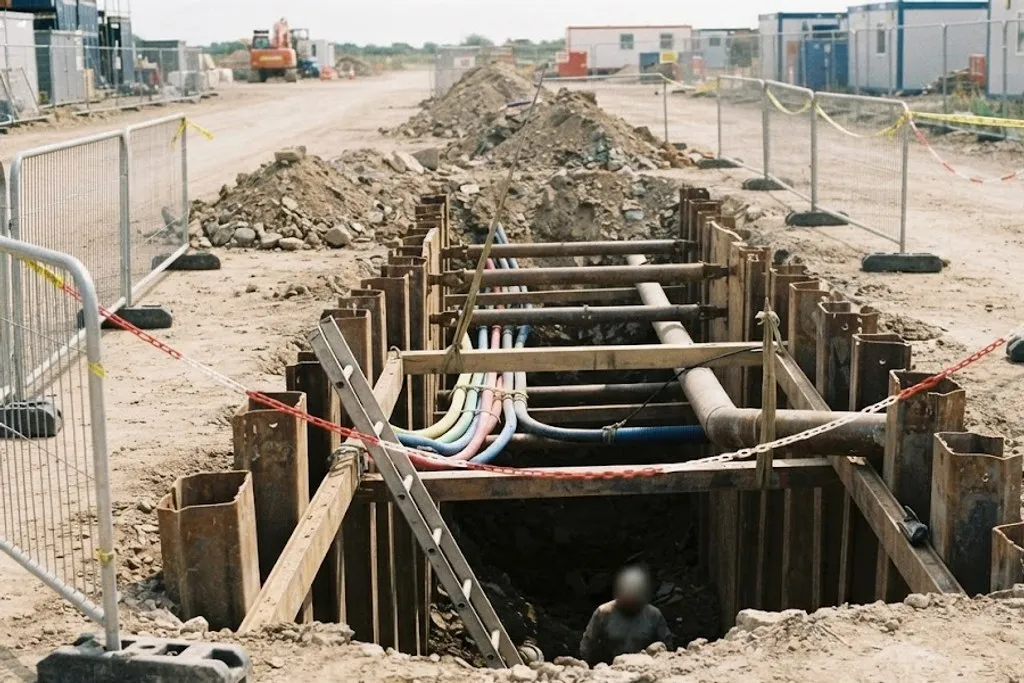
Three ways to keep the walls up, and the soil decides which:
- Battering — cutting the sides back to a safe angle. Needs space, and lots of it in poor ground.
- Benching — stepping the sides. A variation on battering for deeper work.
- Shoring — trench boxes, hydraulic props or sheet piling. Needed where there is no room to batter, or the soil will not stand at any angle.
The safe angle comes from the soil, not from what looks reasonable. The same geotechnical report that set the safe bearing capacity in foundations informs this too.
Buried services: assume they are there
Striking a live cable or a pressurised line is the other way excavation injures people.
The defence is layered, because no single method is reliable:
- Permit to excavate — nobody breaks ground without one.
- Drawings and the underground model — a starting point, but as-builts are often wrong and unrecorded services exist on every old site.
- Cable and pipe detection — CAT and genny, or ground-penetrating radar. Finds most metallic services; may miss plastic pipe and deep runs.
- Hand-dug trial holes — the only method that actually confirms. Used near anything the drawings or the scan suggest.
- Hand digging near known services, machine digging only in proven clear ground.
Water
Groundwater undermines trench walls and hides the bottom of the excavation. Dewatering — sump pumps, or well points around the excavation — is a designed activity, not a matter of dropping a pump in.
It needs watching for a second reason: lowering the water table can consolidate soil over a wide area, settling neighbouring foundations that were perfectly stable before. On a congested plant, dewatering near existing equipment is monitored.
Backfill: the failure that arrives years later
Once the service is laid and tested, the trench is refilled — and this is where a job that went perfectly can still go wrong.
Backfill is placed in layers, each compacted before the next goes on, using specified material. Under roads and paved areas it is tested.
Poorly compacted backfill consolidates over the following years under its own weight and under traffic. The result is a sunken road, a paved area that ponds where it should drain, or a cracked slab — appearing long after the trench was signed off, when nobody connects the two.
Record what you buried
The last step is updating the as-built underground drawings and model with what was actually installed, where.
Not what was designed — what was built, including every deviation made on site to get around something unexpected. The next person to excavate here will rely on that drawing, and an as-built that does not match reality is how the next service strike happens.
It is the same principle as an out-of-date P&ID in reading a P&ID: a drawing that no longer describes reality is worse than no drawing, because it is trusted.
What to take away
- Foundations and gravity drainage win clashes; cables and pressurised services give way.
- Test and inspect anything buried before the backfill goes in.
- Trench collapse gives no warning and kills by suffocation. Support goes in beforehand or not at all.
- Spoil and plant near the edge is the commonest cause of collapse in an otherwise sound trench.
- A clear detection scan is not proof. Trial holes confirm; nothing else does.
- Compaction decides whether the road is still level in ten years.
- Record what you actually buried. The next excavation depends on it.
Check your understanding
10 questions. Nothing is recorded — this is just for you.