
Civil & Structural
Segmental and precast construction
How a metro viaduct, a flyover or a warehouse frame gets built out of factory-made pieces — match-casting, launching girders, balanced cantilever, shear keys and grouted joints — and why the joints and the temporary condition are where the risk lives.
Standards referencedfib Bulletin 74EN 1992-2IRC 112IS 456AASHTO LRFD
A cast-in-place bridge is built where it stands: falsework up, reinforcement fixed, concrete poured, cured, struck. On a greenfield site that is fine. Above a live arterial road in a city, it is close to impossible.
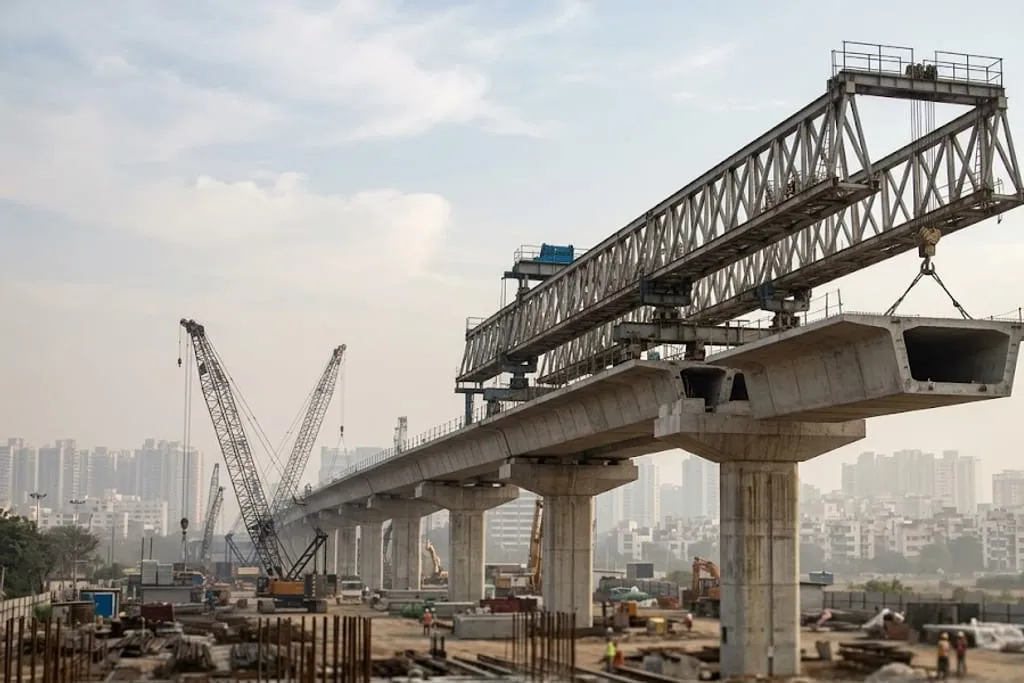
Precast segmental construction moves the work off site. Segments are made in a casting yard under factory conditions, trucked in at night and erected in days. It is why almost every elevated metro built since the 1990s looks the way it does, and the same logic — make the pieces somewhere controlled, connect them quickly on site — gives us precast warehouse frames, hollowcore floors and precast bridge beams.
The engineering shifts accordingly. The pieces are rarely the problem. The joints between them, and the half-built condition, are.
Why it wins in a city
| Cast in place | Precast segmental | |
|---|---|---|
| Where the work happens | Over the road, for months | In a yard, in parallel |
| Road occupation | Continuous | A few night possessions |
| Quality control | Site conditions | Factory conditions, repeated moulds |
| Weather sensitivity | High | Low for casting, moderate for erection |
| Programme | Sequential span by span | Casting and erection run in parallel |
| Up-front cost | Lower | Yard, moulds, launching girder |
| Suits | One-offs, complex geometry | Repetition |
The economics turn on repetition. A casting yard and a launching girder are a large fixed cost that only makes sense across many identical spans — which is exactly what a metro corridor is.
Match-casting: the idea that makes it work
The joints between segments have no reinforcement crossing them. That is only acceptable if the faces bear on each other perfectly, and the way to guarantee that is to cast each segment against its neighbour.
Segment 6 is cast. Segment 6 is then moved to become one end of the mould for segment 7. The two faces are exact negatives. Repeat along the span.
Shear keys — a castellated profile cast into the faces — do two jobs. During erection they drop the segment into position. In service they carry vertical shear across a joint that has no bars through it. Box girders typically use large single keys on the webs and many small keys across the top and bottom slabs.
Epoxy is applied to the faces before closure. It seals the joint against water — the lesson of Ynys-y-Gwas — and while wet it lets the faces slide into full bearing under a temporary stressing force. It is not the structural connection.
The three erection methods
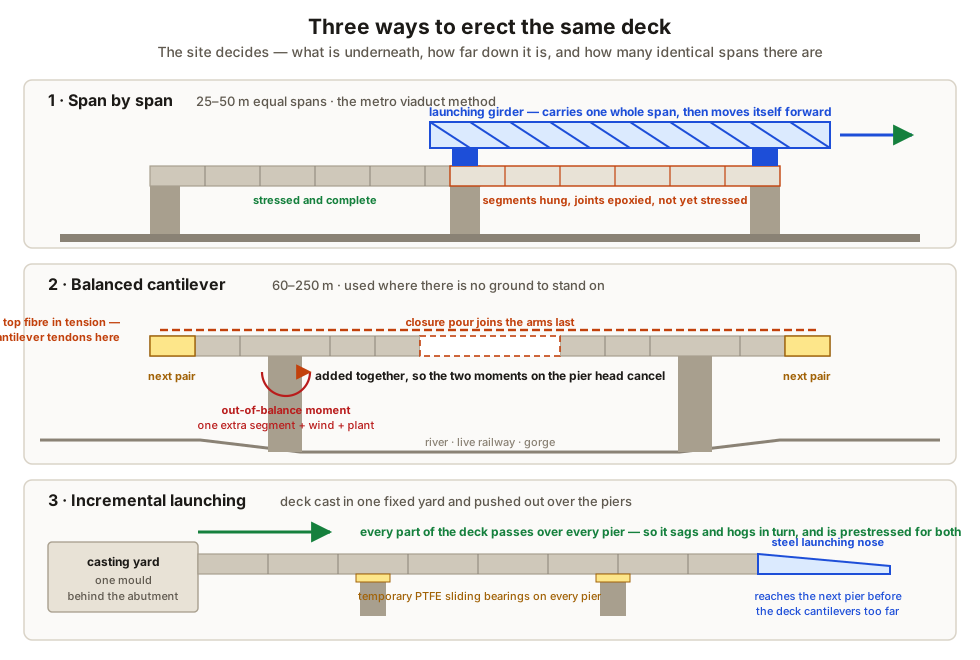
Span by span. A launching girder sits on two piers, picks up a complete span of segments, holds them in line while the tendons are stressed, then self-launches to the next pier. Fastest for many equal spans of 25–50 m. This is the metro viaduct method.
Balanced cantilever. Segments are added in pairs, one each side of a pier head, so the arms grow outwards together and their moments on the pier largely cancel. Used for 60–250 m spans and wherever there is no ground to stand on — a river, a gorge, a live railway. The arms meet at a closure pour at midspan.
Incremental launching. The deck is cast in a fixed yard behind an abutment and pushed out over the piers, with a light steel launching nose ahead of it to reach the next pier before the deck cantilevers too far. Every section of deck passes over every pier, so it experiences sagging and hogging in turn and must be prestressed for both.
Precast in buildings and warehouses
The same logic, less glamorous and far more common:
- Hollowcore slabs — pre-tensioned, voided, spanning 6–16 m without propping. The floor of most precast car parks and mezzanines.
- Double-tee units — long-span roof and floor units for warehouses and car parks.
- Precast columns and beams — bolted or grouted connections, whole frames erected in days.
- Precast wall panels and cladding — often the fastest way to close a building in.
What an inspector looks at
| Where | What | Why it matters |
|---|---|---|
| Segment joints | Opening, stepping, staining, efflorescence | Prestress loss or water entering the ducts |
| Shear keys | Cracking or spalling at the keys | Shear transfer failing across the joint |
| Anchorage pockets | Rust staining, unsealed pockets | Water into the tendon anchorage |
| Deck soffit | Longitudinal cracking on a duct line | Duct corrosion, or grout voids |
| Closure pours | Cracking, cold joints | The weakest concrete on a cantilever bridge |
| Bearings and joints | Movement, debris, leakage | See bearings and expansion joints |
| Precast bearings | Spalled corners, displaced pads | A lost bearing on a hollowcore unit is a collapse risk |
| Tie reinforcement | Grouted, continuous, as detailed | Robustness against progressive collapse |
What to take away
- Precast segmental wins on disruption and repetition, not on strength.
- Match-casting makes a perfect joint possible, and ties erection order to casting order for good.
- Shear keys carry shear, epoxy seals and lubricates, prestress is what holds it together.
- Span by span for many equal spans, balanced cantilever for long ones and difficult ground, incremental launching where a casting yard can sit behind an abutment.
- The half-built structure usually governs, and the tendon layout reflects that.
- In precast buildings, the units are reliable and the connections are the risk — bearing length, pads, grout and ties.
Check your understanding
10 questions. Nothing is recorded — this is just for you.