Instrumentation & Control
Analysers and sampling systems — where the real problem usually is
What an analyser measures that a transmitter cannot, why the sample system causes most of the failures, how transport lag limits what you can control, and why the take-off point decides everything.
Standards referencedISA 76IEC 61285IEC 60079-14
Every other instrument on this site measures a physical property — pressure, temperature, flow, level. An analyser measures what the stream is made of.
That difference is why analysers behave so differently from everything else in the instrumentation section.
What they measure
| Gas chromatograph | Full composition, component by component | Minutes per cycle | Product quality, custody transfer, column control | Carrier gas supply, column ageing, long cycle time |
|---|---|---|---|---|
| Infrared | Specific gases — CO, CO₂, hydrocarbons | Seconds | Combustion products, emissions, leak detection | Cross-sensitivity to other gases present |
| Paramagnetic or zirconia oxygen | Oxygen concentration | Seconds | Combustion control on fired heaters, inerting checks | Zirconia cells need high temperature and age steadily |
| pH | Acidity or alkalinity | Seconds | Effluent neutralisation, water treatment | Electrodes foul and drift; frequent calibration needed |
| Conductivity | Dissolved ionic content | Immediate | Boiler feed water, condensate contamination | Temperature compensation must be right |
| Moisture | Water content in gas or liquid | Seconds to minutes | Gas dehydration, dry product specification | The sample line itself holds moisture and slows response |
| Density and viscosity | Physical properties used to infer composition | Immediate | Blending, product grading | Temperature correction is essential |
| Flammable gas detector | Gas in air, as a percentage of the lower explosive limit | Seconds | Area gas detection, building intake protection | A safety device, not a process analyser — tested on a set cycle |
No rows match that filter.
An ordinary transmitter measures a physical property — pressure, temperature, flow. An analyser measures what the stream is made of. That difference is why analysers need a sample taken, conditioned and delivered, and why they are the least reliable instruments on most plants.
Analysers are used where composition is what matters: product on specification, combustion efficiency, emissions compliance, custody transfer, environmental discharge, and safety detection.
They are also, on most plants, the least available instruments. Understanding why is the whole of this topic.
The analyser is rarely the problem
| Sample line plugged | Reading frozen, or drifting very slowly | Wax, hydrate, solids or polymer in the line | Heat tracing, filtration, larger bore, fast loop |
|---|---|---|---|
| Transport lag too long | Analyser correct but always late; control hunts | Long sample line at low flow | A fast loop returning most of the sample to the process |
| Phase change in the line | Erratic or nonsensical readings | Sample cooling and condensing, or flashing on pressure drop | Tracing, insulation, and reducing pressure at the right point |
| Unrepresentative take-off | Analyser disagrees with the laboratory, consistently | Probe in a dead leg, at the wall, or downstream of a mixing point | Relocating the probe — a design fix, not a maintenance one |
| Calibration gas exhausted | Validation fails, or drift goes uncorrected | Cylinder not replaced, or regulator leaking | Cylinder pressure monitoring and a stocking routine |
| Carrier gas lost | A chromatograph stops producing results entirely | Cylinder empty or supply interrupted | Duplicate cylinders with automatic changeover |
| Sample disposal blocked | No sample flow, and possibly back pressure on the analyser | Return line or vent plugged, or return pressure risen | Checking the disposal route, which is often forgotten entirely |
No rows match that filter.
Industry experience consistently puts the large majority of analyser unavailability in the sample system rather than the instrument. The analyser is generally a sound piece of laboratory equipment being asked to work on whatever arrives down a tube from a process line.
A pressure transmitter sits on the pipe and measures it. An analyser sits in a shelter some distance away and measures a sample that has been taken, transported, conditioned and delivered to it.
Every one of those steps can go wrong, and most of them do.
The take-off point decides everything
If the sample is not representative, nothing downstream can fix it.
A probe should sit in well-mixed flowing stream — not in a dead leg, not at the pipe wall where the boundary layer differs from the bulk, not immediately downstream of a mixing point before the streams have combined, and not where liquid can collect around it.
Conditioning and lag
Between the tap and the analyser the sample usually has to be filtered, have its pressure and temperature reduced, kept in a single phase, and delivered at a controlled flow.
Two things dominate the design.
Phase. A gas sample that cools and condenses, or a liquid that flashes across a pressure reduction, is no longer the thing you meant to measure. Heat tracing, insulation, and taking the pressure drop at the right point are what prevent it.
Transport lag. Sample trickling slowly down thirty metres of small-bore tubing may take several minutes to arrive. The answer is a fast loop — a high flow kept moving through the line and returned to the process, with only a small slipstream taken off for the analyser.
That lag matters beyond patience:
Where they live
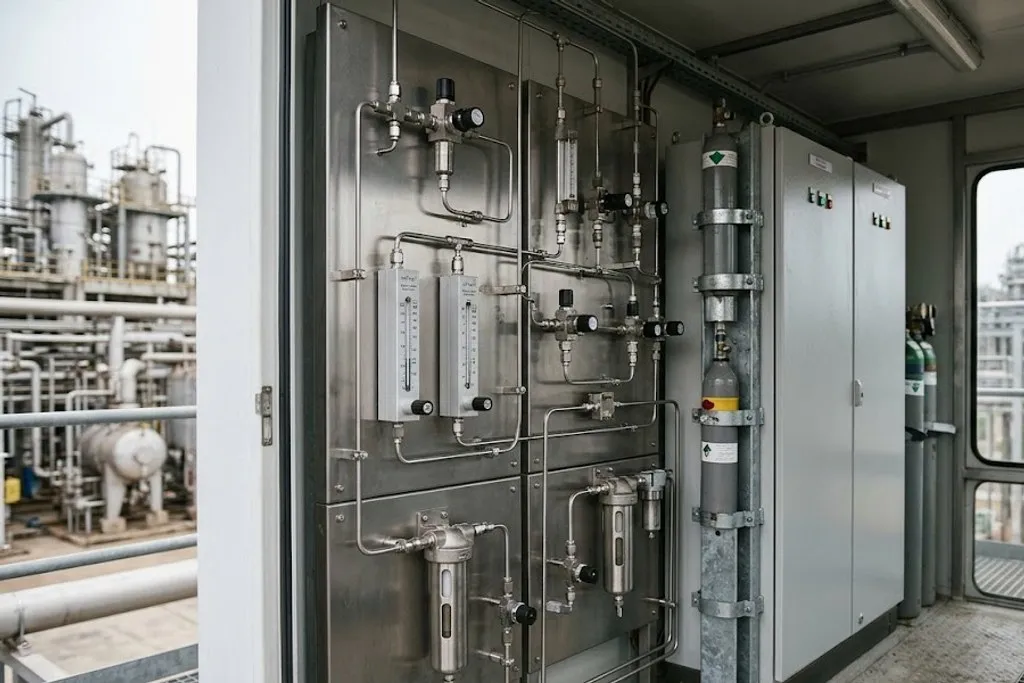
Analysers are often grouped in an analyser house, which is the awkward building described in buildings and shelters: a small shelter that deliberately contains process samples, and is therefore a hazard rather than a refuge from one. Ventilated rather than sealed, gas detected, and often a classified area inside.
Field-mounted analysers avoid the sample transport problem entirely but then have to survive the weather and be maintained at the point of measurement, in whatever hazardous area classification applies.
Calibration and validation
Analysers drift, so they are checked against known reference gases or solutions.
- Validation — passing a known sample through and confirming the reading, without changing anything.
- Calibration — adjusting the response to match.
Both need calibration gas in date and in stock, and the routine that keeps it there. An analyser whose calibration cylinder has been empty for two months is still producing a number on the operator’s screen, and it is the sort of failure nobody notices because the display never goes blank.
What to take away
- An analyser measures composition; everything else measures a physical property.
- Most analyser downtime is the sample system, not the analyser.
- If it disagrees with the lab consistently, move the probe — do not recalibrate.
- Keep the sample in one phase. Condensing or flashing destroys the measurement.
- Use a fast loop to cut transport lag; add cycle time to it to get the real age of the reading.
- A slow analyser trims a faster loop in cascade rather than controlling directly.
- An analyser with expired calibration gas still shows a number. That is what makes it dangerous.
Check your understanding
10 questions. Nothing is recorded — this is just for you.